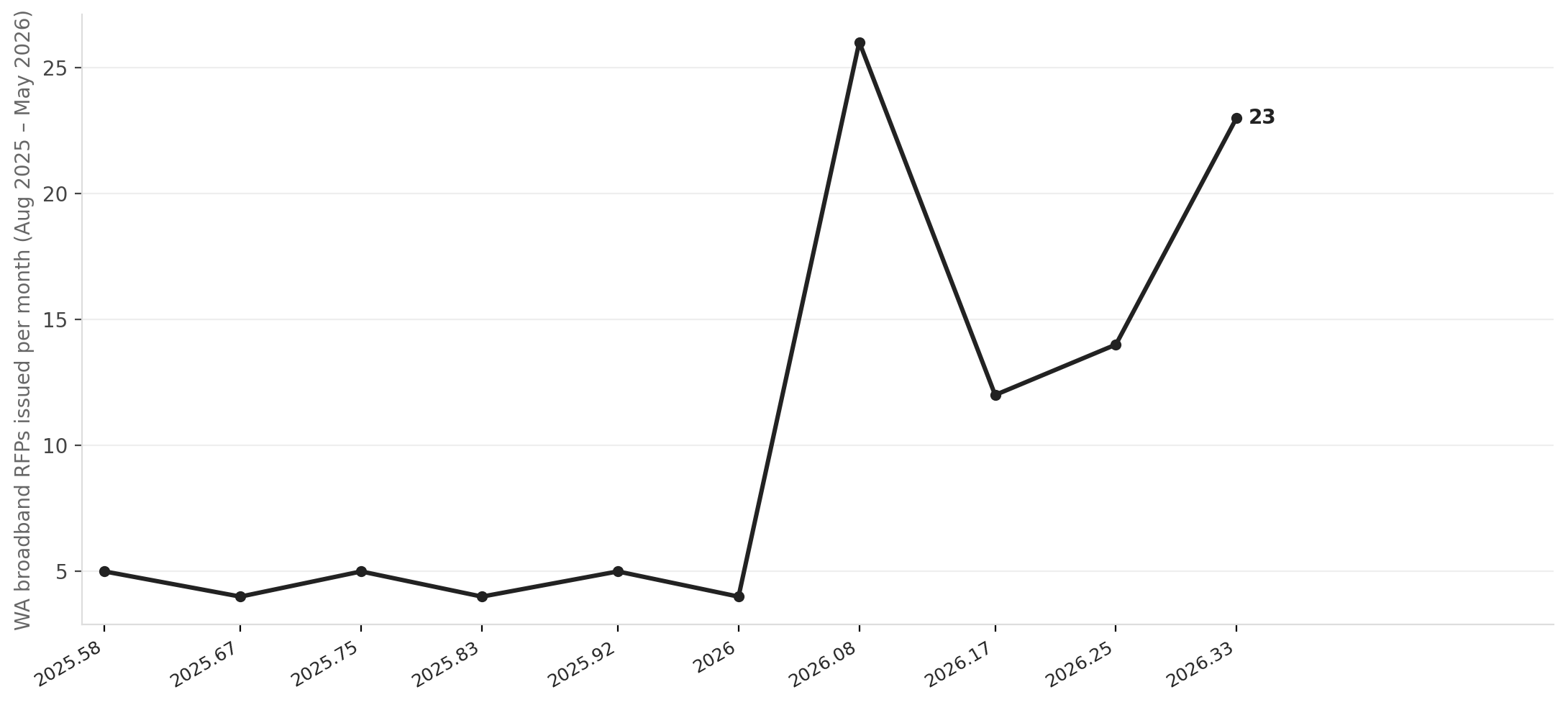
Washington state issued 24 broadband RFPs in the last 30 days, more than three times its monthly average of roughly eight, and the spike traces almost precisely to a single federal action: NTIA's February 26, 2026 approval of the state's BEAD Final Proposal, which unlocked $736 million in federal funds for 238 broadband construction projects across unserved and underserved communities.
The number matters because of what preceded it. Between August 2025 and January 2026, Washington averaged fewer than five broadband RFPs per month. Agencies had paper awards, subgrantee agreements in draft, and engineers ready to scope projects. What they did not have was federal sign-off, which meant contracts could not be executed and procurement could not formally begin. The February approval flipped that switch. The result is a simultaneous procurement wave hitting a market that supplies fiber, conduit, outside plant materials, and engineering labor to dozens of local government networks across the state.
The delay was not routine bureaucratic lag. In June 2025, the Trump administration overhauled BEAD program guidance mid-process, abandoning the previous fiber-preferring rules in favor of a technology-neutral posture that opened the door for fixed wireless and satellite providers including SpaceX. Washington's planning staff had roughly two months to revise a multi-year application to reflect the new framework. The approved plan now includes $45.8 million for Starlink and $9.25 million for Amazon's low-earth-orbit satellite service, alongside the fiber-heavy projects that PUDs and tribes had been designing since 2023. Washington was among the last states in the country to receive BEAD approval, in part because of that mid-process scramble.
Source: NationGraph.
The entities now driving the RFP surge reveal the structural character of Washington's broadband market. Northwest Open Access Network (NoaNet), the statewide middle-mile cooperative that serves as backbone for dozens of rural PUDs and tribal networks, has posted four RFPs in recent weeks covering passive optical network equipment, outside plant materials, and professional services concentrated in Spokane. NoaNet's position in the supply chain means BEAD approvals ripple into its procurement almost automatically: when a PUD wins a subgrant, it often needs NoaNet infrastructure to deliver last-mile service. The City of Opportunity and Spokane County have issued three RFPs, including a BEAD professional services solicitation. Port of Columbia is procuring for a rural E911 and broadband system in Columbia County. Lewis County PUD No. 1, Snohomish County, and Upper Skagit Indian Tribe round out the most active issuers.
Washington's 29 Public Utility Districts are a key structural feature here. State law allows PUDs to operate retail broadband, making them eligible subgrantees in a way that local governments in most other states are not. That means the BEAD subgrantee pipeline is dominated by governmental entities rather than commercial ISPs, and those entities procure in public, through formal RFPs, making the volume of activity legible in ways it would not be if private carriers were executing the same work.
The tribal dimension is also unusually large. Nine of the 238 BEAD project areas are on tribal lands, and Washington's existing $172 million active federal broadband grant portfolio, spread across 30 currently running grants, is anchored by a $48 million Tribal Broadband Connectivity Program award to the Confederated Tribes of Colville and a $30 million NTIA Broadband Infrastructure Program grant to the Department of Commerce. Tribes including Lummi, Tulalip, Swinomish, and Upper Skagit already have active federal grants and are now layering BEAD procurement on top of ongoing construction.
The combined investment picture is substantial. The approved BEAD layer adds $736 million in federal funds and $112 million in state match to the $172 million already in deployment, targeting roughly 166,500 homes and businesses, 76 percent of which have no qualifying broadband service at all. WSBO Director Jordan Arnold described the approval as a transformative moment for the state. A separate tranche of up to $464 million in additional federal BEAD funding is still awaiting federal guidance and could push Washington's total allocation to $1.2 billion.
For residents of the 238 project areas, the immediate signal to watch is subgrantee contract execution: once WSBO formally signs subgrant agreements, construction timelines become binding. All 238 projects must reach completion within four years of award, and some could break ground before the end of 2026. The procurement wave happening now in fiber optic cable, conduit hardware, and professional engineering is the upstream indicator that the construction timeline is real. Whether the regional supply chain can absorb simultaneous demand from PUDs, ports, and tribes across the state, without driving up costs or creating contractor bottlenecks, is the next question WSBO and its subgrantees will have to answer.