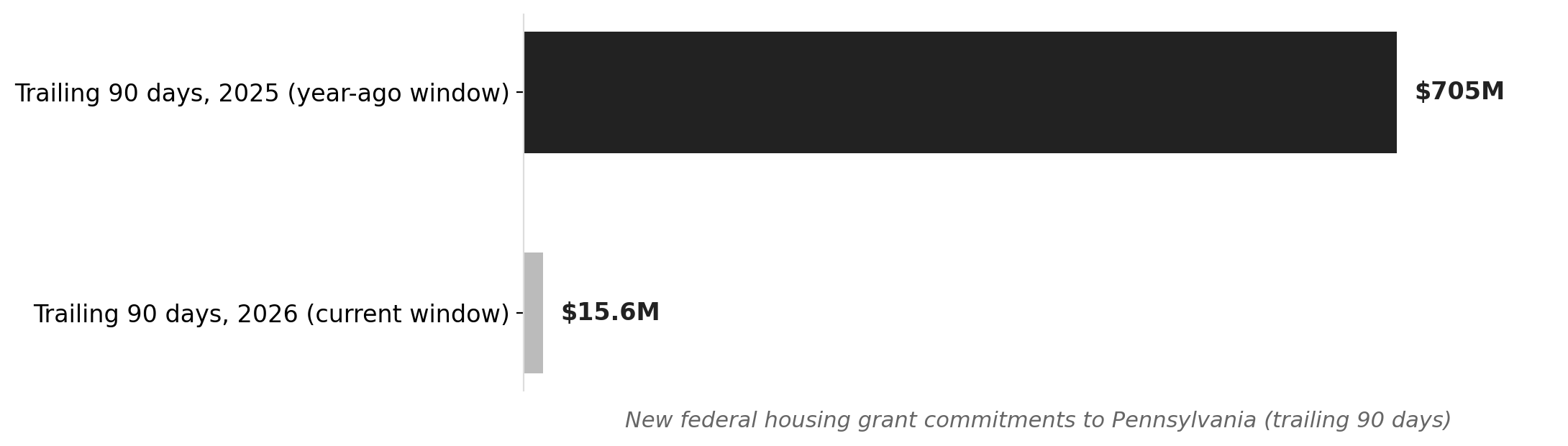
Pennsylvania received $15.6 million in new federal housing grant commitments over the last 90 days. In the same window a year ago, it received $705 million. That 98% collapse is not a Pennsylvania story, it is a national one, and understanding the difference matters enormously for what comes next.
The drop mirrors almost exactly what happened across the country. Nationally, HUD new housing grant starts fell from roughly $17 billion to $369 million in the same year-over-year comparison, according to federal spending records. The Pennsylvania share tracks the national decline to the decimal point. What stopped was not the state's appetite for federal housing money or the federal government's legal obligation to fund it. What stopped was HUD's ability to initiate new grant cycles at all.
Last year's 90-day window was dominated by three programs that together account for nearly the entire year-ago total. Section 8 Housing Choice Voucher renewals produced roughly $335 million across 204 Pennsylvania grants. The Public Housing Capital Fund delivered approximately $196 million across 74 awards to more than 15 housing authorities in a single May wave. The Department of Energy's Weatherization Assistance Program added another $21.9 million. None of those cycles have turned over in the current window. The largest single new award this period is a $7.4 million Section 8 Moderate Rehabilitation renewal to the Lancaster County Housing Authority.
Source: NationGraph.
The proximate cause is a cascade that began in January 2025, when a White House directive temporarily froze all federal financial assistance across HUD programs. As the National Low Income Housing Coalition documented, that freeze reached every major HUD housing program, creating immediate uncertainty for voucher holders, housing authorities, and landlords. DOGE subsequently cut close to half of HUD's staff, and HUD Secretary Scott Turner announced $260 million in identified agency reductions. The Trump administration's FY2026 budget went further, proposing a $32.9 billion cut to HUD overall, including a $26.7 billion reduction to federal rental assistance that analysts said would functionally end Section 8 as currently structured. Congress passed the Consolidated Appropriations Act of 2026 in late January 2026, maintaining most core programs at roughly FY2025 levels, but the staffing losses and freeze-driven disruption appear to have severely delayed the agency's capacity to run its annual grant cycles, even after the legal authority to spend was restored.
The cruel paradox for Pennsylvania residents is that billions of dollars are still moving. The Philadelphia Housing Authority alone carries more than $600 million in active Operating Fund grants, meaning existing residents in its 11,465 public housing units are still being served on commitments made in prior years. The state's active HUD housing portfolio runs well above $1.5 billion in Operating Fund grants alone. Money is flowing, it is just flowing on autopilot from old awards, while the pipe that would replenish the system has nearly closed.
The people caught most visibly in that gap are the ones who were never inside the system to begin with. Philadelphia's Housing Choice Voucher waitlist is currently closed. Pittsburgh's housing authority, when it briefly reopened its voucher waitlist for the first time since 2018, received 7,000 applications in the first 36 hours. Those numbers capture what a pause in new-commitment cycles looks like at street level: demand that was already years ahead of supply now has nowhere to queue.
For Pennsylvania's housing authorities, the operational risk is not hypothetical. HCV renewals are annual; housing authorities commit to landlords based on expected federal reimbursement. A delayed renewal cycle does not produce a clean gap, it produces a cash-flow crisis that can force authorities to draw down reserves or, in the worst case, issue vouchers they cannot yet guarantee. The Bipartisan Policy Center's summary of final FY2026 THUD funding notes that while Congress preserved program structures, the funding levels and administrative capacity to execute them remain under pressure.
Philadelphia's housing footprint makes this particularly acute. The Philadelphia Housing Authority is in the middle of a multiyear repositioning plan exceeding $3.8 billion, one that depends on layering federal capital commitments with private financing. A sustained pause in HUD's grant-initiation capacity does not just delay individual awards, it introduces timing risk into deals structured around the assumption that federal commitments arrive on schedule.
The signal to watch over the next 60 to 90 days is whether the annual Section 8 HCV renewal cycle and the Public Housing Capital Fund awards restart at anything approaching their historical volume. If HUD's depleted staff cannot execute those cycles before housing authorities exhaust operating reserves, the consequences will move from administrative to tenant-facing faster than most waiting lists can absorb.