Federal housing grants newly awarded to Massachusetts have reached $176 million in the trailing 90 days, up 58% from $111 million in the same window a year earlier, and the state is pulling in more than New York, despite having one-sixth the population, and more than all other New England states combined.
The surge is almost entirely federal and almost entirely HUD. The Department of Housing and Urban Development accounts for $174 million of the total, spread across 452 individual grants. Two state entities are absorbing the bulk of it: the Executive Office of Housing and Livable Communities received $100.4 million across 17 grants, primarily Section 8 Moderate Rehabilitation contracts running from mid-2026 through September 2027, each worth between $7 million and $19 million. The Boston Housing Authority collected $47.9 million across 9 grants, a mix of Moderate Rehabilitation contracts and Housing Choice Vouchers. The active HUD portfolio in Massachusetts now stands at $1.63 billion across 1,749 grants, with $1.02 billion already disbursed.
The trigger is a single piece of federal legislation. The Consolidated Appropriations Act of 2026, signed into law on February 3, 2026 as Public Law 119-75, set total HUD appropriations at $77.3 billion, a $7.3 billion increase over FY2025. It boosted Homeless Assistance Grants by $336 million to $4.4 billion, guaranteed $34.9 billion in Tenant-Based Rental Assistance renewals nationwide, and, critically, mandated statutory renewal of all Continuum of Care grants expiring in the first quarter of 2026. That last provision resolved a year-long fight: the Trump administration had attempted in late 2025 to restructure CoC funding priorities, triggering litigation that reached a U.S. District Court in Rhode Island before Congress inserted language overriding the effort. HUD announced $349 million in FY2025 CoC renewal funding on March 31, 2026, and published the FY2026 CoC Notice of Funding Opportunity on June 1, 2026, with awards expected by December 1.
Source: NationGraph.
The mechanics of why Massachusetts captures so much of this flow come down to institutional structure. EOHLC functions simultaneously as a direct Section 8 Mod Rehab awardee and as the administrator of 12 regional Continuums of Care, meaning a disproportionate share of HUD money routes through a single state agency. When federal appropriations increase, the concentration amplifies the year-over-year swing. Boston Housing Authority, one of the larger legacy public housing authorities in the Northeast, captures much of the remainder through its own PHA contracts.
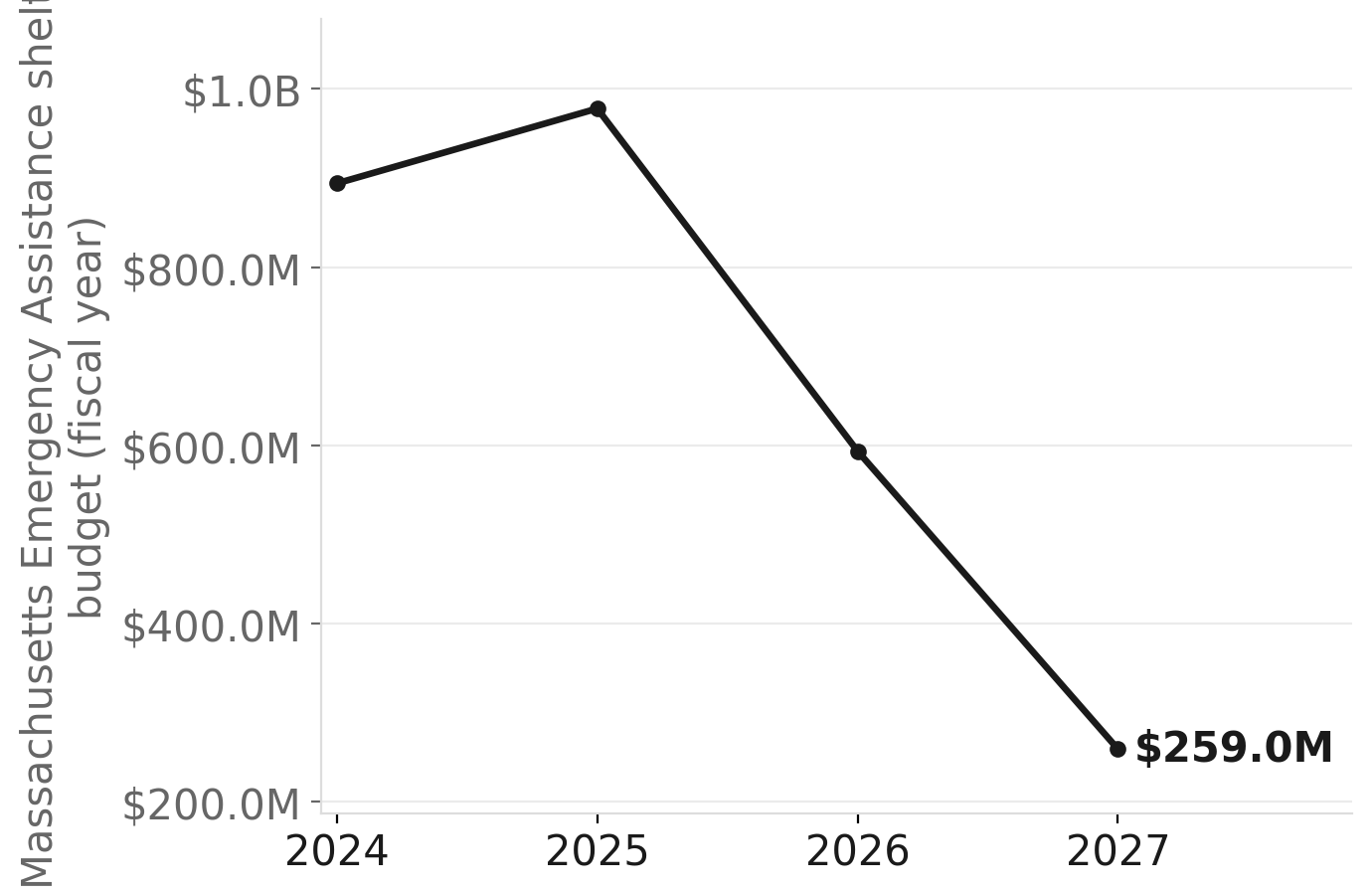
The timing is pointed. Massachusetts is receiving this federal flood at the exact moment it is deliberately stepping back from its own shelter commitments. The state spent $978 million in FY2025 and $894 million in FY2024 on its Emergency Assistance shelter program, driven by the state's unique statutory right-to-shelter requirement, the only such law in the country, and a surge in migrant and homeless family placements that pushed hotel shelter sites to a peak of 100 in summer 2023. Eligibility restrictions enacted by Governor Healey and the Legislature have since cut caseloads sharply; hotel sites stood at 32 as of April 2026. Healey's proposed FY2027 budget allocates only $259 million for Emergency Assistance, a reduction of more than 70% from peak-year spending.
That deliberate contraction makes the federal rental-assistance surge more consequential, not less. The Section 8 Moderate Rehabilitation contracts flowing to EOHLC pay landlords the difference between fair market rent and a tenant's contribution in privately-owned rehabilitated housing. The Housing Choice Vouchers administered by Boston Housing Authority and routed through EOHLC let low-income households lease private-market units directly. These are not emergency shelter programs; they are long-term housing stabilization tools. As the National Low Income Housing Coalition noted in its summary of the FY2026 appropriations bill, the rental assistance renewals guarantee housing stability for existing voucher holders, a baseline protection that becomes more load-bearing as state shelter options narrow.
For Massachusetts residents who were served by the Emergency Assistance hotel system at its peak, and who now find that route closed or restricted, whether a Section 8 voucher or a Mod Rehab unit is actually available depends on local PHA waitlists, which in most Massachusetts cities run years long. The federal money is real and large, but it flows into a fixed stock of contracted units and vouchers, not an expandable emergency capacity.
The next signal to watch is the FY2026 CoC competition. HUD's June 1 Notice of Funding Opportunity opens a new competitive round, with Massachusetts's 12 regional CoCs eligible to apply. Awards are expected by December 1, 2026. How much of the $4.4 billion Homeless Assistance Grants pool Massachusetts captures in that round will determine whether the federal offset to state shelter retrenchment grows, holds, or begins to shrink, and whether the 58% year-over-year surge in this window turns out to be a new floor or a one-time spike.