Federal grants tagged to electric vehicles in Connecticut totaled $19.3 million in the trailing 90 days ending mid-September 2026, a 207% increase over the $6.28 million obligated in the same window last year. The number looks like a success story. The context around it is considerably more complicated.
The 90-day figure is dominated by a single $19 million Federal Transit Administration State of Good Repair grant awarded to CT DOT on July 31, 2026, covering CTtransit farebox system replacement and CTfastrak bus shelter and support-system upgrades with EV-compatible components. That grant, a formula allocation rather than a competitive award, flows to CT DOT's own transit capital needs and is not connected to the public highway charging buildout driving the larger policy fight.
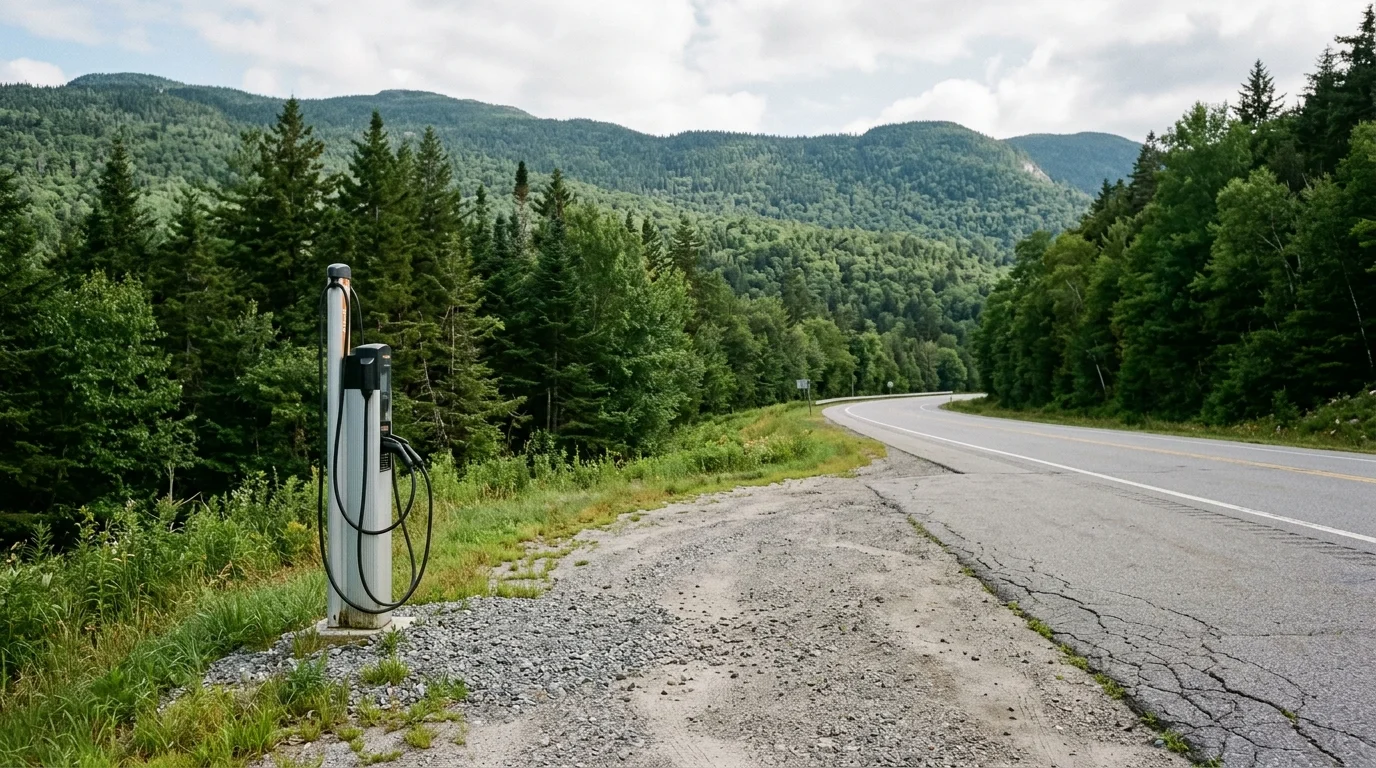
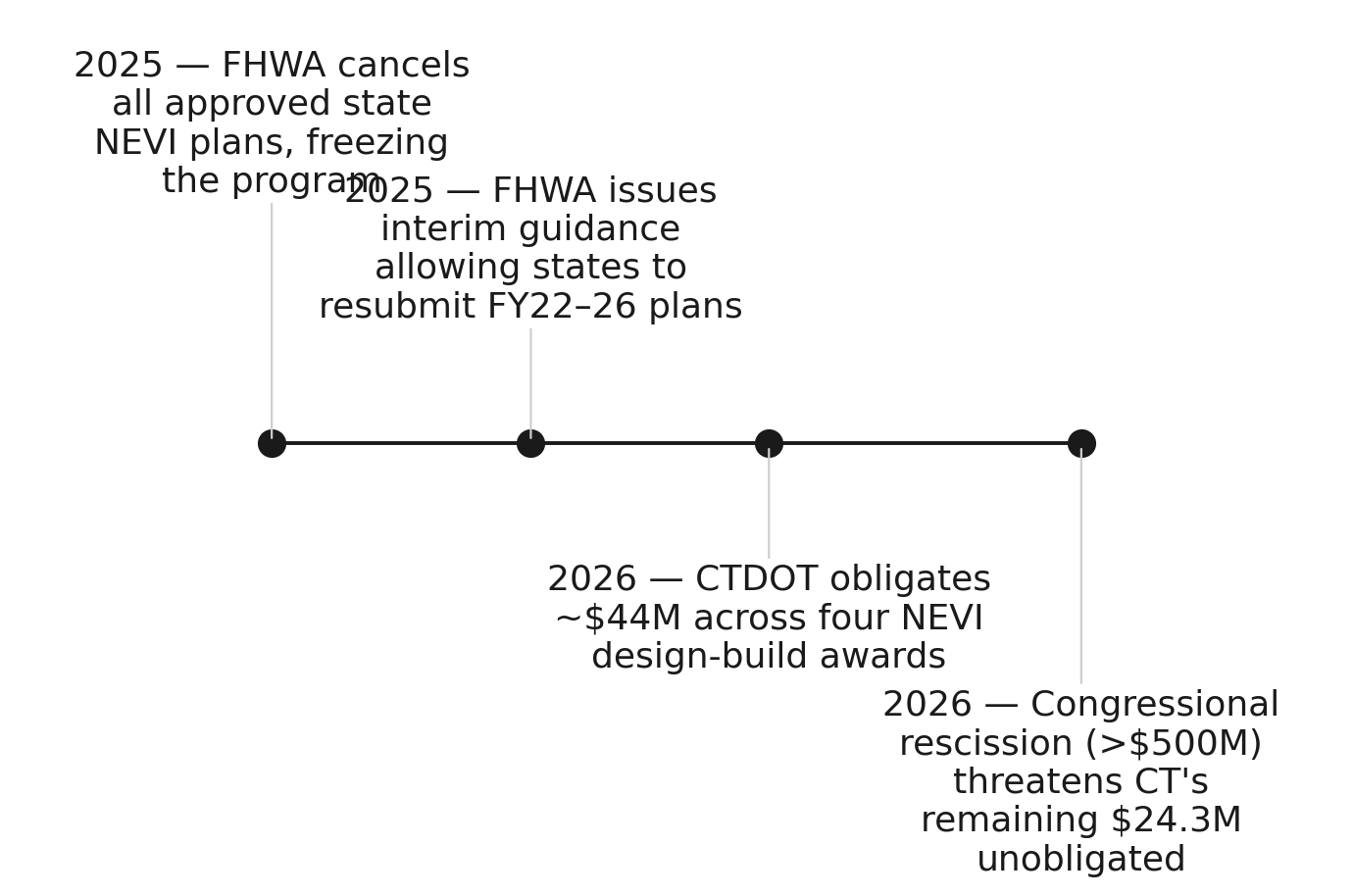
The more consequential story sits just outside that 90-day window, in a single frantic week in late January 2026. On January 30, a federal district court ruled in Washington v. U.S. Department of Transportation that the Trump administration's February 2025 freeze of the National Electric Vehicle Infrastructure program was illegal. FHWA had cancelled all previously approved state plans and halted new obligations roughly a year earlier. The court ordered funds restored. CT DOT, which had spent the intervening months resubmitting its FY2026 NEVI plan under new FHWA interim guidance and receiving approval in September 2025, moved within days of the ruling. Four NEVI design-build awards totaling approximately $44 million were obligated to statewide EV fast-charger deployment along Alternative Fuel Corridors, covering I-91, I-95, I-84, I-395, and Route 7, with contracts running through 2040.
Source: NationGraph.
That obligation wave was the direct product of the court order. It was also a race against a second clock.
As Eno Transportation Weekly has tracked, the court ruling restored access to funds states had already obligated, but it left future apportionments exposed to congressional action. A rescission of more than $500 million nationally, buried in the FY2026 federal transportation package, now threatens the portion of NEVI funds states had not yet committed. For Connecticut, that means $24.3 million of its expected $52.5 million five-year NEVI allocation is in limbo. CTDOT communications manager Josh Morgan has confirmed the agency is monitoring those funds for potential clawbacks.
The architecture of Connecticut's exposure matters here. NEVI, the FTA State of Good Repair program, and the FTA Formula Grants are three distinct federal mechanisms doing three different things. NEVI passes federal dollars through CT DOT to private, public, and nonprofit charger operators building public DC fast-charging stations on highway corridors, and its competitive subaward structure makes it uniquely vulnerable to a program-level rescission. The State of Good Repair and Formula grants are formula-allocated funds for CT DOT's own transit capital needs; those $19 million and $283 million awards, respectively, face a different and somewhat lower clawback risk. Connecticut's active EV-related federal portfolio now exceeds $370 million in total, but the NEVI slice, the one that builds the public charging network, is the piece hanging by a thread.
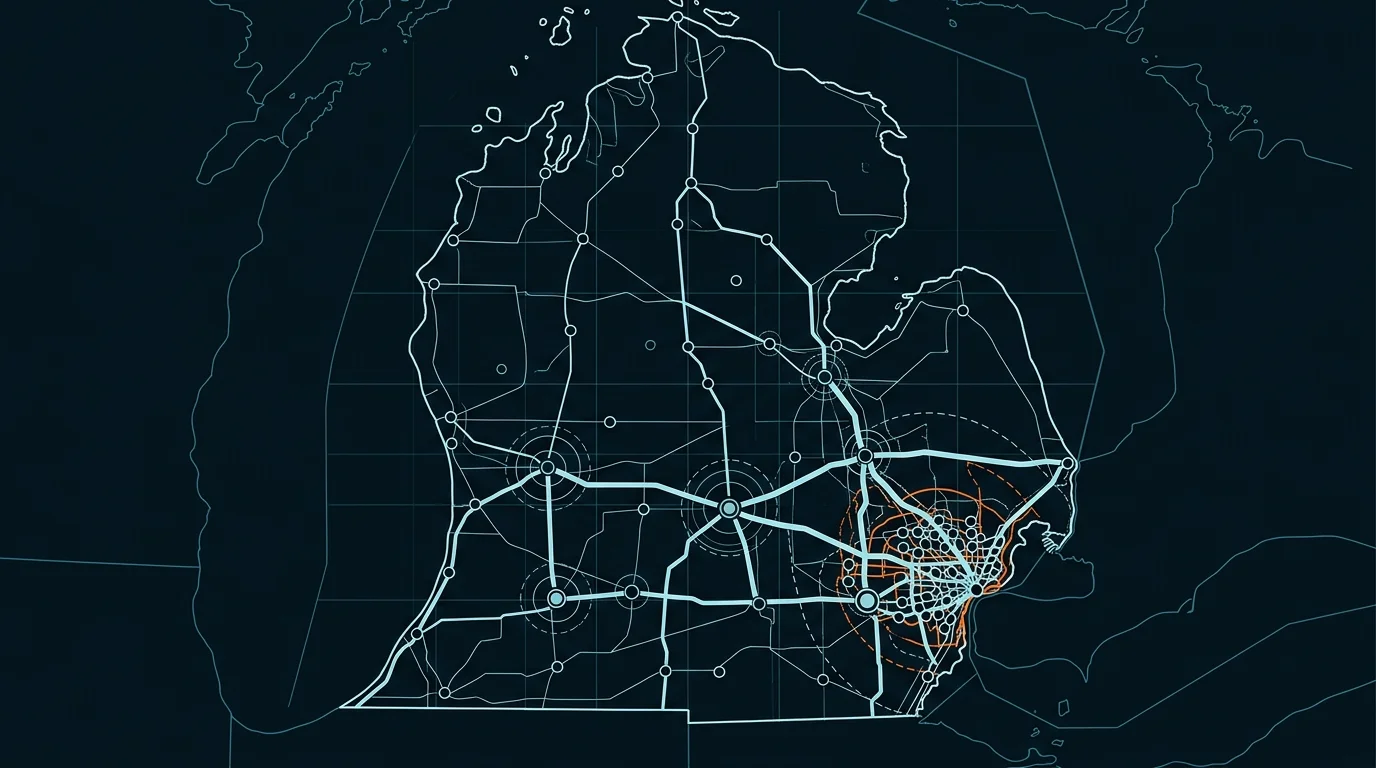
The geographic stakes extend beyond state lines. Connecticut's highway network sits at the center of the Northeast EV corridor: I-95 through New Haven and Bridgeport, I-91 north toward Springfield, I-84 west toward New York. Gaps in Connecticut's fast-charging coverage are gaps for every driver moving between Boston and Philadelphia. In the trailing 90-day Northeast comparison, New York has pulled in $85.5 million in new EV grants across 17 awards, and Massachusetts has received just $50,000. Connecticut's $19.3 million across only two awards underscores how heavily the state's position depends on a small number of very large DOT grants, and how little margin for error exists if any one of them falls through.
CT DOT Deputy Commissioner Laoise King said after the September 2025 NEVI plan approval that the agency would "continue moving forward with grant awards to help expand the state's electric vehicle charging network." That statement preceded the obligation wave. What comes next depends less on CT DOT's planning capacity than on what Congress does with the rescission language and whether the January court ruling survives further legal challenge.
The next signal to watch is whether the FY2026 appropriations rescission is finalized as written. If it is, CT DOT and its design-build contractors will be left defending $44 million in already-obligated contracts while the remaining $24.3 million disappears from the program entirely. If a court intervenes again, the window to obligate those remaining funds reopens, briefly, one more time.