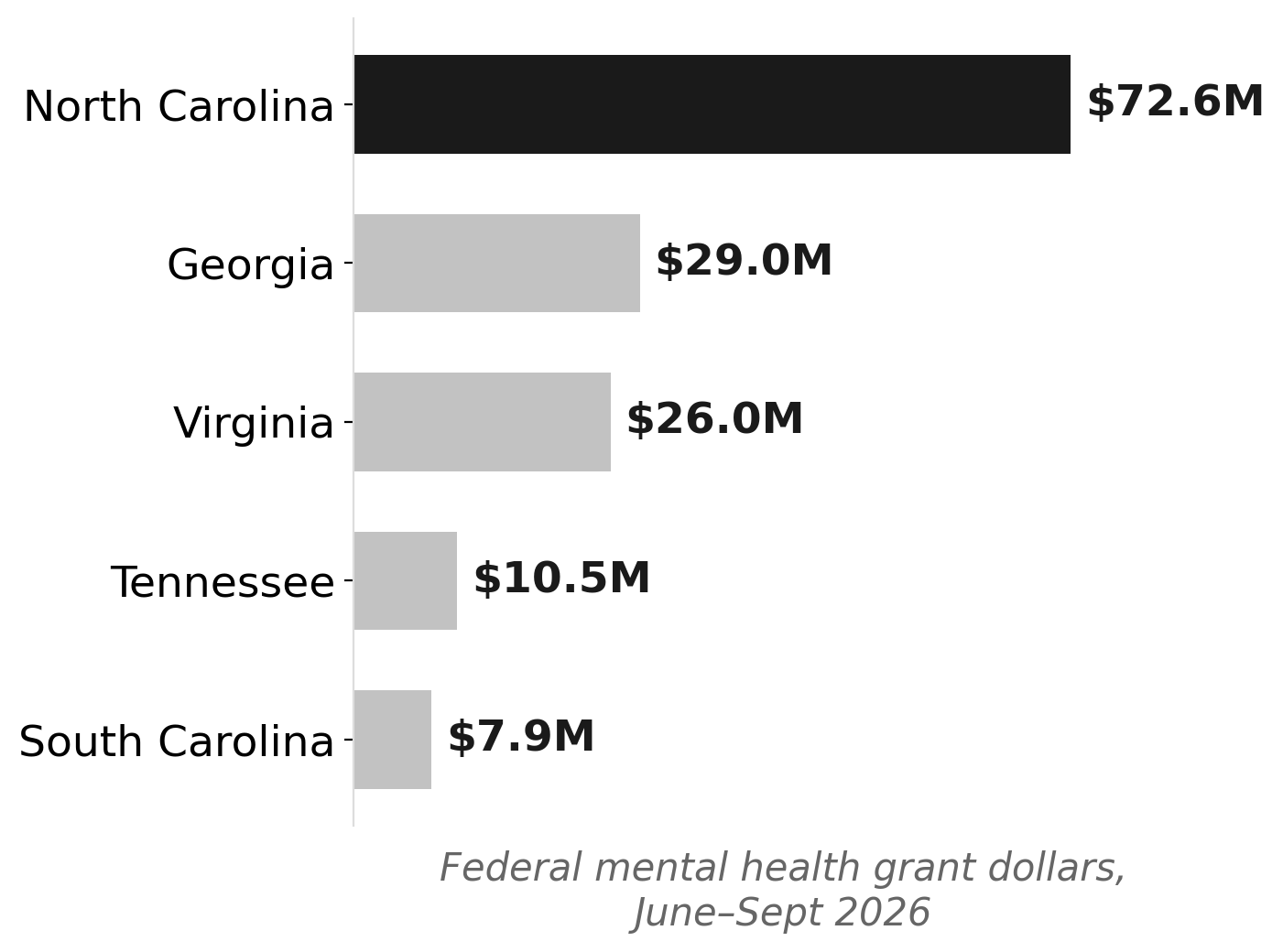
North Carolina pulled in $72.6 million in federal mental health grants in the 90 days from mid-June through mid-September 2026, a 118% jump over the $33.3 million the state received in the same window last year, and more than Georgia, Virginia, Tennessee, and South Carolina collected in that period combined.
The comparison to regional peers is stark. Georgia, the South's next-closest recipient, logged $29 million. Virginia recorded $26 million. Tennessee and South Carolina, at $10.5 million and $7.9 million respectively, received roughly what North Carolina obligated in a single week in August, when 46 grants totaling $34.4 million were awarded in a 31-day stretch.
Two distinct forces produced the surge, and they are not the same program doing the same thing. The first is mechanical: the federal fiscal year ends September 30, and NIH historically obligates a heavy volume of peer-reviewed research grants in July, August, and September. In FY2026, that cycle delivered 95 awards to North Carolina institutions, compared to a much thinner roster in the same window last year. Duke University and UNC-Chapel Hill are the dominant recipients, capturing NIMH Mental Health Research Grants, NIAAA Alcohol Research awards as large as $2.76 million, and NIDA Drug Use and Addiction grants reaching $3.83 million. NC State and UNC-Asheville are also in the mix. These are competitive extramural research grants scored through NIH peer review; they fund science, not services, and they flow to universities because those universities have the faculty, infrastructure, and grant-writing capacity to win them.
Source: NationGraph.
The second force is structural, and it operates on a different track entirely. On December 29, 2025, CMS awarded NC DHHS $213 million through the Rural Health Transformation Program, the first of up to five annual performance-benchmarked payments that could total more than $1 billion. NC DHHS Secretary Dev Sangvai called it "a once-in-a-lifetime opportunity to transform health care in North Carolina." One of the program's six pillars is behavioral health integration, delivered through locally governed "NC ROOTS" hubs designed to connect medical care, mental health services, and social supports across the state's 85 rural counties. That grant is not producing NIH-style research awards; it is financing a systems-level transformation of how rural North Carolinians access behavioral health care. The two streams reinforce the same declared state priority but are governed by separate agencies under separate rules.
Laying beneath both is the platform the state built first. North Carolina's General Assembly committed $835 million in state funds to behavioral health infrastructure in 2024, a figure that has carried into the 2026-2027 budget cycle. According to NC DHHS, the investment targets crisis care capacity, the collaborative care model, children's behavioral health, and workforce expansion. In February 2026, NC's Department of Public Instruction separately received $11 million in U.S. Department of Education grants to build a school psychology workforce pipeline in high-need rural districts. Two concurrent SAMHSA Community Mental Health Services Block Grants, totaling approximately $58.4 million and running through 2026 and 2027, provide the state's community service backbone, formula-based federal funds administered by NC DHHS for prevention, treatment, and recovery for adults with serious mental illness and children with serious emotional disturbances.
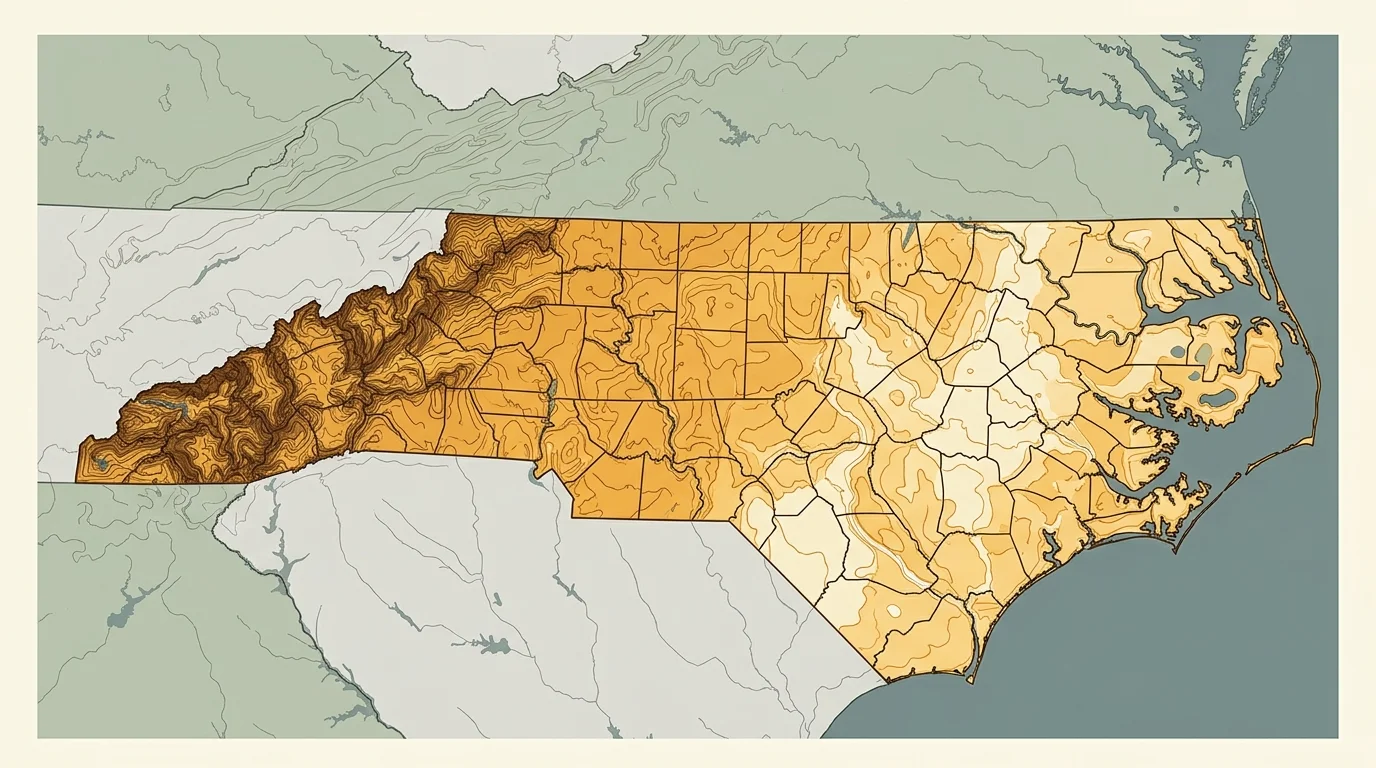
The absorptive capacity matters. North Carolina has the second-largest rural population in the country, more than 3 million people across 85 counties. Forty percent of residents live in federally designated mental health professional shortage areas. The state expanded Medicaid in 2023, adding more than 700,000 newly insured residents who now require behavioral health services. Against that backdrop, the research university ecosystem, Duke, UNC-Chapel Hill, NC State, UNC-Asheville, East Carolina University, gives the state something peer Southern states cannot replicate at scale: institutions that can absorb and deploy large NIH grants quickly, generating both knowledge and clinical partnerships.
There is a counterweight to watch. ECU Health and rural hospital leaders have warned that Medicaid reductions in the federal reconciliation bill (H.R. 1, signed July 2026) could erode coverage gains that the RHTP and state investments are designed to build on. The research grants flowing to Duke and UNC-Chapel Hill will not feel that pressure directly. The CMS rural transformation hubs, which depend on Medicaid as a payment mechanism for the services they coordinate, may. NC DHHS has not publicly quantified the exposure, but the tension between federal investment in one column of the budget and federal cuts in another is real and unresolved.
The next signal to watch is whether the RHTP's Year 2 payment clears on schedule and whether CMS judges NC's behavioral health integration benchmarks as met. Those determinations are expected in late 2026 and early 2027, around the same time the next NIH fiscal-year-end cycle will test whether this summer's 95-grant haul was a one-time surge or the new baseline.