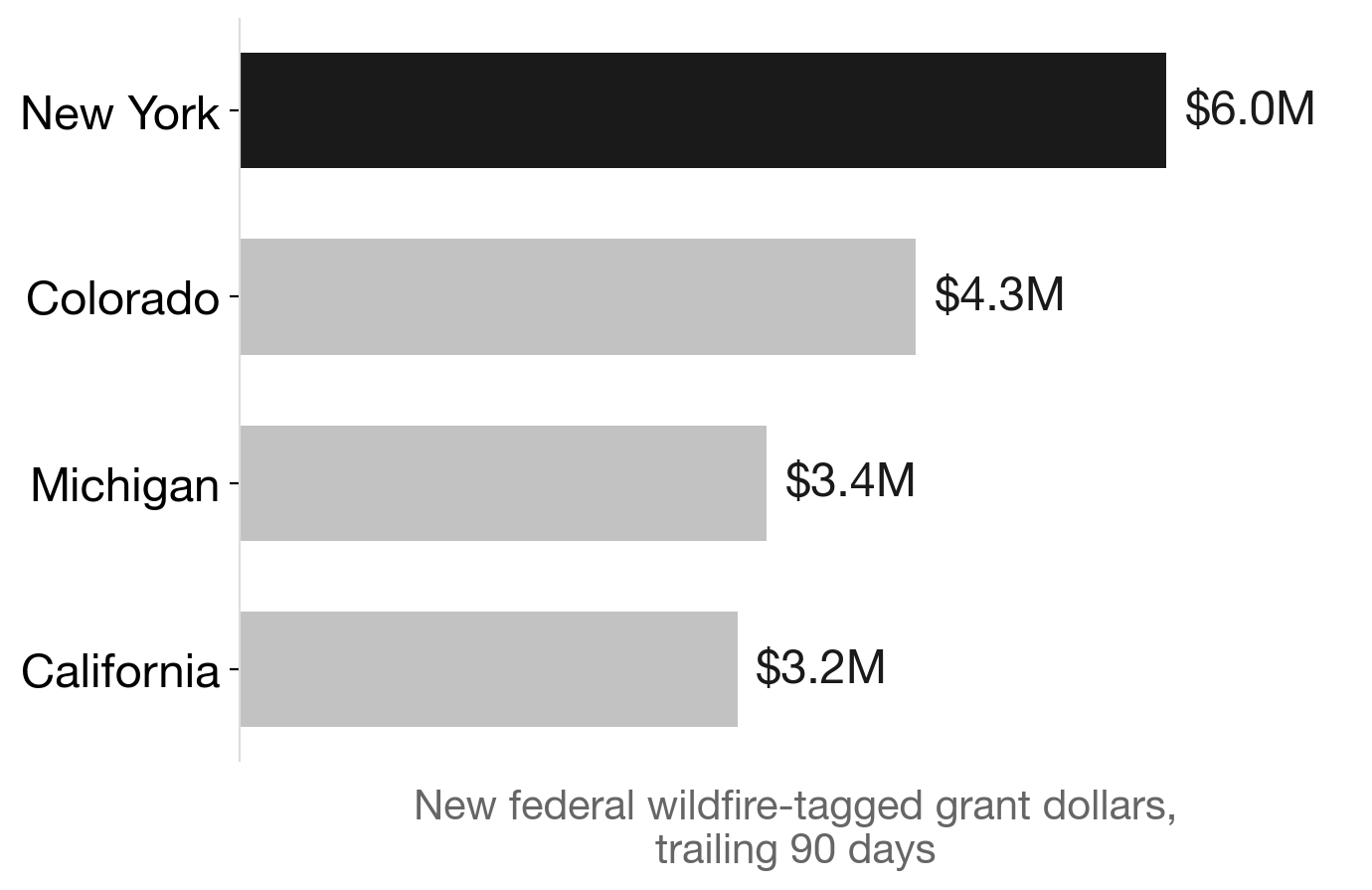
New York has received $5.96 million in federal wildfire-related grants in the past 90 days, up from $30,000 in the same window last year, a 19,775% increase that has, improbably, placed the Empire State ahead of California, Colorado, and every other state in new wildfire grant dollars for the quarter. This is not a western story that wandered east. It is a New York story, and it starts in Orange County on the night of November 8, 2024.
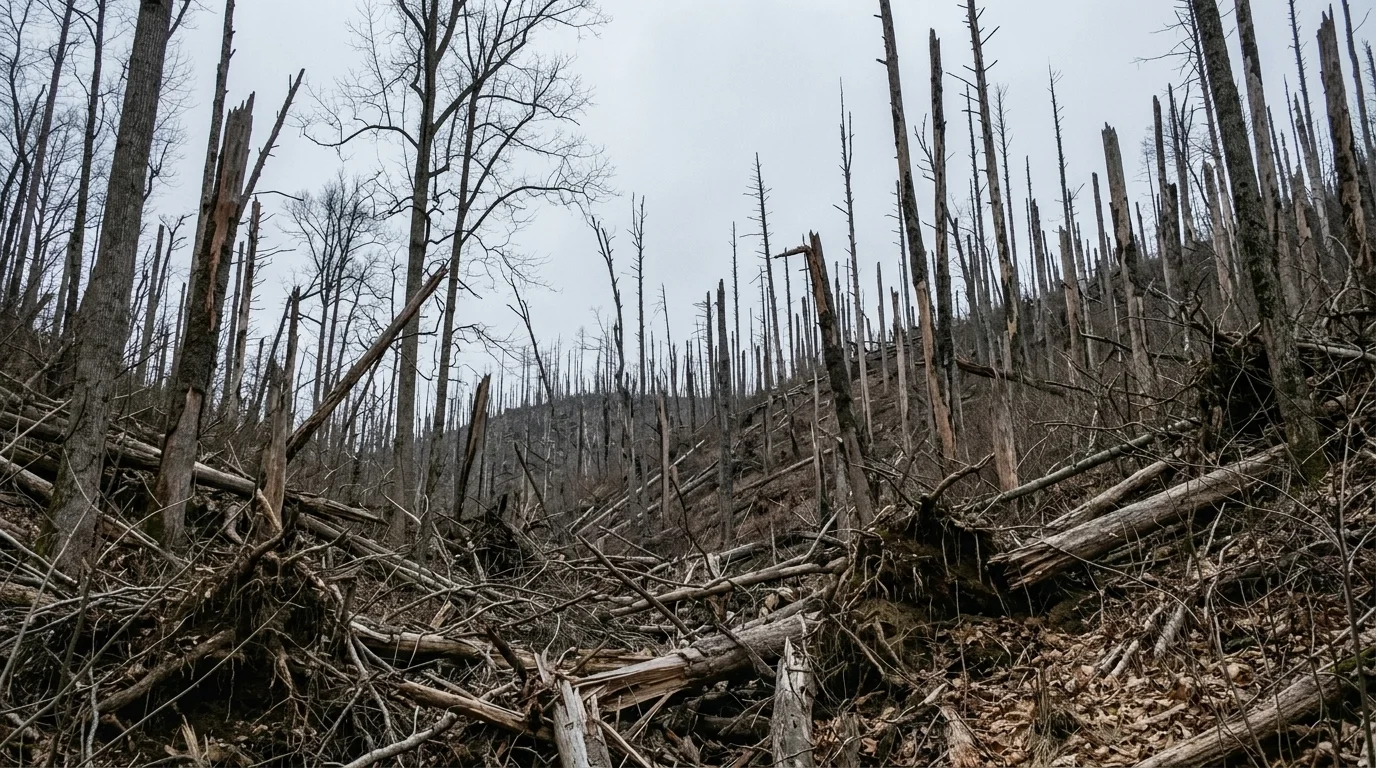
The Jennings Creek wildfire ignited in the Hudson Highlands that evening and burned more than 2,100 acres over two weeks, threatening roughly 650 structures, including about 500 homes in Warwick and Tuxedo Park. Governor Hochul's office called it the largest wildfire in the state since at least 2008. On November 15, Governor Hochul secured a FEMA Fire Management Assistance Grant declaration (FM-5547-NY), covering 75% of eligible firefighting costs and requiring the state to demonstrate at least $1.85 million in qualified expenditures to qualify. That declaration did more than reimburse suppression costs. It established, in the federal record, that New York had a wildfire problem worth funding.
What followed was a downstream cascade of appropriations that took roughly 18 months to fully materialize. The largest single award now on the books is a $4.05 million NIH grant to Weill Medical College of Cornell University, beginning September 1, 2026, under the National Institute on Aging's initiative studying how extreme weather and disaster events affect elderly post-acute care patients. Wildfires, as a source of sustained smoke exposure and sudden displacement, are central to the research design. The NIA recently distributed six grants under this program nationally; New York captured the largest. For more on Cornell's expanding climate-health research portfolio, the Cornell Initiative on Aging and Climate Adaptation outlines how the institution has positioned itself for exactly this funding moment.
Source: NationGraph.
On the operational side, the NY Department of Environmental Conservation received two USDA awards totaling $1.70 million in June 2026: $1.32 million under Cooperative Forestry Assistance for the state's Forest Action Plan, and $381,000 under State and Private Forestry Cooperative Fire Assistance specifically earmarked for ranger prescribed-fire training, personal protective equipment, and ATV procurement for wildfire suppression. These are not planning documents. They are hardware and skills the DEC's Forest Ranger Division, which carries statutory fire-protection responsibility across 23.1 million acres, will use in the field. Separately, the SUNY Research Foundation holds a $2.4 million Department of Energy grant, started October 2025, for smart wildfire-arrival forecasting designed to protect electrical grid infrastructure, a concern that the 2024 fire season made newly concrete for utilities serving the Hudson Valley.
The ranking anomaly is worth sitting with. California, which spent years building the institutional vocabulary for wildfire spending, received $3.20 million in new wildfire-tagged federal grants in the same 90-day window. Colorado received $4.35 million. New York's $5.96 million puts it first. Part of the explanation is compositional: the Weill Cornell NIH award is classified under wildfire-relevant keywords and is large enough to move a state total on its own. But that grant exists because a university saw a funding opportunity, and that opportunity exists because federal agencies are explicitly expanding their wildfire-health research portfolios into regions previously considered low-risk. New York was ready to apply because Jennings Creek made the case.
The broader shift in how New York thinks about fire risk has been building quietly. The Adirondacks, Catskills, Hudson Highlands, Shawangunk Ridge, and Long Island Pine Barrens are all fire-prone landscapes that state policy largely treated as secondary to flood and hurricane preparedness. Canadian wildfire smoke blanketing New York City in June 2023 and again in 2025 eroded the assumption that wildfire was a western export at most. Jennings Creek shattered it. The NSF-sponsored Adirondack Fire Futures Symposium, held at Clarkson University in Potsdam on July 27-29, 2026, brought together seven universities, the Adirondack Park Agency, and state and federal policymakers to formalize a regional wildfire science network. North Country Public Radio reported that rangers contained a small fire on Sawteeth Mountain in the Adirondack High Peaks during the same week, an unplanned illustration of why the symposium existed.
For New Yorkers living near the Adirondack High Peaks, the Pine Barrens, or the Hudson Highlands ridgelines, the practical near-term change is additional ranger capacity, better equipment, and the beginning of a prescribed-fire program that the state has historically lacked. The research investments at Cornell and SUNY will take years to produce clinical findings, but the infrastructure those grants build, databases, protocols, interagency relationships, will outlast any single grant cycle.
The next signal to watch is whether the FEMA FMAG declaration from November 2024 triggers a broader Hazard Mitigation Grant Program application from the state, which would dwarf the current figures. Albany has until late 2026 to file. If it does, New York's anomalous quarter at the top of the wildfire spending rankings may turn out to be a floor, not a ceiling.