New Mexico received just $10.6 million in new federal water infrastructure grants over the past 90 days, down 81 percent from the $55.6 million awarded in the same window a year ago. The number looks like a crisis. It is closer to a structural reckoning: the most ambitious federal water-spending cycle in American history is winding down, and the programs that were supposed to follow it have not materialized.
The math of last year's window is instructive. Two grants accounted for nearly $44 million of that $55.6 million total: a $24.9 million EPA Drinking Water State Revolving Fund capitalization grant to the New Mexico Finance Authority and an $18.9 million WIIN Act Emerging Contaminants grant to the New Mexico Environment Department, both dated July 1, 2025. The current 90-day window contains a $7.6 million DWSRF capitalization grant to the same Finance Authority, a 70 percent reduction from the prior year's equivalent award, and no WIIN Emerging Contaminants successor at all. The other grant in the current window is a $3 million EPA earmark for the East Pecos Mutual Domestic Water Consumers Association.
The reason for the compression is structural, not punitive. FY2026 is the final year that Congress authorized supplemental State Revolving Fund appropriations under the Bipartisan Infrastructure Law. From FY2022 through FY2026, those supplemental dollars added roughly $11.7 billion to the Drinking Water SRF and an equivalent amount to the Clean Water SRF nationwide, effectively tripling annual federal capitalization. Congressional Research Service analysis confirms that regular SRF appropriations have been flat at $3.04 billion for three consecutive fiscal years, FY2024, FY2025, and FY2026, meaning states absorbed the BIL decline without any base-level increase to cushion the landing. New Mexico's own DWSRF Intended Use Plan for SFY26 noted that "final allocations are not available from congress" because of a continuing resolution, a routine federal budget dysfunction that compounds the structural problem.
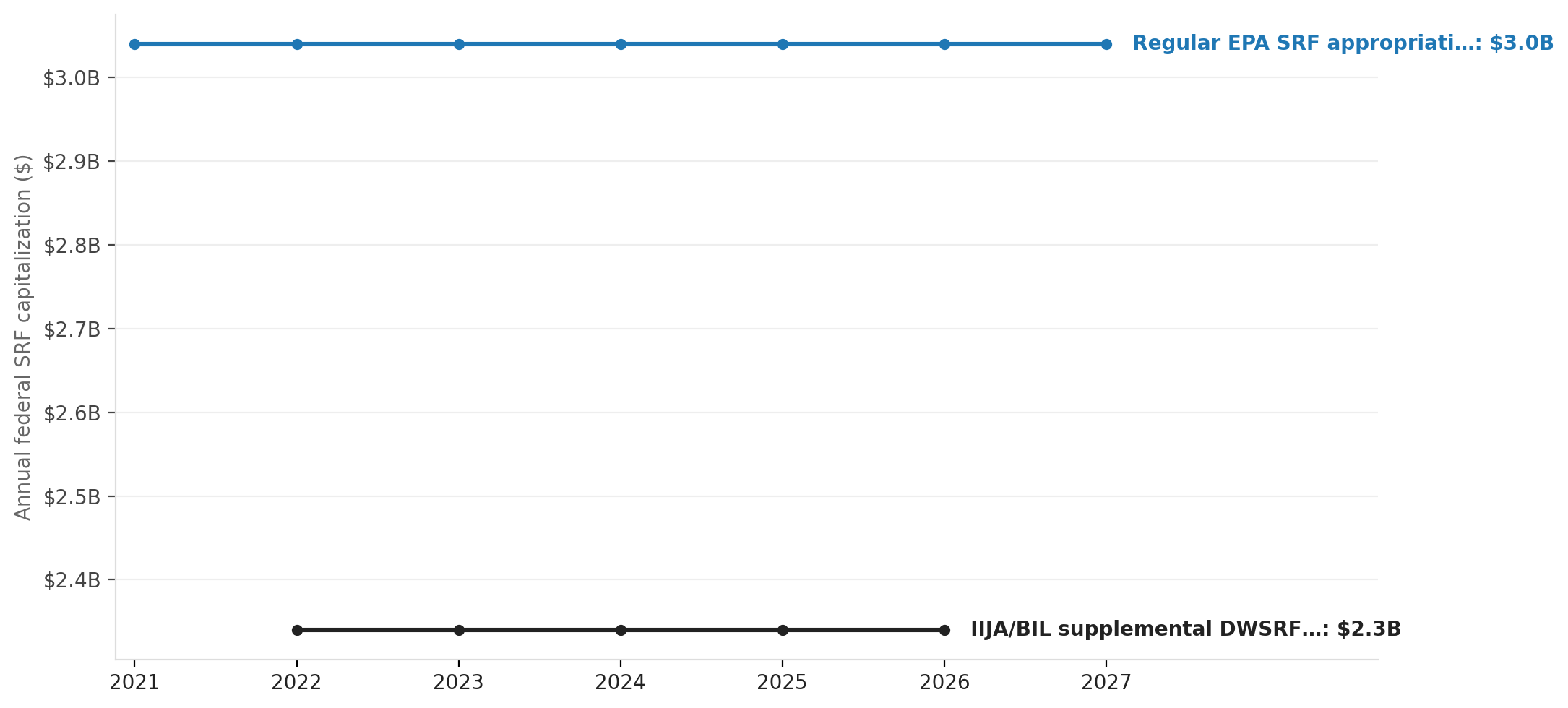
Source: NationGraph.
The second pressure comes from the Trump administration's approach to EPA grant programs. The administration's FY2026 budget proposed cutting EPA funding by more than half. More concretely, a court filing reported by Axios in May 2025 revealed EPA plans to cancel 781 environmental justice grants, a category that overlaps significantly with the WIIN Act Emerging Contaminants program that New Mexico had relied on to address PFAS contamination near military installations and in rural and tribal water systems. The absence of a WIIN successor grant in this cycle is the most acute single loss: those awards were explicitly designed for disadvantaged communities that lack the rate base to self-finance upgrades.
New Mexico is not uniquely exposed to the first problem. Arizona, Colorado, Texas, and Nevada show similarly depressed new-commitment numbers in the same trailing 90-day window, confirming that the BIL cliff is a national inflection point, not a state-specific funding failure. But New Mexico is more exposed than most to the second problem. It is among the most water-stressed states in the country, with a semi-arid climate, documented PFAS contamination near multiple military installations, and a high proportion of rural and tribal communities dependent on aging small water systems that cannot qualify for conventional financing. The BIL-era provisions, supplemental DWSRF capitalization, principal forgiveness for disadvantaged communities, WIIN Emerging Contaminants grants, were the tools specifically engineered for places like this.
The practical intermediary for nearly all of this money is the New Mexico Finance Authority, which administers the DWSRF on behalf of the state and then loans or grants the capital downstream to individual utilities. When the Finance Authority's capitalization grant drops from $24.9 million to $7.6 million, the pipeline narrows for dozens of small systems that have no other realistic path to infrastructure upgrades.
One important counterweight: New Mexico still holds an active multi-year grant portfolio worth more than $250 million in awards running through 2027 to 2031. Prior commitments are still disbursing. Water projects funded in FY2023 and FY2024 are under construction. The immediate danger is not that work stops tomorrow; it is that the queue of new starts is not being replenished, and the communities that would have been next in line, the ones relying on emerging-contaminants funding for PFAS remediation, or on principal forgiveness provisions to make any project financially viable, are now waiting for a program that has no announced replacement.
The next signal to watch is whether Congress passes a standalone SRF reauthorization or includes new water infrastructure appropriations in a broader reconciliation or appropriations package before the end of FY2026. Without that, the flat $3.04 billion baseline becomes the new ceiling, and New Mexico's annual capitalization grant settles significantly below what the state has planned around for the past five years.