Vermont issued 8 solar RFPs in August 2026, against a trailing 12-month average of roughly 2.2 per month, a 3.6x surge with a statistical significance score of 28.4. Every single one came from a public agency: the Vermont Military Department, the Town of Cabot, the City of Burlington, the Town of Hartford, Cavendish Fire District No. 2, and the Mount Ascutney Regional Commission. The month before, July, produced exactly one.
That inflection point is not a coincidence. Two policy shocks converged in quick succession, and Vermont's public sector is responding to both at once.
The first shock came from Montpelier. H.710, passed by the Vermont Legislature 108-30 in the House on May 27-28, 2026, and effective July 1, clarifies the Public Utility Commission's "single plant" definition in a way that directly accelerates solar co-location permitting at existing sites. For a municipality that already owns a parking lot, a fire station, or an armory, the new law substantially reduces the regulatory friction that once made small-site solar projects more trouble than they were worth. The permitting runway is now shorter, and agencies that had been watching from the sidelines are moving.
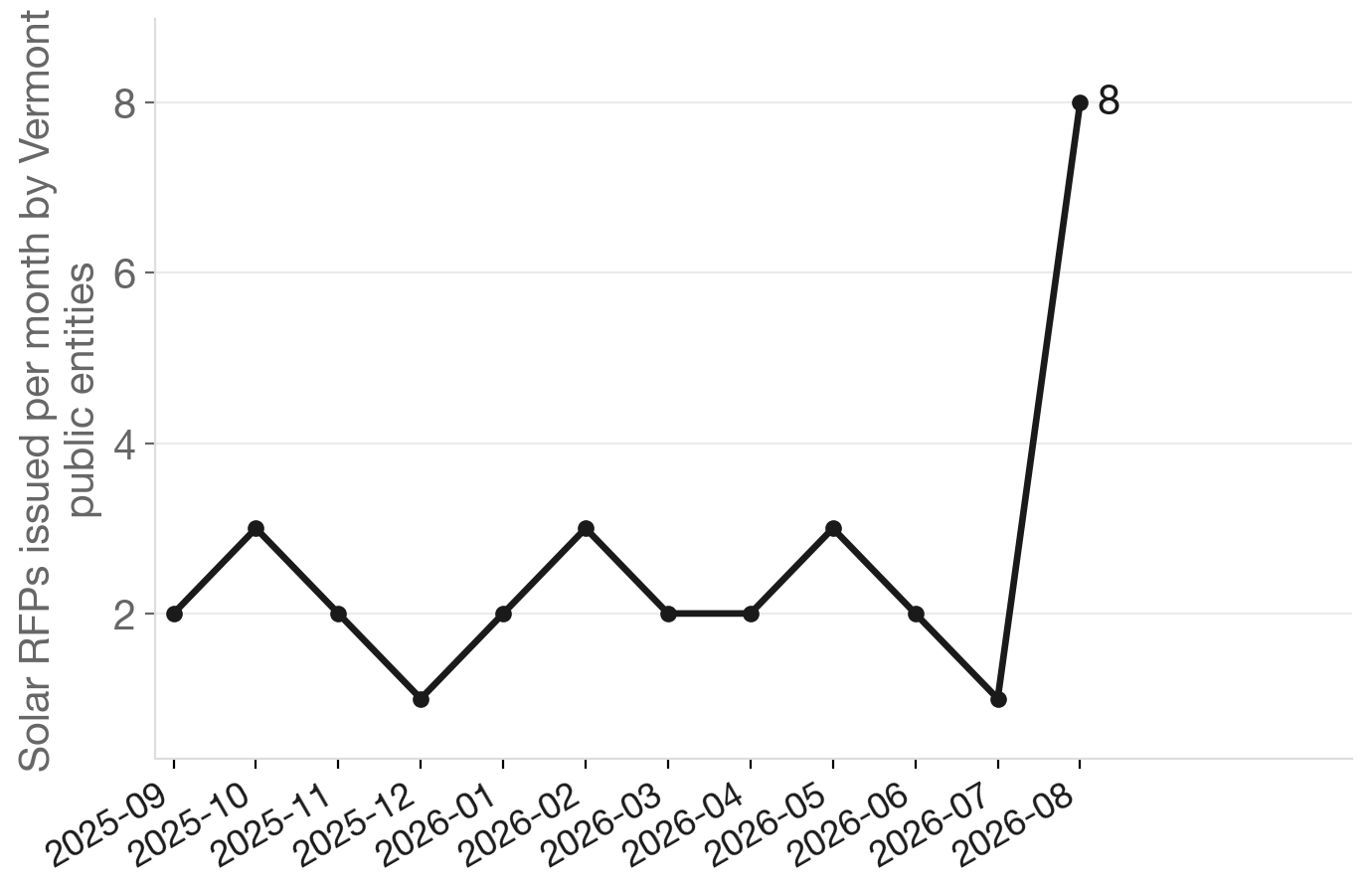
Source: NationGraph.
The second shock came from Washington. The Trump EPA terminated Vermont's $62.45 million Solar for All grant in August 2025, money awarded under the Greenhouse Gas Reduction Fund to deliver at least 20% electricity bill reductions to roughly 8,300 low-income Vermont households. Only about $150,000 of that grant had been spent before the freeze. Governor Phil Scott's administration filed an administrative dispute and is pursuing litigation alongside other affected states. Renewable Energy Vermont executive director Peter Sterling called the original award "historic," saying there had "never been anything on this scale in Vermont" for low-income solar access. That money, for now, is gone. Then H.R.1 eliminated the 30% federal residential solar tax credit at the end of 2025, removing the primary cost subsidy that Vermont's below-average net-metering compensation rates had leaned on to make rooftop solar affordable for middle- and lower-income households.
The combination effectively orphaned the households the Solar for All program was designed to serve. With the federal subsidy stack dismantled and the state's Department of Public Service unable to deploy the contested grant, the burden has shifted downward. Municipalities, fire districts, and state agencies, which can self-procure without federal strings attached, are now the most capable actors in the Vermont solar market.
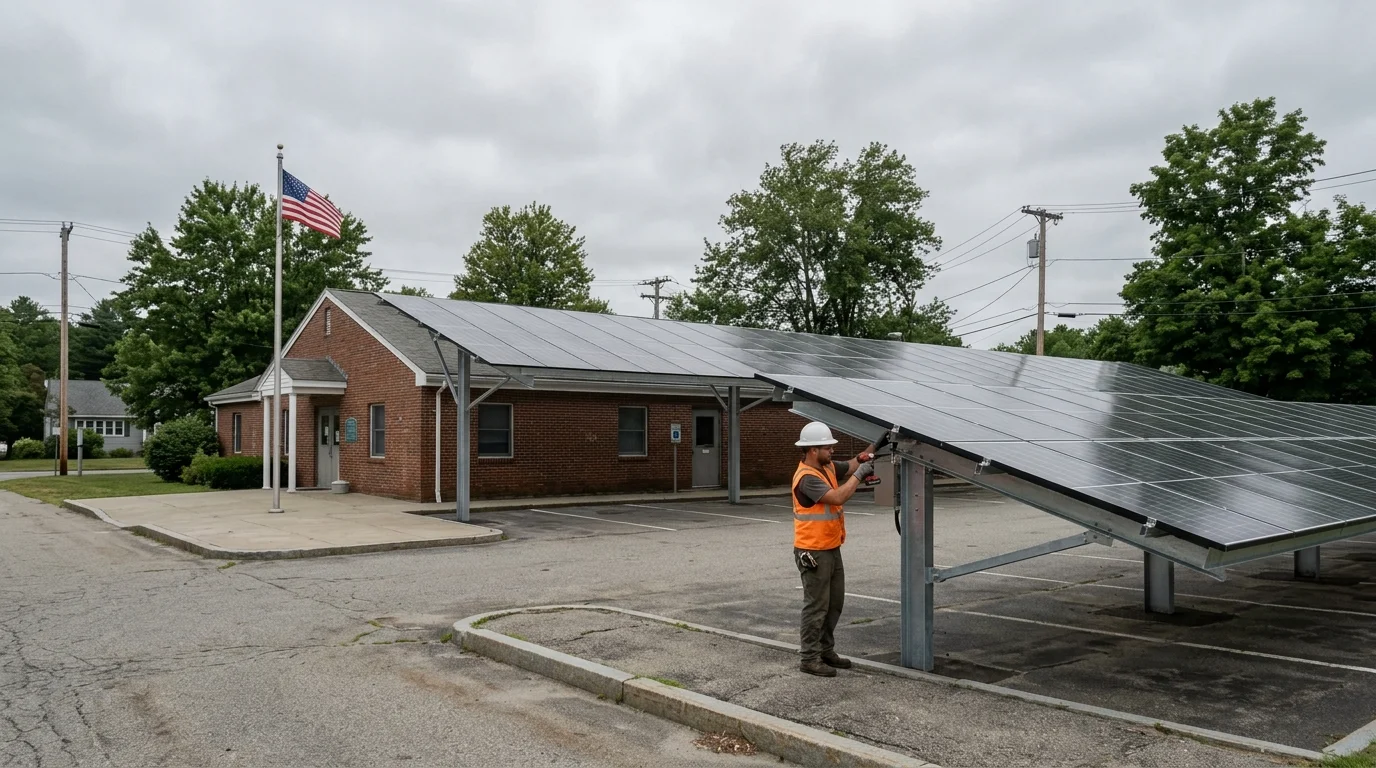
The Vermont Military Department's activity this month illustrates how broad that shift has become. The department issued two separate RFPs in the same 30-day window: one for solar maintenance and repair services, and a second to replace fossil fuel systems at Bradford Armory with solar generation. An armory converting away from fossil fuels is not an energy story most Vermonters would have predicted a year ago. Burlington's solar canopy RFP and Cavendish Fire District No. 2's solar carport design-build project point to the same logic: public agencies with control over their own sites are treating H.710's permitting clarity as a green light.
The Vermont specificity of the surge is worth noting. Neighboring New Hampshire issued zero solar RFPs in August. Maine issued two. Massachusetts, with five times Vermont's population, issued 13. Vermont's eight represent a per-capita rate that significantly outpaces the region, and the timing alignment with H.710's July 1 effective date is hard to read as coincidence.
What this means for Vermont residents is more complicated. Public agency procurement will add solar capacity to the grid and may lower costs for the agencies involved, savings that in theory flow through to taxpayers. But public canopies and armory arrays are not substitutes for the household-level bill relief that the Solar for All program was designed to deliver. The roughly 8,300 low-income households that program targeted have no equivalent replacement on the table. Vermont is also the only New England state without an energy storage requirement or goal, a gap that the legislature's own 2026 Annual Energy Report has flagged, and one that limits how much distributed solar can stabilize the grid without backup capacity.
The next signal to watch is the litigation timeline on the Solar for All termination. If Vermont recovers any portion of that $62.45 million, the state will face immediate pressure to redesign the program for a post-ITC, post-federal-partnership landscape. If the litigation fails, the municipal procurement surge visible in August's RFP data may be less an emergency patch and more a permanent structural shift in who Vermont relies on to build its clean energy future.