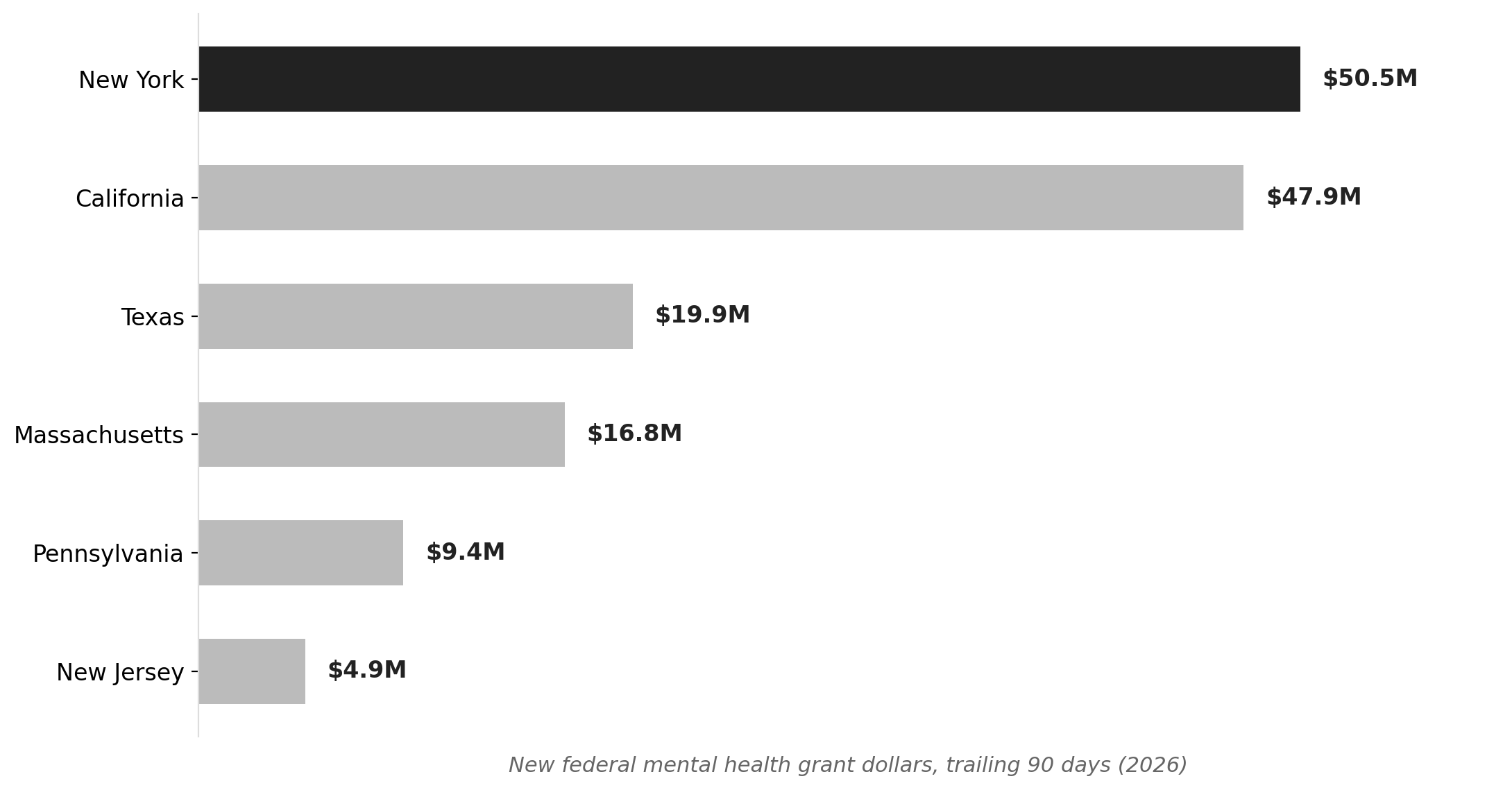
Federal mental health grants newly committed to New York institutions in the trailing 90 days total $50.5 million, up 62% from $31.1 million in the same window a year ago, and the state now leads every peer in raw dollars received. That last fact is the surprising one: New York pulled in more than California ($47.9 million) while issuing 30% fewer grants, 47 to California's 69, meaning New York's average award is substantially larger. Texas received $19.9 million in the same period. Massachusetts, $16.8 million. No other state is close.
The reason is institutional, not accidental. Governor Hochul's multi-year mental health transformation plan, funded through the FY2026 and FY2027 state budgets, committed more than $196 million in new state spending in a single fiscal year, including $160 million for 100 new forensic inpatient psychiatric beds at Wards Island and $16.5 million to expand Assisted Outpatient Treatment programs in counties across the state. Since Hochul took office, New York has added more than 1,000 psychiatric beds. That buildout created procurement infrastructure, active RFP cycles, and expanded institutional capacity at the NY Office of Mental Health, all of which now functions as a gravitational field for competitive federal awards.
The timing aligns with a federal funding surge as well. The FY2026 Consolidated Appropriations Act, passed in January 2026, allocated $2.8 billion to SAMHSA's mental health activities, a $15 million increase over the prior year, while preserving the Community Mental Health Services Block Grant that the administration had proposed restructuring. SAMHSA distributed $319 million in block grant funding nationally in February 2026. New York, as one of the most populous states and one of the most program-rich, received a formula-weighted share that OMH channels to community providers.
Source: NationGraph.
January 2026 was the single largest month in the trailing two-year time series: $49.5 million in new mental health grant starts in one month. The pace has sustained through June 2026 at $15 to $21 million per month. New York's full active federal mental health grant portfolio now stands at 819 grants totaling $3.68 billion in committed funding, with $2.47 billion already disbursed.
Five institutions account for roughly 79% of the trailing 90-day total. Rockefeller University leads with $13.0 million, followed by Columbia University at $9.3 million, the Icahn School of Medicine at Mount Sinai at $6.6 million, NYU at $6.4 million, and Albany Medical College at $4.8 million. The concentration at research universities is not a coincidence. Mount Sinai's Icahn School ranks second nationally in NIH neuroscience funding and third in psychiatry, with multiple research hubs directly funded by the National Institute of Mental Health. New York's cluster of elite academic medical centers gives it an absorption capacity for competitive NIH and HHS research dollars that no other state's geography replicates.
What makes the current moment distinct is that the research money and the delivery infrastructure are expanding simultaneously. The NY Office of Mental Health's active procurement cycle, with RFPs issued between April and July 2026, covers Project TEACH psychiatry access expansion, collaborative perinatal mental health care, tele-mental health services, opioid settlement fund deployment, and community diversion programs. Federal research dollars are landing on a system that is actively adding capacity to use them, not waiting for implementation to catch up.
The structural driver likely to sustain this for years is workforce. The Center for Health Workforce Studies projects a shortfall of up to 2,650 psychiatrists in New York by 2030. Hochul has already launched a loan repayment expansion for mental health practitioners serving underserved communities, and workforce pipeline grants have become a recurring feature of the state's federal applications. As long as that gap persists, the grant demand persists with it.
For New Yorkers, the immediate consequence is a mental health system adding capacity at an unusual clip: more beds, more community providers, more research programs in psychiatric care. The question the next 12 months will answer is whether the delivery side, community programs, outpatient providers, peer support networks, can scale fast enough to match what the research and inpatient infrastructure is building toward. The state's engagement of public lands and natural settings as therapeutic environments for veterans reflects the same expansionist logic: New York is testing every channel available.
The open variable is federal policy. If the next appropriations cycle revisits the SAMHSA block grant consolidation that the FY2026 act deferred, New York's formula allocation could shift. The state's competitive research grants, flowing through NIH and discretionary HHS channels, would be largely insulated. Its community services funding would not be.