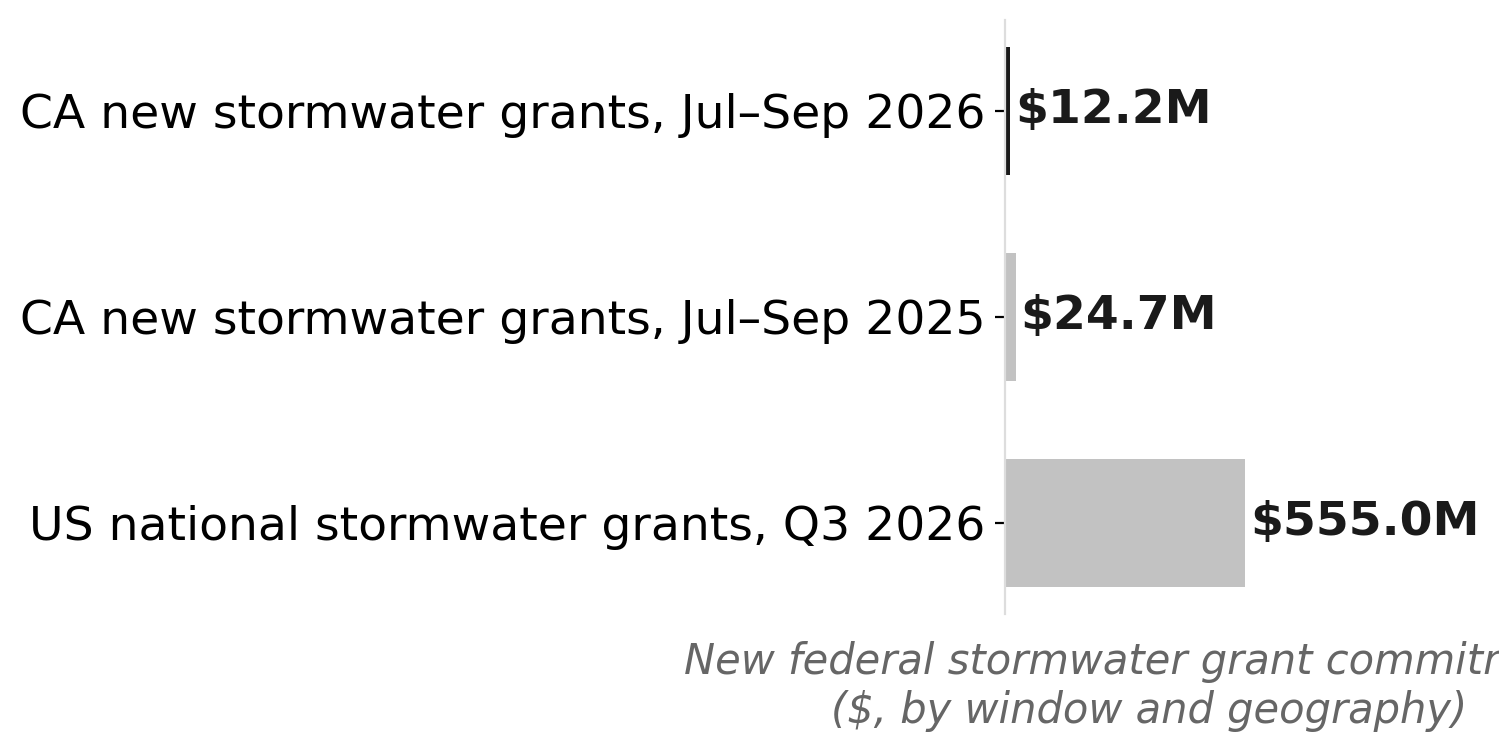
Federal stormwater grants newly committed to California have fallen to $12.25 million in the last 90 days, down 50 percent from $24.69 million in the same window a year ago, and the drop has nothing to do with a national slowdown. Nationally, stormwater grant volume in the third quarter of 2026 hit $555 million, nearly double any prior quarter. California is not in a cycle trough. It is in a structural gap.
The shape of the current window reveals the problem quickly. Only two federal grants are in the count: an $11.25 million Department of Transportation Port Infrastructure Development award to the San Diego Unified Port District and a $1 million CMAQ grant to Caltrans. The EPA, which drove the prior-year peak, contributes zero new stormwater obligations. That is not a rounding error. In the first half of 2025, EPA's Environmental and Climate Justice Community Change Grants delivered more than $39 million to California stormwater-related projects in a single six-month window. Those grants are now gone.
The Trump administration terminated all 80 Track I Community Change Grants in May 2025. The One Big Beautiful Bill Act, signed in July 2025, then rescinded the remaining unobligated IRA funds that had authorized the program. The terminations were not a programmatic judgment: the EPA's own Inspector General found the Community Change Grants were properly awarded. California Attorney General Rob Bonta co-led a 20-state amicus brief in July 2025 calling the terminations unlawful, and a class-action brought by nonprofits, tribes, and local governments is still working through federal court. Neither challenge has restored a dollar of funding.
Source: NationGraph.
California was disproportionately exposed because of who the Community Change Grants were designed to serve. The program targeted disadvantaged communities for climate resilience and stormwater mitigation, exactly the profile of dozens of California neighborhoods in the Los Angeles Basin, the Central Valley, and the San Diego region. The San Diego Foundation alone had been slated to receive $20 million for stormwater and climate resilience work in the Historic Central Barrios before the termination wiped out the award. Communities that were counting on specific, named grants are now counting on nothing.
The EPA did announce a separate $80 million national stormwater round through its Sewer Overflow and Stormwater Reuse Municipal Grant program in April 2026. That program, grounded in the Clean Water Act rather than the IRA, survived the administration's cuts. But it is a different instrument with different eligibility rules, and it is not an environmental justice program. California's estimated annual allotment under the OSG program runs roughly $4.5 million, a fraction of what the Community Change Grants were delivering, and targeted at a narrower set of projects prioritizing small and financially distressed communities.
The structural alternative most often cited in Sacramento is Proposition 4, the $10 billion climate bond California voters approved in November 2024. The measure authorized $101.5 million for urban stormwater grants, with 40 percent required to benefit disadvantaged communities. But Proposition 4 is a state bond program, not federal money and not a substitute for what the Community Change Grants were doing. Its stormwater component is administered by the State Water Board under its own rules, and as of September 2026, the solicitation has not yet opened. The State Water Board held its first public guidelines workshop on July 21, 2026. Applications are still months away.
There is also a parallel capital source that does not appear in the grant figures: the Infrastructure Investment and Jobs Act's Clean Water State Revolving Fund supplemental, through which California expects roughly $178 million in the final IIJA year. That money flows as revolving loans, not grants, which means it reaches different borrowers on different terms and does not close the gap for the environmental justice communities that needed grants, not debt.
For residents and local agencies in California's disadvantaged communities, the practical situation is this: the federal program specifically designed to fund their stormwater and climate resilience projects has been terminated, litigation to restore it is unresolved, the replacement federal program offers a fraction of the prior funding, and the state bond program that might partially address the same needs has not yet issued a single solicitation. The gap is real and, for now, widening.
The next signal to watch is the State Water Board's timeline for finalizing Proposition 4 stormwater guidelines and opening its first competitive round. Until that solicitation drops, California communities that lost Community Change Grant awards are waiting with infrastructure plans and no active funding path to execute them.