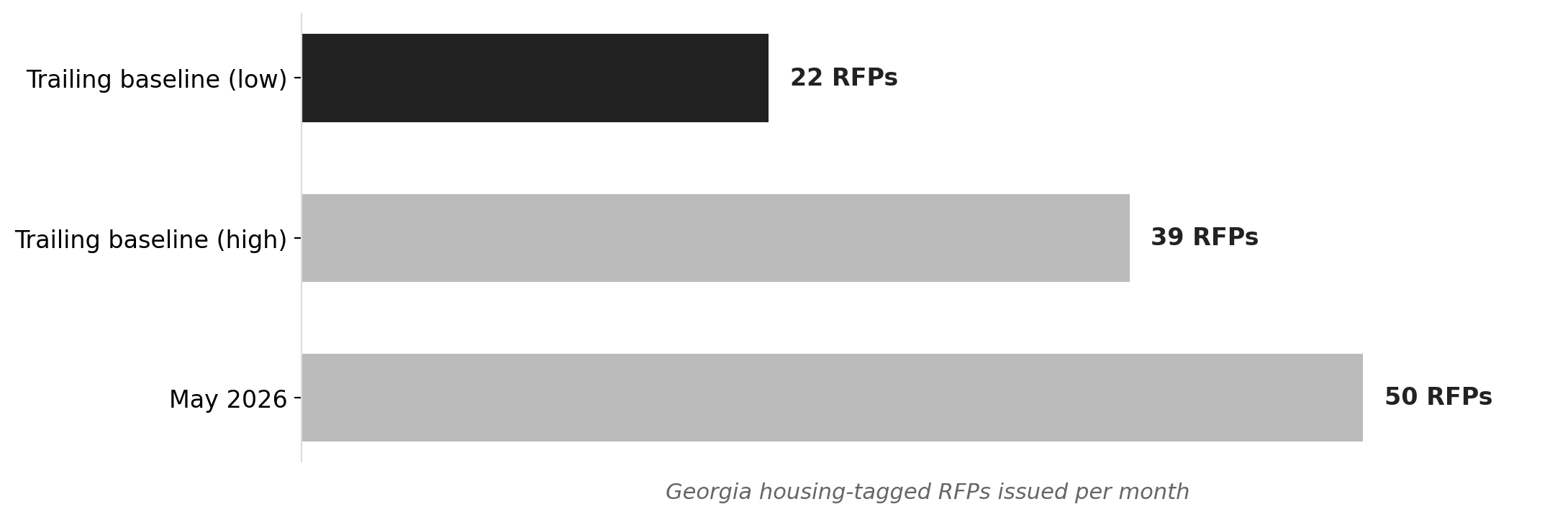
Fifty Georgia institutions issued housing-tagged RFPs in May 2026, the highest monthly count in at least 18 months and roughly double the 22-to-39 baseline that prevailed through most of the past year. The spike is not coming from Atlanta. It is coming from Cairo, Waynesboro, Tifton, and Royston, small cities that have not historically been active housing procurers and are now racing to secure development partners before a state grant deadline passes them by.
The proximate trigger is the OneGeorgia Authority's Rural Workforce Housing Initiative. The program released a $34 million Notice of Funding Availability for its FY2026 July cycle, offering competitive grants up to $2.5 million per project for infrastructure and $1 million for construction financing. To compete, local governments must partner with private developers and submit housing need studies demonstrating unmet demand. For cities that have never run that process before, the first step is an RFP to find the developer. The grant deadline is, in effect, a procurement deadline.
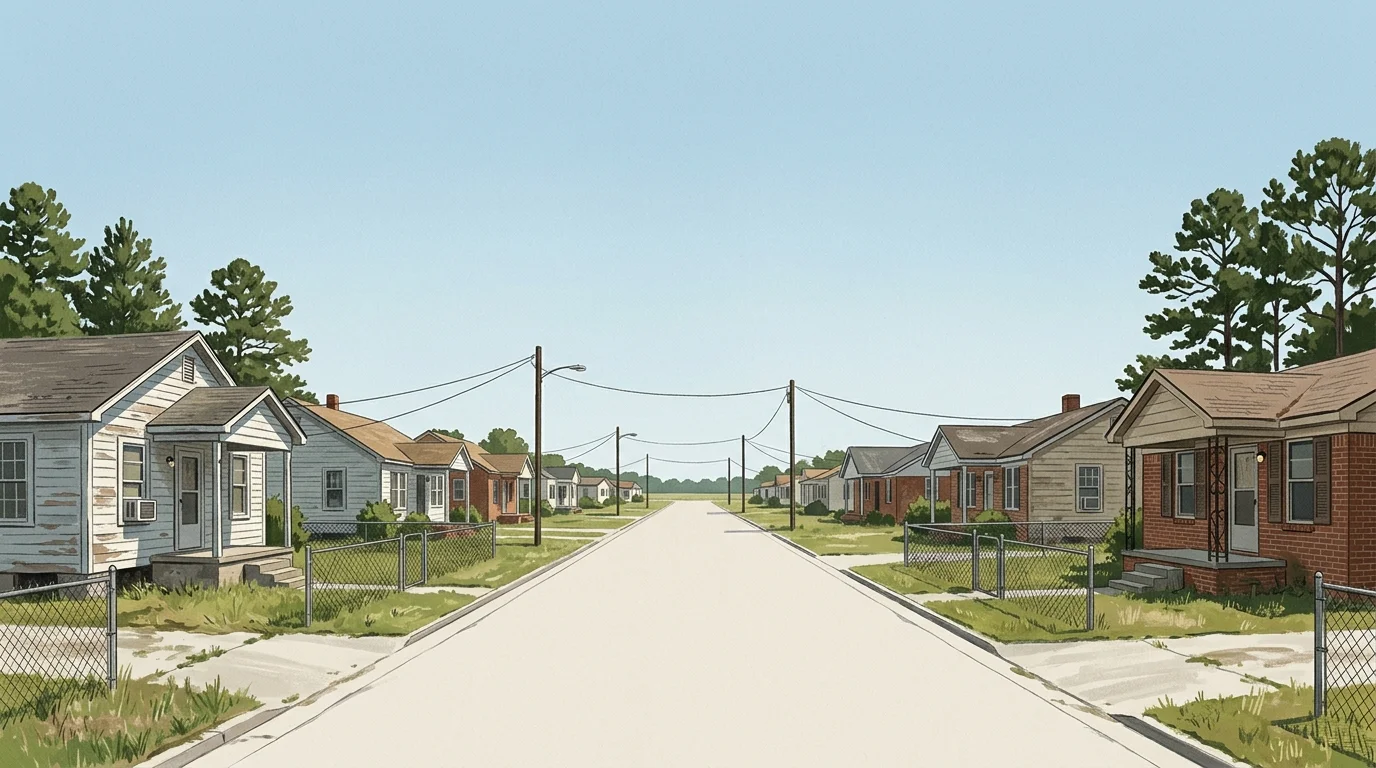
The concentration of activity outside the metro cores reflects OneGeorgia's eligibility rules: only counties qualifying under the OneGeorgia framework can apply, which routes money toward rural and small-city Georgia rather than Fulton or Gwinnett. That targeting explains why the cities showing up in this procurement wave are places like Cairo, the Grady County seat with a population around 10,000, and Waynesboro in Burke County, issuing a HUD Section 3 single-family development RFP for the first time in recent memory. These governments are not responding to population growth. They are responding to a competitive grant with a clock attached.
Source: NationGraph.
The underlying demand is real. When Georgia DCA last opened its Housing Choice Voucher waitlist in 2023, it received more than 177,000 applications for 13,000 available spots, in four days. That number captures the metro-heavy portion of unmet need, but rural Georgia has its own version: a workforce housing shortage that employers cite as an active barrier to recruitment. The OneGeorgia program was designed specifically to address that constraint, and the current procurement wave is the most visible evidence yet that local governments are treating it as a serious enough opportunity to act.
The activity extends beyond rural workforce housing. Macon-Bibb County is procuring an affordable housing fund brokerage service. Newnan and Chalk Level are running housing rehabilitation RFPs. The Royston and Gwinnett housing authorities are seeking renovation partners. And in the highest-profile transaction in this cycle, the Georgia Department of Corrections is seeking developers for the Roosevelt Collection, a large-scale affordable housing redevelopment linked to a surplus state property. That project, documented previously by NationGraph, is the anchor of the current wave and illustrates how state agencies beyond DCA are now active participants in the housing procurement market.
The legislative backdrop has shifted, too. Georgia House Bill 159, passed during the 2025 session, doubled the Georgia Dream homebuyer program's bond cap from $3 billion to $6 billion, according to a session wrap from Enterprise Community Partners. That expansion matters because it widens the pool of first-time buyers who can access subsidized mortgages, which strengthens the demand side for the workforce housing projects now entering the procurement pipeline. Developers evaluating an RFP from Cairo or Tifton now have more confidence that completed units will find buyers.
At the federal level, the U.S. Senate passed the ROAD to Housing Act in October 2025 as part of the National Defense Authorization Act, a measure Georgia's municipal league has flagged as giving cities new permitting streamlining tools and access to competitive federal grants. If the House concurs, Georgia's smaller governments would gain another lane of funding to layer on top of OneGeorgia, potentially sustaining procurement activity beyond the current FY2026 cycle.
The macro context is not comfortable. Georgia Trend documented earlier this year that just three investment firms control nearly 11 percent of single-family rentals across five major metro counties, compressing the affordable inventory available to buyers and renters alike. The state's active federal housing grant portfolio, led by HUD, totals more than $805 million obligated across 759 active grants, a substantial base of activity, but one concentrated in established programs and established recipients. What is new in May 2026 is the geography: the procurement energy is moving toward places that have been largely outside the housing finance conversation.
The next signal to watch is DCA's FY2026 July award announcements. How many of the 40 first-time procurers in this wave produce applications that score competitively, and which projects reach financial close, will determine whether the current RFP surge translates into groundbreakings or simply into paperwork. The deadline forced governments to the table. The awards will show how many were ready to sit there.