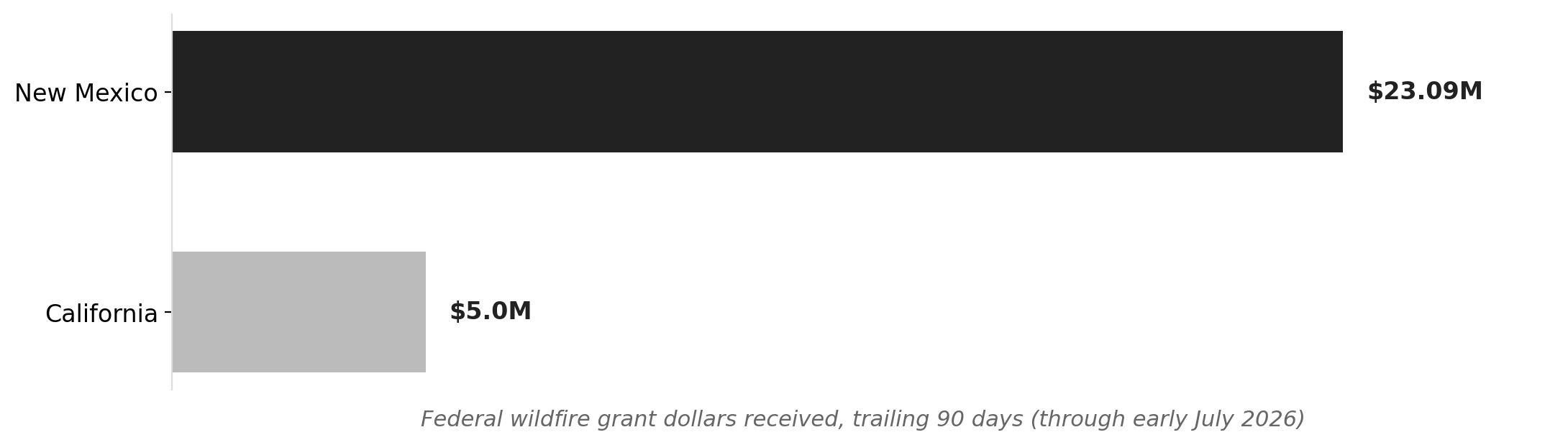
Federal wildfire grants flowing into New Mexico have reached $23.09 million over the past 90 days, a 1,999 percent increase over the $1.1 million recorded in the same window a year ago, and the entire sum is a single check: a USDA Community Wildfire Defense Grant awarded April 20, 2026, to the state's Energy, Minerals and Natural Resources Department (EMNRD). That one award made New Mexico the top recipient of wildfire grant dollars among all 50 states over the period. California, which ranked second, collected roughly $5 million spread across five separate grants.
The scale of the award is striking on its own. The context around it is harder to ignore. The same federal government that caused the largest wildfire in New Mexico history, when a USFS prescribed burn escaped in April 2022 and burned 342,000 acres across San Miguel and Mora Counties, is now sending the state its biggest-ever prevention investment. New Mexico is accepting the money with one hand and preparing a federal lawsuit with the other: Governor Michelle Lujan Grisham's office has confirmed the state is pursuing $445 million in unresolved FEMA claims tied to the Hermit's Peak/Calf Canyon Fire, including $70 million for a Mora reforestation center that has not been funded.
The grant itself draws from the USDA's Community Wildfire Defense Grant program, authorized at $1 billion over FY2022 through FY2026 under the Infrastructure Investment and Jobs Act. The program prioritizes high-hazard, low-income, and disaster-impacted communities, a description that fits most of rural New Mexico almost precisely. The April 2026 award runs through June 30, 2030, giving EMNRD's Forestry Division a four-year runway to deploy the funds on fuel reduction, community wildfire protection planning, and defensible-space work on the non-federal, non-tribal, non-municipal lands the division is statutorily responsible for protecting.
Source: NationGraph.
The timing of the award is not incidental. Two weeks before the grant was dated, on April 6, 2026, EMNRD imposed sweeping statewide fire restrictions citing what Acting Secretary Erin Taylor described as "unseasonably hot and dry" conditions. Taylor noted that nine of ten wildfires in the state are caused by humans, and the restriction order took effect immediately, covering campfires, fireworks, and outdoor burning across all jurisdictions. The state's 2025 Communities at Risk planning document, updated by EMNRD's Forestry Division, found that demand for fuel-reduction funding has consistently exceeded available supply, a gap the 2022 plan noted and the 2025 update confirmed has not closed.
The $23 million sits on top of an existing USDA portfolio. EMNRD already holds roughly $41 million in active wildfire and forestry grants running through the late 2020s, covering Cooperative Forestry Assistance, Southwest Forest Health initiatives, and Hazardous Fuel Reduction programs. Federal dollars make up more than half of EMNRD's $175.8 million FY2025 budget. The agency is, by design and by necessity, a conduit for federal wildfire investment, and this grant is the largest single deposit that conduit has received.
The recovery side of the ledger remains unresolved. Congress allocated nearly $4 billion for Hermit's Peak and Calf Canyon victims after the 2022 fire, then added $1.5 billion more in late 2024. A state official said earlier this year that the claims office appears to be running low on funds. An audit released April 28, 2026 found widespread mismanagement of Mora County recovery dollars. The state's $445 million in outstanding FEMA claims, including funds for communities that have waited four years to rebuild, remains in dispute even as prevention money arrives in volume.
That dual posture, aggressive prevention investment and active litigation over past disaster recovery, reflects something larger about where federal wildfire policy stands in 2026. The CWDG program was designed to get ahead of fires that Congress would otherwise pay to clean up afterward. New Mexico is the clearest available test of that logic. The state that absorbed the nation's costliest government-caused wildfire is now the top recipient of the prevention program meant to stop the next one.
What it means practically for communities in San Miguel, Mora, and the other high-hazard counties EMNRD serves is more fuel-reduction crews on the ground, more defensible-space assessments, and more wildfire protection plans updated before the 2026 fire season accelerates. The restrictions already in place mean the prevention work and the acute risk are running in parallel.
The next signal to watch is whether New Mexico's lawsuit against FEMA advances, and whether the outcome reshapes how other disaster-affected states approach the gap between recovery appropriations and actual claims paid. The CWDG program's five-year authorization ends with FY2026; what replaces it, if anything, will determine whether the prevention investment continues after the current grants expire.