Thirty-seven California public institutions issued their first solar RFP in more than a year during May 2026 alone, part of a single-month total of 137 solar solicitations that is the highest volume in the 18-month window NationGraph has tracked. The prior peak was 90 RFPs in February 2026. This is not a gradual acceleration. It is a sprint.
The reason is a collision of two hard deadlines. California's updated Title 24 Building Energy Efficiency Standards, which took effect January 1, 2026, extended mandatory solar-plus-battery requirements to nonresidential and institutional buildings for the first time, sweeping in assembly halls, laboratories, high-rise multifamily buildings, and campuses that had previously been exempt. At the same time, H.R. 1, the "One Big Beautiful Bill" signed by President Trump on July 4, 2025, set a matching date one year later as the last day for public agencies to "begin construction" on solar projects and retain access to the 30% direct-pay investment tax credit under Section 48E. For tax-exempt institutions, universities, school districts, cities, that direct-pay mechanism is the only way to capture the federal subsidy. Miss the July 4, 2026 cutoff, and the credit disappears.
The result is roughly five weeks of procurement runway remaining, and institutions that had gone quiet on solar for a year or more are suddenly moving. As Clean Energy Group has documented, the combination of the construction-start deadline and domestic content compliance rules creates compounding risk for public entities that delay, since projects lacking domestic content certification face an additional haircut on the direct-pay amount even if they do begin on time.
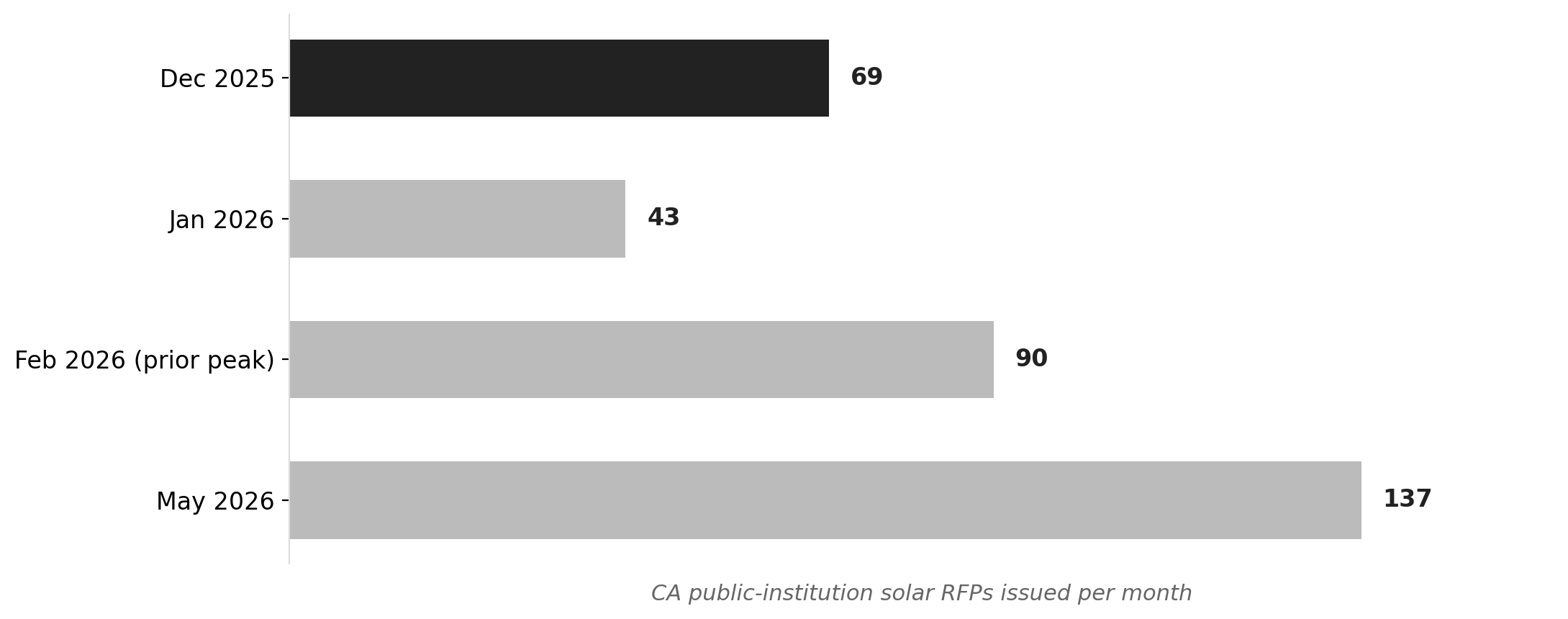
Source: NationGraph.
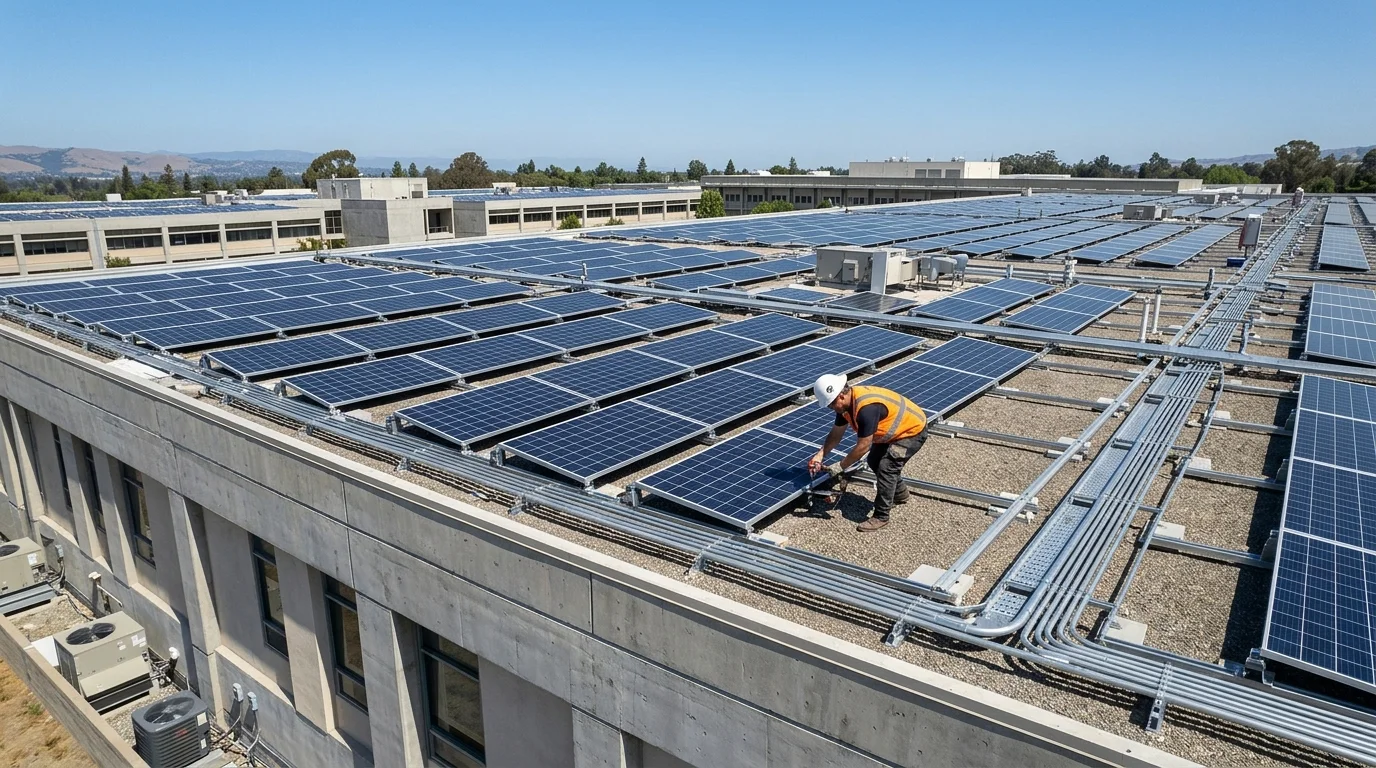
The 37 cold-start institutions span nine counties, from Yolo and Sonoma in the north to San Bernardino and Los Angeles in the south, which rules out a regional funding push or a single utility territory as the explanation. UC Davis entered with a Solar PPA and Site License solicitation. CSU San Bernardino bundled PV with a Battery Energy Storage System in a single RFP, a pairing now required under the Title 24 update. CSU Dominguez Hills split its campus across two lots, each with its own solar-storage solicitation. Porterville Unified School District and Sequoia Union High School District, both in inland valleys with limited prior solar procurement history, issued first-time solicitations in the same window. The City of Adelanto, a small municipality in the high desert, moved on solar-powered smart street lighting.
The paired-system structure matters beyond compliance. Title 24's expanded rules do not simply require solar panels; they require solar plus storage, meaning institutions that procure now are locking in battery capacity that insulates campuses and municipal facilities from grid outages. CSU Dominguez Hills and CSU San Bernardino both reflect this bundled mandate explicitly in their RFP language.
California's state-level funding provides some cushion regardless of what happens federally. The California Public Utilities Commission designated more than $280 million in 2025 for residential PV and battery implementation, establishing a demand floor. But that allocation is weighted toward residential programs, and institutional buyers have been counting on the ITC direct-pay credit to close the gap on larger capital projects. A 30-cent reduction on every dollar of eligible costs on a $10 million campus system is $3 million. That math is the engine behind May's volume.
Industry analysts have described the current window as "now-or-never" for public agencies seeking the full federal incentive. The "begin construction" standard under IRS guidance generally requires either physical work of a significant nature at the project site or five percent of total project costs incurred, thresholds that can be met before panels are delivered, but not before contracts are signed and deposits made. An RFP issued in late May still needs to close, go through board approval, and mobilize a contractor before the clock stops on July 4.
For anyone living near one of these institutions, the practical consequence is a faster-than-normal procurement process that compresses vendor selection, contract negotiation, and board votes into weeks rather than months. Some of these projects will not close in time. The open question is what happens to the institutions that miss the cutoff by days or weeks: whether they abandon the project, scale it back, or absorb the lost credit through other budget lines.
The next signal to watch is the period between mid-June and July 3, when construction-start documentation will either be filed or won't be. California has never had this many public solar projects simultaneously trying to cross a single federal deadline. The pile-up is visible now in the RFP data. Whether it translates into 137 projects actually breaking ground is a different question.