
Seven body camera RFPs have hit Pennsylvania's procurement system in the last 30 days, roughly ten times the monthly average, and every single one of them comes from the City of Philadelphia. Zero from Pittsburgh. Zero from Allentown, Harrisburg, Erie, or any of Pennsylvania's other 2,500-plus local police departments. The statewide spike is, in reality, one department finishing a hardware cycle it started years ago.
The backdrop is Pennsylvania Act 53 of 2025, signed by Governor Josh Shapiro on November 24, 2025, and effective January 23, 2026. The law, described by ABC27 as the largest expansion of body camera authorization in the commonwealth since 2017, cleared Attorney General Dave Sunday's roughly 100 special agents, DCNR rangers, Game Commission officers, and Fish and Boat Commission deputies to wear cameras for the first time. It passed the House 196 to 7 and the Senate unanimously. That kind of near-total political consensus signals a real shift in how Pennsylvania lawmakers view the technology, but political consensus does not move procurement calendars on its own.
What is moving the calendar in Philadelphia is a multi-year rollout already deep into its final phase. Philadelphia PD's FY26 budget testimony confirmed that all patrol districts are receiving upgraded AB4 body-worn cameras, with specialized units, SWAT, Highway Patrol, Narcotics, K9, in active infrastructure installation. Commissioner Kevin Bethel has also flagged plans to add smart-holster sensors that auto-activate cameras the moment an officer draws a weapon, a next-generation hardware category that requires its own procurement round. That combination, a large department upgrading multiple unit types simultaneously while adding entirely new sensor hardware, is what generates seven RFPs in a single month.
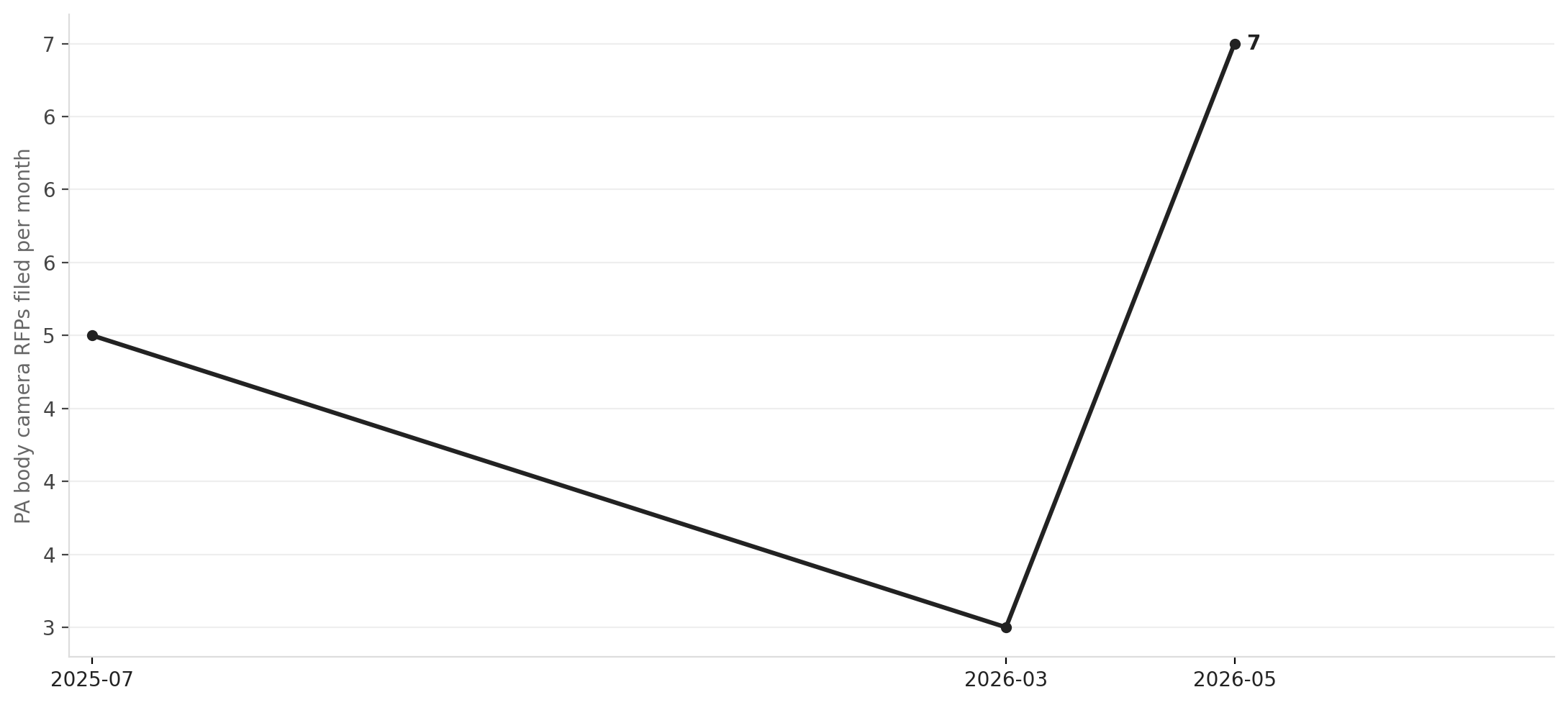
Source: NationGraph.
The time series makes the driver visible. Five RFPs appeared in July 2025, the month after SB 520 cleared the Senate unanimously in June. Three more came in March 2026, during the compliance planning window following the law's January effective date. May 2026 produced seven, the highest single-month volume on record in the dataset. Each cluster corresponds to a real deadline: a legislative milestone, a legal effective date, a budget cycle. Philadelphia was already buying; the law gave the department an additional compliance pressure to accelerate.
The RFP descriptions themselves reflect a department running multiple procurement vehicles in parallel. Some orders cover six to twelve cameras, specifying CammHD F6 4K models with IP68 waterproofing, the kind of small-unit purchase that comes when a specialized squad gets its first hardware allocation. Others bundle dash cameras for vehicle fleets. The specificity suggests Philadelphia is not issuing one blanket contract but routing different unit types through separate solicitations, possibly as a deliberate shift toward competitive bidding after years of sole-source Axon arrangements. WHYY reported in 2021 that Philadelphia bypassed open bidding to award Axon a $12.5 million body camera contract directly. The current RFP cluster, by contrast, appears structured for vendor competition.
Pennsylvania State Police completed their own statewide body-worn camera rollout ahead of schedule in early 2025 under a five-year Axon contract, per PSP's announcement. That rollout covered troopers across Philadelphia, Montgomery, and Delaware counties. It did not, however, reach the local departments those troopers work alongside. Pennsylvania's structural fragmentation, more than 2,500 independent local departments, most of them small, means Act 53 created hundreds of individual procurement obligations at once rather than a single statewide contract. Most of those departments have not yet issued a single RFP.
That gap is the real story the Philadelphia numbers are obscuring. A 6,500-officer department with an $872 million annual budget can respond to a new law within months. A borough department with twelve officers and a shared municipal budget cannot move at the same speed. When the rest of Pennsylvania's departments do begin acting on Act 53's mandates and the compliance pressure that comes with them, the procurement signal will look very different from what May 2026 is showing. It will be diffuse, slow-moving, and spread across dozens of jurisdictions without Philadelphia's institutional capacity to run parallel solicitations.
The next signal to watch is whether the newly authorized agencies under Act 53, particularly the OAG's special agents and DCNR rangers, begin issuing their own RFPs before the end of FY26. Attorney General Sunday committed publicly to equipping nearly 100 agents. If that procurement surfaces in the statewide data over the next 60 to 90 days, it would confirm that Act 53 is producing activity beyond Philadelphia's existing hardware cycle. If it does not, the law's practical reach may be moving slower than its near-unanimous vote suggested.