Federal housing grant starts in Hawaii have fallen to $22.7 million in the last 90 days, down from $156.7 million in the same window a year ago, an 86% collapse that looks, on paper, like a catastrophic funding cut. It isn't, exactly. The vouchers are still technically active. The cut hasn't passed Congress. What's changed is the disbursement cadence, and for housing authorities trying to sign multi-year landlord contracts in one of the most expensive rental markets in the country, the difference between a cut and a drip barely matters.
A year ago, HUD issued Hawaii's housing agencies their Section 8 Housing Choice Voucher renewals in the standard form: large, multi-month bulk awards. The City and County of Honolulu received $42.3 million in a single commitment. The Hawaii Public Housing Authority received $31.9 million. Maui County and Hawaii County received $14.6 million and $14.4 million, respectively. Those lump sums gave agencies the runway to make binding commitments to landlords, plan staffing, and maintain waiting lists with predictable capacity.
This year, the same four agencies have received a combined total of under $400,000 in Section 8 grants. HUD is now issuing individual monthly authorizations, some as small as $3,000, none exceeding $236,000, in place of the quarterly lump sums. The underlying vouchers haven't been cancelled, but the administrative architecture that makes them useful to housing authorities has been dismantled, at least temporarily. As Shelterforce reported in March 2025, this kind of policy uncertainty was already straining affordable housing operators months before the disbursement cadence fully shifted.
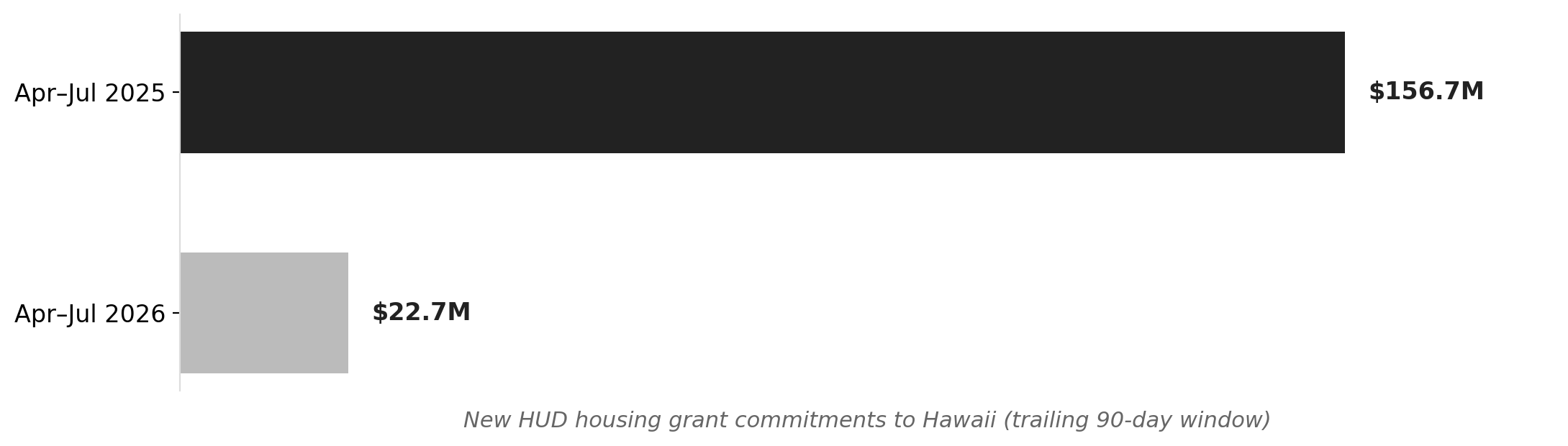
Source: NationGraph.
The proximate cause is budget paralysis in Washington. HUD has operated without a final FY2026 appropriations bill since October 1, 2025, governed instead by a series of continuing resolutions that legally constrain how the agency structures multi-month grant commitments. The January 2026 continuing resolution maintained most HUD programs at FY2025 funding levels, but it did not restore HUD's authority to issue the forward-looking bulk awards that make the voucher program function as a planning tool rather than a monthly lifeline.
The only significant new award in the current 90-day window is a $22.3 million Native Hawaiian Housing Block Grant renewal to the Department of Hawaiian Home Lands, almost the entire $22.7 million Hawaii total. That program funds housing construction and rehabilitation on Hawaiian Home Lands, a trust obligation with a distinct legal foundation from standard federal housing assistance. It is also, notably, the one program the Trump administration's FY2026 and FY2027 budget proposals would eliminate entirely. The National Low Income Housing Coalition has detailed the administration's broader proposal: a 44% reduction to HUD overall, a $26.7 billion cut to federal rental assistance, and the consolidation of Section 8 vouchers, Public Housing, and three other programs into a single State Rental Assistance Block Grant sent directly to states. If that proposal advances, the grant that is currently Hawaii's entire housing funding lifeline would disappear from the federal ledger.
Hawaii's exposure to this uncertainty is acute in ways that distinguish it from most other states. The private rental market provides no meaningful fallback: Hawaii has the highest cost of living in the nation, and the gap between a voucher-supported rent and an unassisted market rate in Honolulu is not a gap most low-income households can bridge. The state has no large-scale state-funded rental assistance program that could absorb federal disbursement delays. And Hawaii already carries one of the highest per-capita rates of homelessness in the country, meaning that disruptions to voucher flow show up quickly in visible ways. Honolulu Civil Beat reported in December 2025 that local nonprofit leaders estimated 400 to 450 people on Oahu alone could return to homelessness if proposed HUD Continuum of Care rule changes are finalized, a figure that predates the disbursement cadence shift now showing up in the grant data.
HPHA's active grant portfolio remains substantial on paper: more than six Public Housing Operating Fund grants totaling over $20 million are still running, and a $15.5 million Capital Fund award extends through 2029. Those existing commitments provide some operational continuity. But they were made under prior administrations on prior budget cycles. No new multi-year commitments are being issued in their place.
The signal to watch is the FY2026 appropriations process, which remains unresolved as of mid-2026. A final bill that restores HUD's authority to issue multi-month bulk awards would likely produce a rapid normalization of the grant start numbers, a catch-up disbursement cycle similar to what occurred after prior continuing resolution periods. A further continuing resolution, or a budget that advances the administration's block grant proposal, would extend and deepen the uncertainty. Hawaii's housing authorities are, for now, planning month to month in a state where the median rent leaves no margin for that kind of improvisation.