Eighteen California institutions issued their first transit-related procurement solicitation in over a year during the 30-day window ending August 28, 2026, a re-entry wave layered on top of the 41 to 88 agencies already active each month. The same 30 days produced the Inglewood Transit Connector's 90% GMP solicitation for a $500 million Phase 1 project covering three mobility hubs and a pedestrian bridge to the Metro K-Line. That one solicitation is the clearest example of what just happened across the state: money that had been promised finally became money that agencies could spend.
The trigger arrived six weeks earlier. On July 16, 2026, Governor Newsom announced nearly $2.5 billion in California Transportation Commission-approved investments covering more than 150 transit and highway projects, bringing the state's FY2025-26 transportation total to $13.8 billion. The package drew from $547 million in federal Infrastructure Investment and Jobs Act dollars, $736 million from SB 1, and $1.1 billion from the State Highway Account. CTC approval is the formal unlock: without it, agencies can hold a grant and still lack authorization to solicit contractors. Once it came through, solicitations followed.
A second clock is also running. The federal surface transportation bill expires in September 2026, and the Associated General Contractors has warned state and local agencies that procurement pipelines started after that deadline face authorization risk. Agencies that had been waiting on CTC approval found themselves, almost simultaneously, with the green light from Sacramento and a hard deadline from Washington. That combination explains why re-entry happened in a cluster rather than gradually.
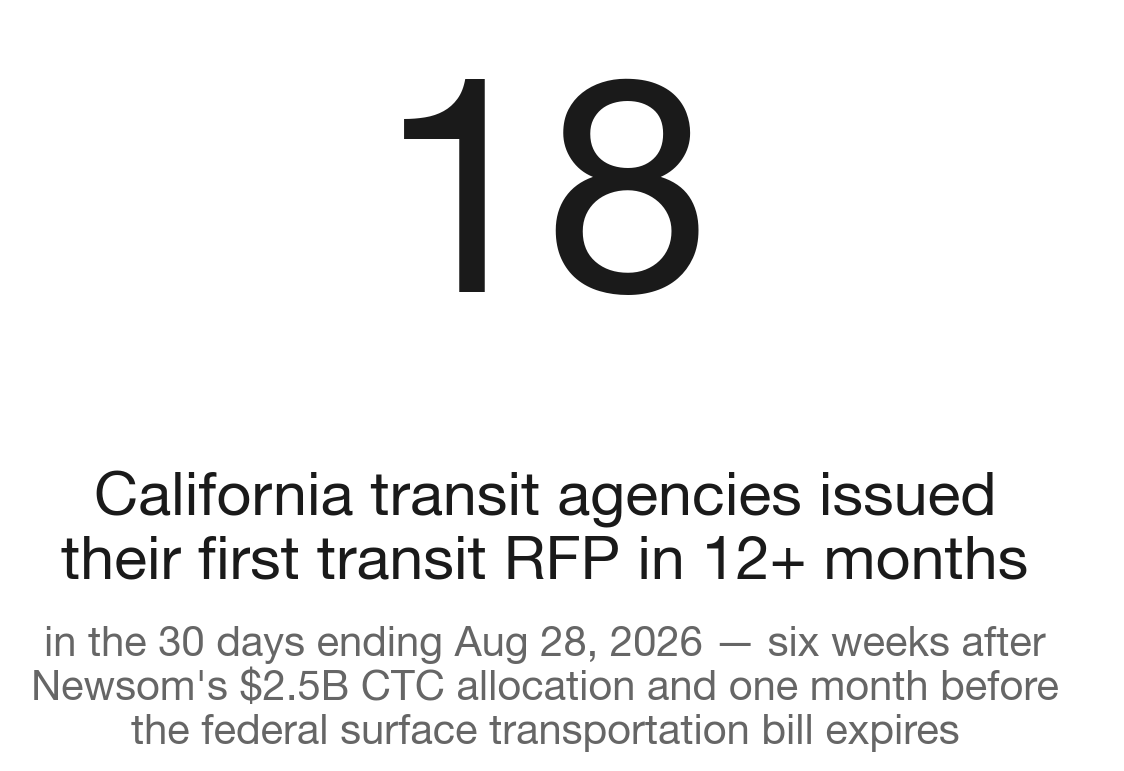
Source: NationGraph.
The geography of the 18 institutions is what makes the pattern significant. This is not a Los Angeles story with footnotes. Lake Transit Authority in rural Lake County solicited construction management services for a new Interregional Transit Center, its first transit RFP in over a year. Union City issued a solicitation for its Block 6 Interim Transit Facility. Emeryville moved on construction management for its 40th Street Multimodal Project. Sacramento Regional Transit issued an RFP for an enterprise ERP system covering bus, rail, and paratransit operations. From the North Bay to the LA Basin to the Central Valley, the July allocation appears to have cascaded to agencies well outside the major metro procurement offices that dominate the baseline count.
The Inglewood solicitation sits at the marquee end of that range. The Transit Connector has been years in development, backed by a $502 million federal Capital Investment Grant. What August's 90% GMP solicitation signals is the transition from grant-in-hand to contractor-wanted, the moment a project stops being a funding announcement and starts being a construction schedule. The July CTC package explicitly named a mobility hub network in southwest Los Angeles County, worth $257 million, that directly supports the Connector's footprint. State approval followed federal commitment; solicitation followed state approval.
California's broader transit capital portfolio gives the 18-institution wave a larger frame. LACMTA holds a $2.49 billion Capital Investment Grant. The San Francisco City and County program carries more than $540 million in State of Good Repair commitments. Santa Clara VTA's BART Silicon Valley Phase II is backed by $1.1 billion in federal funds. California has received approximately $16.7 billion annually in infrastructure funding since IIJA's passage, more than any other state. According to a Rock Products report on the FY2025-26 budget, the $13.8 billion allocation represents the largest single-year transportation investment the state has executed. The 18 dormant agencies re-entering procurement are the trailing edge of a capital deployment that the largest agencies began years ago.
For residents of smaller jurisdictions, the concrete change is that projects which existed only as approved plans are now soliciting the contractors who will build them. Lake County's transit center moves from a line item to a construction management contract. Emeryville's multimodal corridor moves from design into the bid process. That timeline compression matters in communities where years-long gaps between approval and groundbreaking are the norm.
The next signal to watch is September. If the federal surface transportation bill lapses without reauthorization, agencies that have not yet executed contracts face potential interruption of the procurement pipelines they just activated. For the 18 institutions that re-entered in August, the question is how many will move from solicitation to award before the authorization clock runs out. California Transportation Secretary Toks Omishakin, named as the key administrative driver of the CTC allocation, will face pressure to accelerate state-level approvals that keep that timeline moving.