Prairie View A&M University, a historically Black university northwest of Houston, received $9.86 million from the Department of Defense in August 2026 to expand its artificial intelligence research capacity and supply trained talent for national-security missions through 2031. That single award is the largest piece of a striking number: federal AI grants newly committed to Texas in the trailing 90 days total $24.8 million across 25 awards, nearly double the $12.5 million recorded in the same window one year ago.
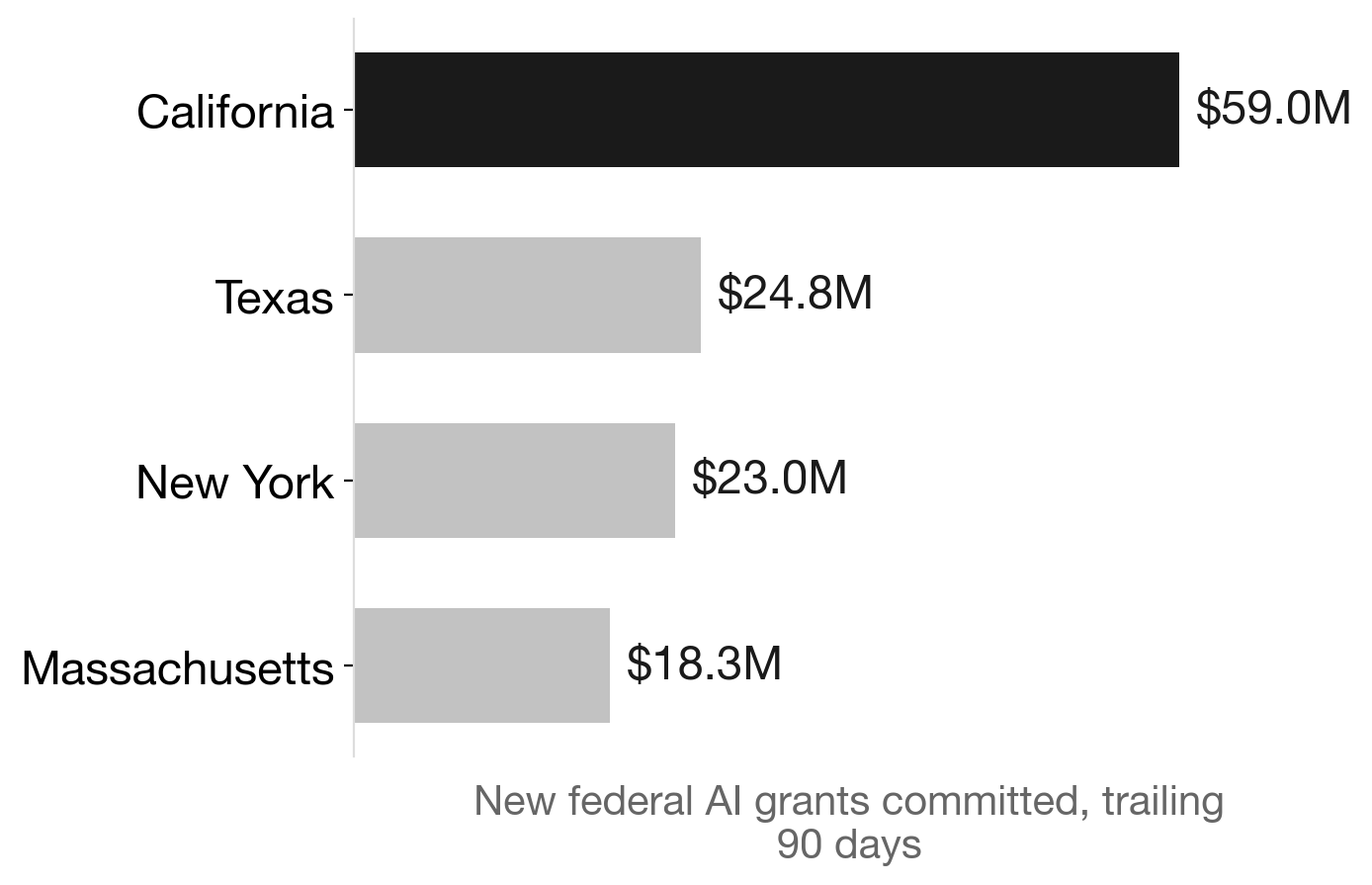
That 99 percent increase puts Texas at number two nationally in AI grant flow for the period, behind California at $59 million and ahead of New York at $23 million and Massachusetts at $18.3 million. No other non-California state is close.
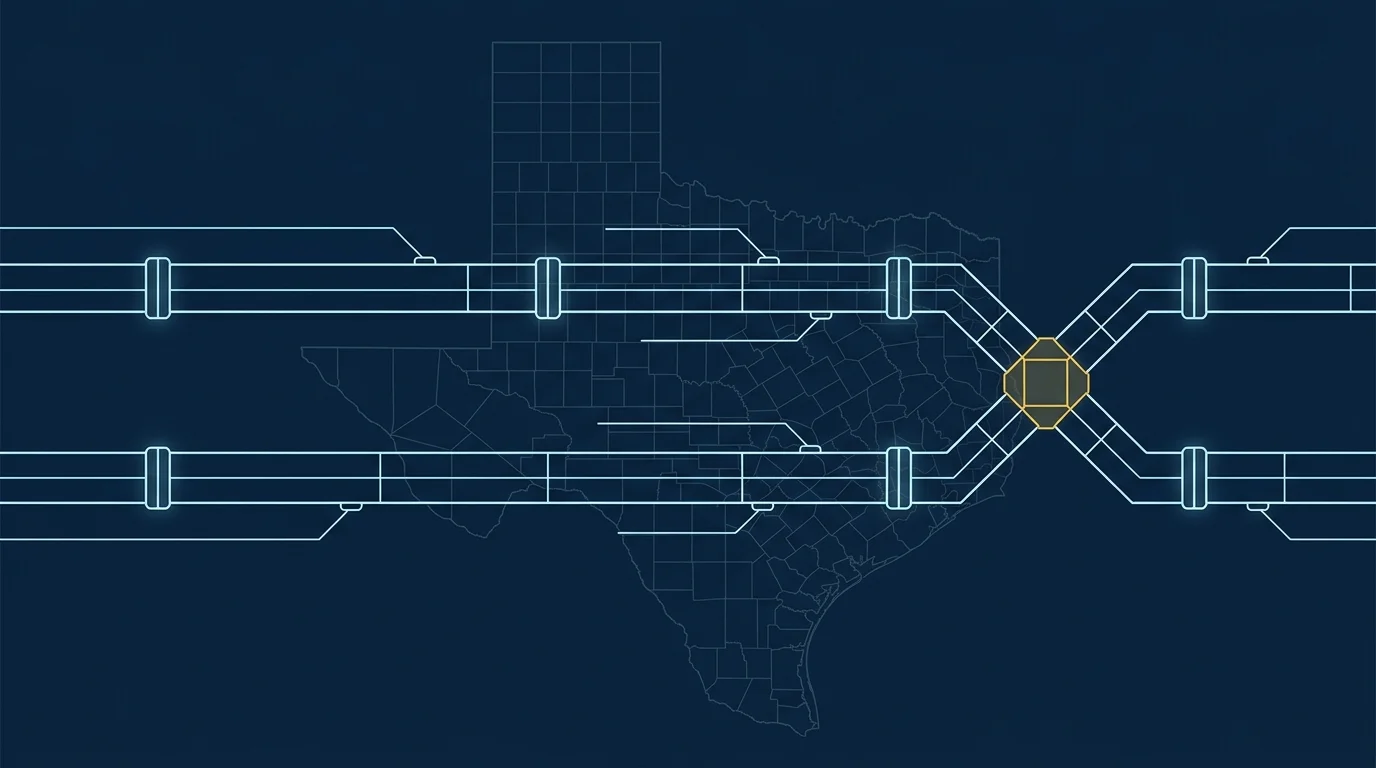
What makes Texas unusual is the structure underneath that number. Most states building research capacity anchor it in a single flagship university. Texas is running two tracks simultaneously: a Tier-1 research engine at UT Austin and a deliberate federal investment in its HBCUs, with Prairie View A&M as the leading example. Those two tracks are now compounding off each other in ways that are accelerating the state's total grant intake.
Source: NationGraph.
The UT Austin track is the older and larger one. NSF's July 2025 $100 million investment in five national AI research institutes renewed UT Austin's Institute for Foundations of Machine Learning for a second five-year phase, this time with a mandate to push generative AI into protein engineering and clinical imaging. The renewal was backed by Capital One and Intel and represented the largest single-day expansion of the program since it launched in 2020. That institute sits on top of a broader research infrastructure: UT Austin ranked first in the nation for NSF research funding in FY2024, drawing $176 million from NSF alone, including $90 million in computer and information sciences. The Texas Advanced Computing Center at UT Austin is also leading the NAIRR national supercomputer consortium, which means Texas is becoming physical AI infrastructure, not merely a grant recipient.
The PVAMU track is newer and, in some ways, the more consequential signal. The $9.86 million DoD award is a follow-on to an $8 million DoD grant Prairie View received in 2024 for AI and big-data analytics research. The explicit goal of the 2026 award is to advance PVAMU toward R1 Carnegie classification, the designation reserved for universities with the highest research activity. An HBCU earning R1 status would be rare. An HBCU earning it on the back of Pentagon AI funding, with a stated mandate to produce national-security talent, would be rarer still.
Legislation moving through Congress would accelerate that trajectory. Rep. Valerie Foushee introduced the HBCU Artificial Intelligence Research Leadership Act on February 27, 2026, which would require that 10 percent of NSF AI Institutes be operated by or formally partnered with HBCUs. If enacted, that provision would create a structural floor for institutions like PVAMU in every future NSF AI Institute competition, not just the current cycle.
NSF accounts for 19 of the 25 new Texas awards in the 90-day window, totaling $10.9 million, spread across smaller grants to research teams across the state. DoD contributed $9.9 million, almost entirely the PVAMU award. The Department of Energy added $2.9 million, directed to the University of Houston. That distribution matters: it means the doubling of Texas AI grant flow is not driven by a single agency's budget cycle. It reflects coordinated investment from three separate federal funders with different mission priorities.
Texas carries an active AI grant portfolio of 244 grants worth $755.7 million in total obligations, of which $265 million has already been disbursed. The new 90-day commitments are arriving on top of a research infrastructure that is already operational and staffed, which means the marginal impact of each new dollar is higher than it would be in a state building from scratch.
The state's operating environment reinforces the dynamic. Texas has no income tax, an energy grid that tech companies prize for large-scale compute, and a legislature that has not moved to restrict AI research. Federal dollars flowing into university labs face fewer downstream obstacles than in states where regulatory uncertainty is higher.
For researchers, graduate students, and institutions watching where federal AI funding is concentrating, the next signal to watch is the HBCU AI Research Leadership Act's progress through committee. If it advances, PVAMU's trajectory from regional HBCU to Pentagon-funded R1 AI research institution stops looking like an outlier and starts looking like a template.