Oregon's federal transit-category grants totaled $396 million in the trailing 90 days, a 159% jump over the $153 million in the same window last year. Strip out one award and the underlying numbers look ordinary. The $362.7 million Bridge Investment Program grant obligated to ODOT on September 24, 2026, accounts for roughly 91% of that surge, and it has nothing to do with buses or light rail. It is the moment a bridge that has been planned, studied, litigated, and deferred for the better part of two decades finally converted paper commitments into construction money.
The unlock was a long time coming. FHWA and FTA issued a joint Amended Record of Decision on July 1, 2026, completing the National Environmental Policy Act review for the Interstate Bridge Replacement program and clearing Oregon and Washington to move toward contractor selection. That environmental clearance, the finish line of a federal review process that stretched across multiple governors and two collapsed legislative sessions, triggered the final tranche of Bipartisan Infrastructure Law funding. The BIP grant, described by Senators Wyden and Merkley as the largest Bridge Investment Program award in the country for any single applicant, carries a performance period running through 2035.
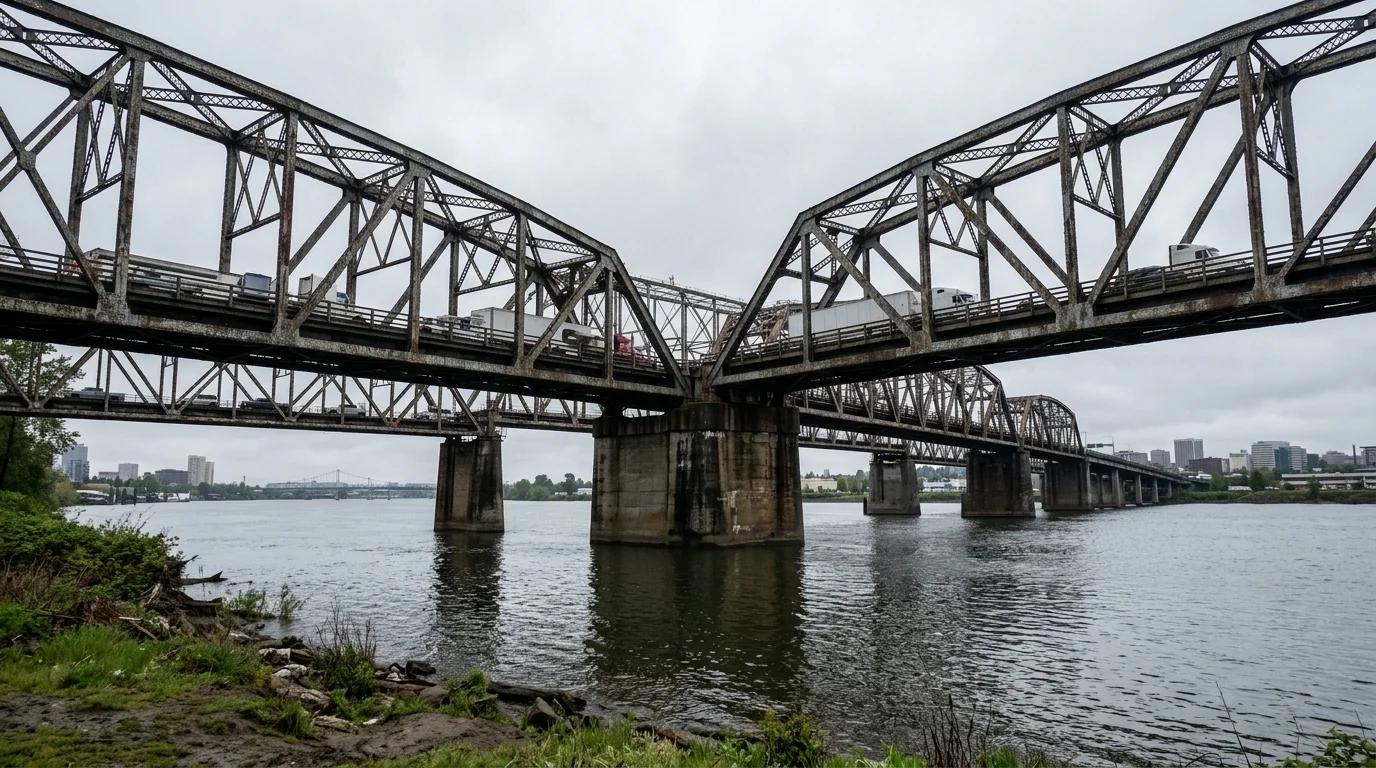
The I-5 crossing it will help replace is not an abstraction. The existing spans, built in 1917 and 1958, carry 140,000 vehicles and an estimated $132 million in goods daily between Portland and Vancouver, Washington. Engineers have rated it among the most seismically vulnerable critical infrastructure links on the West Coast. The IBR program issued its construction request for qualifications for the Columbia River Bridge Replacement on August 17, 2026, meaning contractor selection is now underway in parallel with the federal funding obligations piling up.
The $362.7 million is not the first federal money the project has attracted, but it is the piece that signals construction is imminent rather than theoretical. A $600 million Mega Grant arrived in December 2023 under the Bipartisan Infrastructure Law's National Infrastructure Project Assistance program, followed by a $1.49 billion Bridge Investment Program award announced in 2024. Total federal commitments to the IBR now stand at roughly $2.5 billion. The project's full cost is estimated at $13.5 to $15.2 billion; approximately $5.7 billion in state, federal, and future toll revenues is currently secured. Oregon's own state budget shortfall, flagged publicly by ODOT, means federal BIP and Mega funding are doing the majority of the capital heavy lifting for this first construction phase.
What the number does not yet represent is light rail. The IBR's bridge components are being built light-rail-ready, but the actual light rail extension connecting Portland's MAX system to Vancouver requires a separate, roughly $1 billion FTA Capital Investment Grant that is not expected until approximately 2030. Light rail service, if the CIG is awarded on schedule, is projected to begin no earlier than 2036. The BIP grant and the future CIG are distinct federal competitive programs targeting different components of the same corridor; the bridge construction money flowing now does not accelerate the rail timeline.
Beyond the IBR signal, Oregon's active transit grant portfolio tells a steadier story. ODOT holds a $39 million Low-No Emissions grant for TriMet bus fleet replacement, active through 2028. An Enhanced Mobility for Seniors and Individuals with Disabilities program has roughly $25 million in active grants statewide. The trailing 90-day window also included $4.8 million in FTA Section 5339 Buses and Bus Facilities competitive grants to ODOT for fleet replacement across smaller Oregon operators, $3.6 million in formula grants to Metro and the Portland region, $3.3 million to Corvallis, and $1.2 million to Josephine County. ODOT is also running a parallel Competitive Transit Grant cycle worth up to $25 million for bus procurement and operations statewide. That activity is real and ongoing; it is simply invisible against the scale of a single megaproject grant.
Oregon trails only California among western states in trailing-90-day transit grant volume, but the comparison is misleading in the other direction: California's $683 million reflects dozens of competitive and formula awards distributed across transit agencies statewide. Oregon's figure is essentially one project, one applicant, one environmental milestone finally reached.
The next signal to watch is the outcome of the Columbia River Bridge Replacement construction RFQ, which will determine which firms are shortlisted to build the new spans. After that, the IBR program's ability to close the roughly $7.8 to $9.5 billion gap between secured funding and total project cost will depend on future federal appropriations, toll revenue projections, and ultimately whether Congress and USDOT treat the remaining BIP allocations and the CIG application as priorities when Oregon comes back for more.