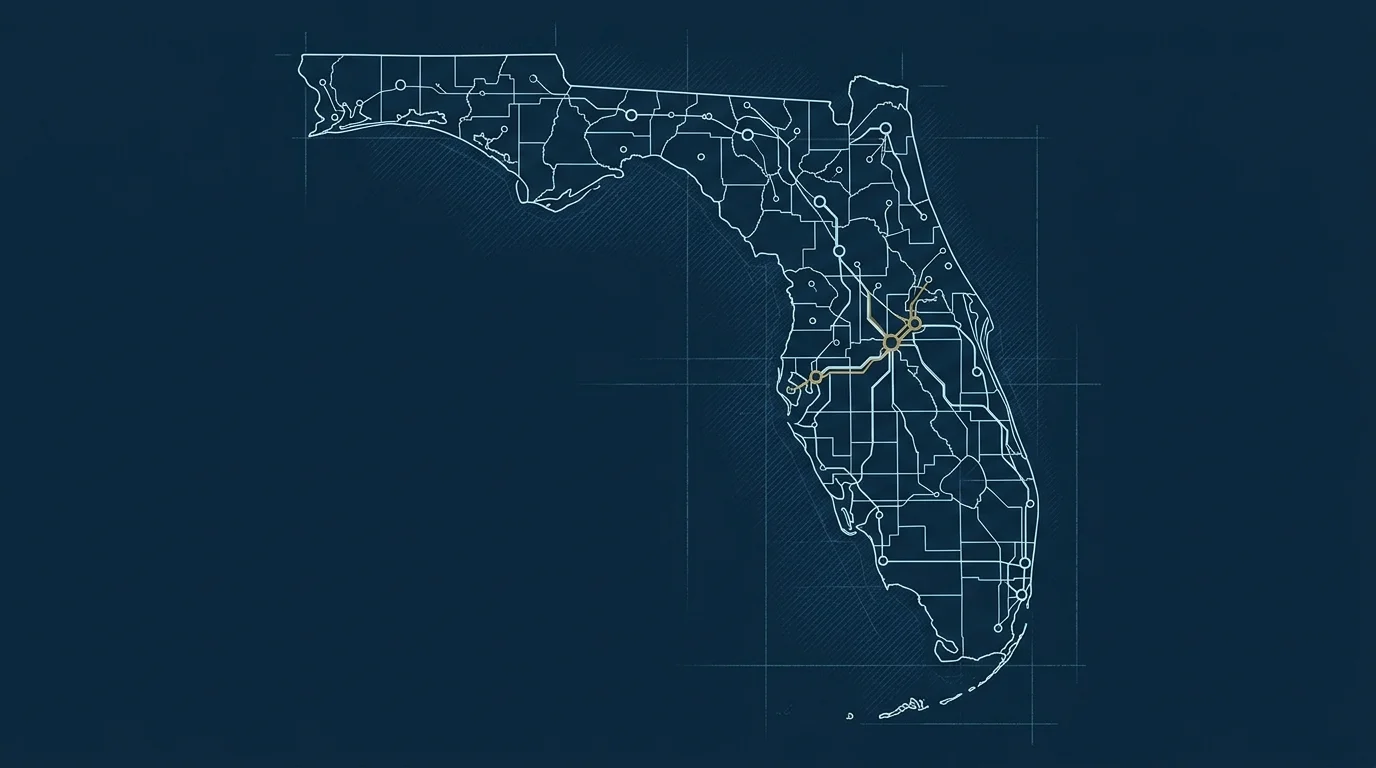
Florida issued 28 pickleball-related construction RFPs in the trailing 30 days through mid-November 2026, against a 12-month monthly average of 9.2, a threefold spike driven by 23 distinct agencies across more than 20 counties. The geography alone signals something more systematic than a recreation fad: Monroe and Escambia counties, Fort Myers and Taylor County, Orange and Sumter, rural Gulf County and suburban Lake Wales all moved in roughly the same 30-day window.
The explanation is bureaucratic, not athletic. Florida's Recreation Development Assistance Program, the state's primary competitive grant for outdoor recreation, closes its application window on September 30 every year. Awards follow in the fall. Municipalities that apply and receive notice of a likely FRDAP award must move quickly to procurement, their grant timelines demand it. The result is a compression of RFP activity into October and November, predictably, year after year. The same pattern appeared in March 2026 (24 RFPs) and May 2026 (20 RFPs), tracking earlier award cycles through the pipeline.
FRDAP, administered by Florida DEP's Land and Recreation Grants Section, caps awards at $200,000 per project, modest by construction standards, but enough to fund a basic multi-court installation in a small municipality. Taylor County's Southside Park pickleball court is explicitly described in county records as 100% FRDAP-funded, with the county having opened bids and named a bid committee this fall. Lake Wales applied for the full $200,000 in October 2026 to add lighted courts, with the application appearing on the city council agenda the same week neighboring Polk County communities were making similar moves.
For larger projects, FRDAP is a floor, not a ceiling. Fort Myers is pursuing a $1.5 million federal Land and Water Conservation Fund grant, a separate federal program, also administered through DEP but funded by offshore oil and gas lease revenue, with no fixed per-project cap, to build a 14-court complex in the Forum neighborhood. The city council advanced those plans with a December 2025 grant application, putting Fort Myers on a different funding timeline than the FRDAP cohort. LWCF grants for outdoor recreation newly started in Florida in FY2026 total at least $7.58 million across multiple DEP subawards, a secondary channel that runs on its own award schedule and requires a local match.
A third funding stream is in play for coastal communities. Franklin County is building pickleball courts across St. George Island, Carrabelle, and Apalachicola using Tourist Development Council funds, the local bed tax collected from visitors. A recent change in Florida statute now allows fiscally constrained coastal counties to redirect TDC dollars toward infrastructure, a category that now includes sports courts. This is a local levy, not a state or federal program, and it operates on the county's own budget cycle rather than any external grant deadline. For tourism-dependent small counties, it offers a path that doesn't require competing against larger municipalities for capped state grants.
These three mechanisms, FRDAP, LWCF, and TDC funds, have different eligibility rules, funding sources, and timelines, but they converge on the same output: publicly funded pickleball courts scattered across a state that already leads the country with 1,071 court locations. National pickleball participation reached 24.3 million players in 2025, a 171% increase over three years. Florida's retiree population, year-round outdoor climate, and sports-tourism economy mean local officials face constituent pressure from multiple directions simultaneously: residents who want courts near their homes, convention bureaus seeking tournament venues, and community redevelopment districts that have identified pickleball as a foot-traffic anchor.
What makes the current surge structurally different from a demand-driven wave is its concentration in time. Demand for courts has been building for years; the October RFP spike is specifically the product of a hard deadline. Agencies that miss the September 30 FRDAP window wait another full calendar year for the next application cycle. That is real money left on the table, $200,000 that a small rural county can't easily replace from its general fund.
The next signal to watch is FRDAP award announcements, which DEP typically releases in the late fall or early winter following the September close. Projects that receive awards will move to formal bidding and contract execution in the first quarter of 2027. Those that don't will face a decision: find alternative funding, wait for the next September window, or drop the project. For the 23 agencies that issued RFPs this October, the award list will determine how many of those courts actually break ground.