California public agencies issued 58 EV charging RFPs in October 2026 alone, 3.7 times the trailing 12-month average of roughly 15.6 per month. The state's October volume is four times that of Washington, the next-highest state at 14 RFPs, and dwarfs New York (10), Colorado (9), and Texas (1) over the same window. The numbers don't describe a single program rolling out. They describe a system-wide unlock.
The unlock has a specific date. On September 20, 2026, Governor Newsom signed a six-bill package that streamlined EV charger permitting across California. The most consequential of the six, SB 1283, authored by Senate Majority Leader Angelique Ashby, extended California's existing fast-track permitting rules to cover the work that had been the real bottleneck: trenching, electrical panel upgrades, solar canopies, and battery storage. Under prior law, the charger itself could move quickly through permitting while the conduit going into the ground sat in a separate, slower queue. SB 1283 collapsed that distinction. The package took effect immediately upon signing.
The timing collided with something else. On October 7, 2026, the California Energy Commission opened the first DC fast-charging funding window under its CALeVIP incentive program, offering up to $100,000 per port and covering 100 percent of eligible installation costs. That window closes January 14, 2027. For local agencies that had been waiting for the right moment, October delivered both conditions at once: the red tape was gone and the application clock was running.
The money behind that moment is substantial. The CEC announced a $95.2 million ZEV infrastructure investment in August 2026, including $55.2 million channeled specifically through CALeVIP for DC fast-charging. That state appropriation sits alongside a much larger federal portfolio: California holds roughly $961 million in active EPA grants tied to EV and zero-emission vehicle infrastructure, anchored by a $499.9 million Climate Pollution Reduction Grant to the South Coast Air Quality Management District and a $322.2 million Clean Ports Program grant to the Port of Oakland. The Department of Transportation has added another $75.3 million in active EV charging grants, including $54.6 million to LA Metro through the Federal Transit Formula program. Much of that federal money disburses through sub-awards, which means local agencies are the ones doing the actual procuring.
What the permitting bills did was separate from what any of those grants do. The grants provide capital. The bills reduce the friction that prevented capital from becoming installed hardware. California had, by most measures, already committed the money. The chargers were not keeping pace. The October RFP surge is the most visible sign yet that the two problems were solved in the same month.
The breadth of agencies issuing RFPs reinforces that reading. The California Energy Commission led all issuers with five RFPs in the past 30 days, but the volume behind it came from an unusually wide field: East Palo Alto (four RFPs), UCSF (three), Pasadena Water and Power (three), along with transit districts, school districts, open-space districts, and a military department. Coachella and the Midpeninsula Regional Open Space District both appear in the data. This is not a coastal-corridor phenomenon or a single agency's procurement cycle.
The broader market context helps explain why local officials are moving quickly rather than waiting. ZEV sales in California reached 19.1 percent of new vehicle registrations in Q2 2026, a 3.3-point jump from the prior quarter, partly driven by gasoline price spikes. California already has more than 216,000 public and shared charging plugs statewide, including over 20,000 DC fast-charge ports, but EV adoption at that pace puts pressure on charging ratios in ways that agencies are increasingly required to address in capital plans.
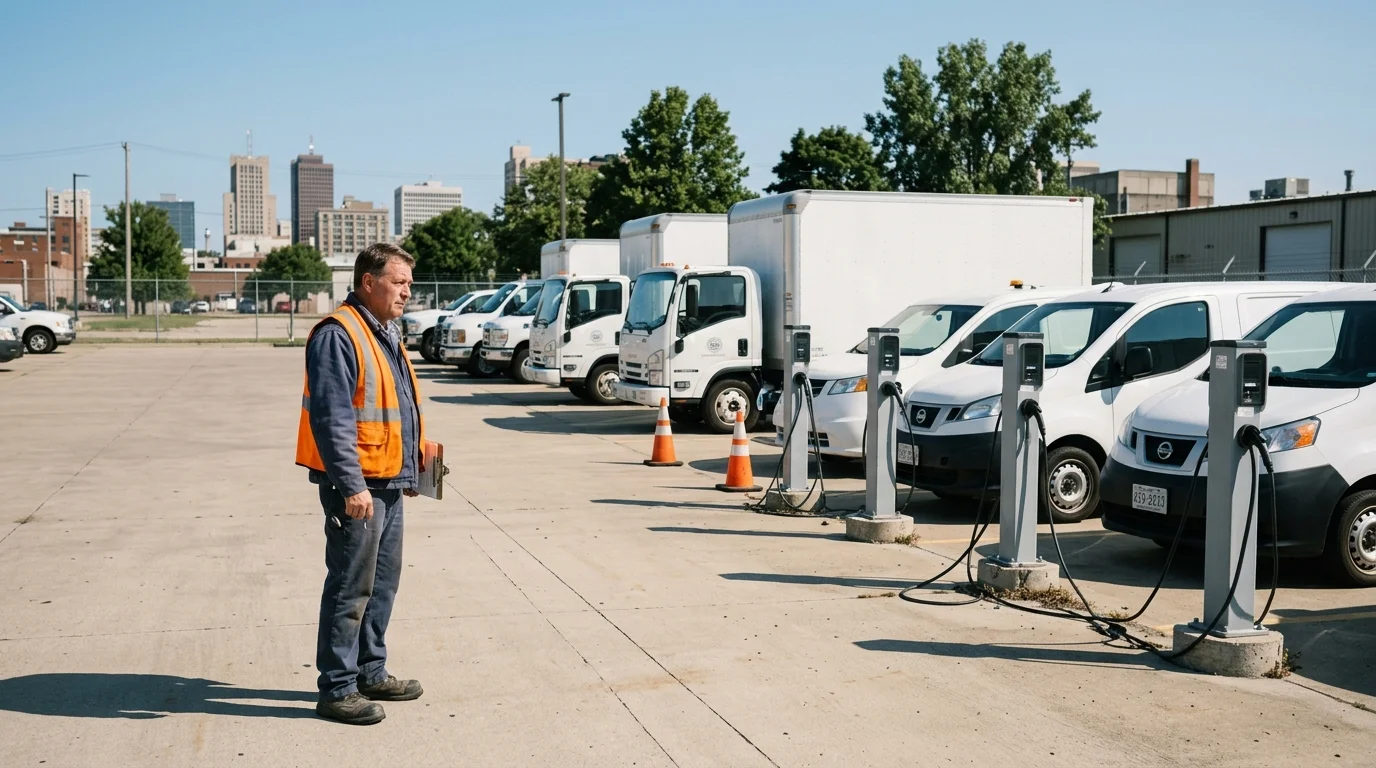
What changes for someone living in California is less abstract than it might seem. School districts procuring chargers create infrastructure that doubles as community charging during off-hours. Water and utility districts adding chargers to their yards electrify fleets that run routes through neighborhoods. The procurement wave now underway will determine which gaps in the existing charging network get filled before the next funding cycle, and which don't.
The next signal to watch is the CALeVIP window itself. Applications close January 14, 2027, and the CEC has not indicated whether a subsequent DC fast-charging round will follow immediately. Agencies that issued RFPs in October are racing to select vendors, finalize contracts, and submit applications before that date. How many of the 58 RFPs convert to funded, permitted projects by mid-January will be the first real measure of whether the permitting overhaul did what its authors intended.