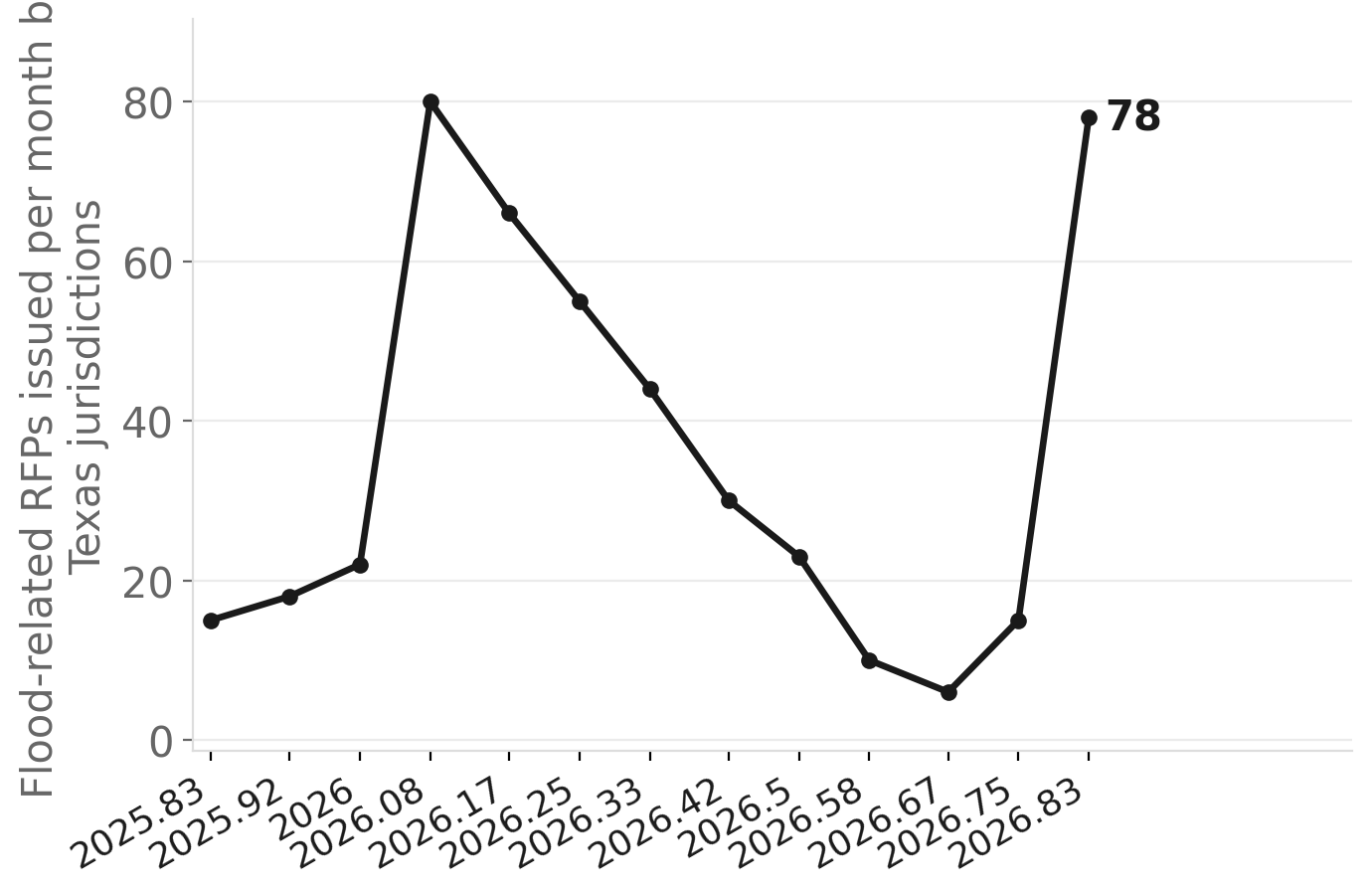
Texas jurisdictions issued 78 flood-control procurement solicitations in October 2026, nearly three times the trailing 12-month monthly average of about 27.5. The surge is not broad-based activity. It is a timed response: communities have fewer than three weeks to position for $92 million in federal block grant money that disappears on November 18 if unspent, and they are doing it after watching the same river valley flood catastrophically in consecutive summers.
The acute trigger is the GLO's Mitigation Reallocation Program, launched October 19 by Commissioner Dawn Buckingham. The MRP draws from deobligated HUD Community Development Block Grant for Mitigation funds and makes $92 million available to cities, counties, and special districts in CDBG-MIT-eligible counties. The November 18 application deadline cannot be extended. HUD has set statutory closeout dates for the entire CDBG-MIT program, and any funds not committed by that date are returned to the federal government. That is the "spend it or lose it" dynamic visible in October's RFP titles, many of which explicitly reference "CDBG-HAZ-MIT" and "GLO CDBG-DR" in their scope descriptions.
The MRP is one of three distinct programs converging on the same calendar window, and they should not be read as a single federal initiative. The Texas Water Development Board's 2026-2027 Flood Infrastructure Fund, a state appropriation funded by Texas voters, is offering roughly $312 million in grants and 0% interest loans for flood mitigation projects that appear in approved Regional Flood Plans. FEMA's Flood Mitigation Assistance program, a separate federal grant administered through the TWDB and focused on reducing claims against the National Flood Insurance Program, added $49.5 million for Texas in April 2026. Each program runs on a different statutory authority, different eligibility criteria, and a different application process. The October procurement spike reflects all three pipelines requiring contractor relationships and project documentation simultaneously.
Source: NationGraph.
Harris County is the single largest source of October volume: 14 of the 78 RFPs, or 18 percent of the total, originated from the Harris County Flood Control District. That is consistent with HCFCD's role as a direct HUD CDBG-MIT recipient with a $546 million allocation, the largest in Texas and one of the largest in the country. HCFCD runs a near-continuous procurement cycle regardless of external deadlines; in a month when other jurisdictions are also racing to procure, Harris County's baseline volume amplifies the statewide count. Galveston, Walker, and Rockwall counties each contributed three to four RFPs of their own.
The political urgency behind all of this procurement did not arrive with Commissioner Buckingham's October announcement. It arrived on the Guadalupe River. The July 2025 Hill Country flood killed more than 130 people, caused $1.1 billion in damage, and exposed the absence of a flood warning system in Kerr County. Twelve months later, the same corridor flooded again, killing two people and damaging more than 490 homes across 20 counties in a single event. That second flood, in July 2026, generated its own federal disaster declaration and unlocked FEMA Hazard Mitigation Assistance flows to Kerr County, including $644,000 in emergency measures approved in October. It also generated the kind of sustained political pressure that makes November 18 feel, to local officials, like a hard floor rather than a bureaucratic formality.
The month-by-month procurement data captures the pressure cycle clearly. RFPs spiked to 80 in February 2026, likely reflecting post-disaster planning activity from the 2025 floods, then plateaued in the mid-forties to mid-sixties through spring. Volume collapsed between June and September, dropping as low as six in a single month, as jurisdictions waited for funding cycles to open. October's resurgence to 78 is not a continuation of the spring plateau. It is a convergence: a hard federal deadline, an open state loan program, and a community of engineers, planners, and county commissioners who have watched the same valley flood twice.
For communities still weighing whether to apply for MRP funds, the window is closing. The November 18 deadline applies to applications, not to project completion, but applicants need scopes of work, cost estimates, and in many cases executed contractor agreements to submit credible proposals. That is precisely what a procurement solicitation produces. The RFP volume in October is, in that sense, a leading indicator of how many Texas jurisdictions intend to be in the queue before the federal government closes it.
The next signal to watch is how many of October's 78 solicitations convert into awarded contracts before the MRP deadline, and whether the TWDB's Flood Infrastructure Fund cycle produces a secondary procurement surge when its own awards are announced in early 2027.