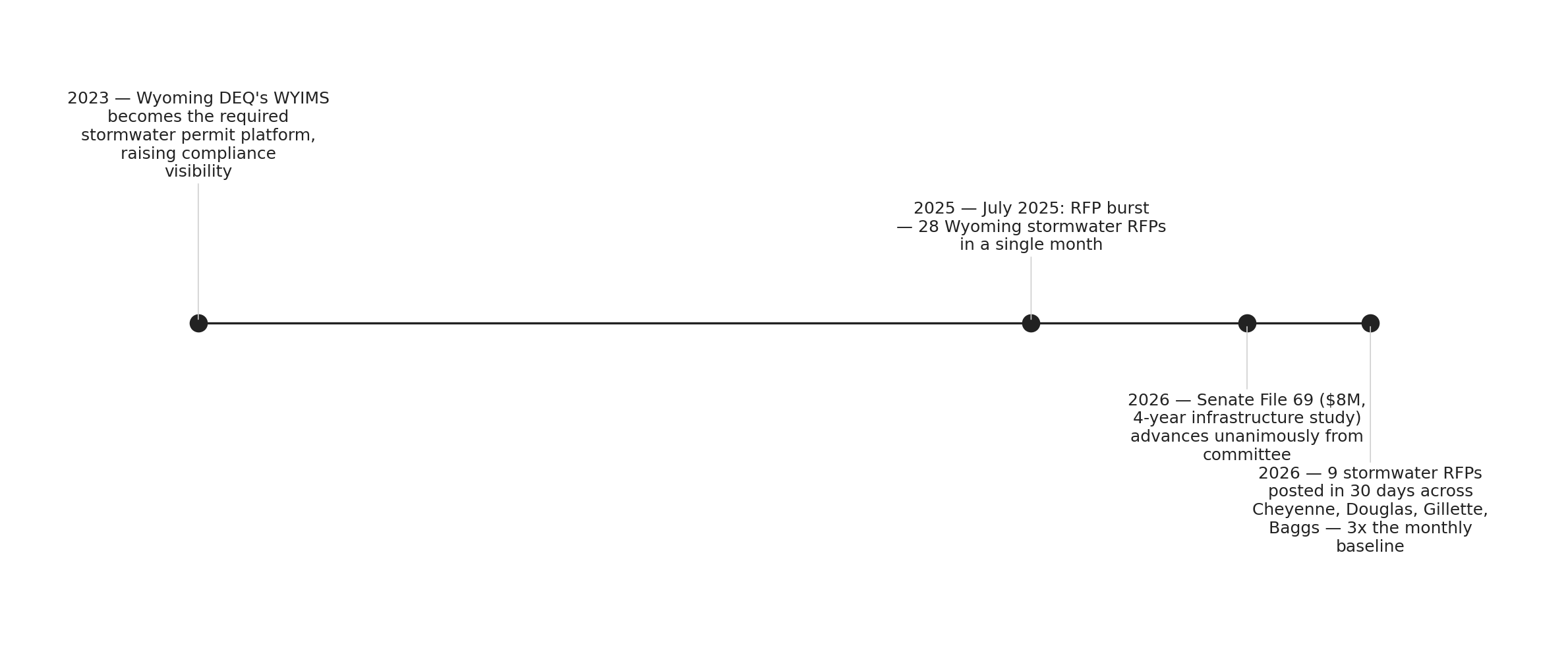
Wyoming municipalities issued 9 stormwater management RFPs in the last 30 days, three times the monthly average of roughly 3, as cities scramble to assess aging pipes before a state-mandated inventory deadline forces their hand.
The spike is concentrated across four cities in four counties: Cheyenne, Douglas, Gillette, and the Baggs Solid Waste Disposal District. That geographic spread matters. This is not one large city driving a single capital program. It is smaller municipalities, spread across the state's eastern and central corridors, all moving toward procurement at roughly the same moment.
Three things happened in early 2026 that explain the timing.
Source: NationGraph.
First, Wyoming Senate File 69, the "Waste and Storm Water Infrastructure Study," advanced unanimously out of the Senate Agriculture Committee in February with an $8 million appropriation and a July 1, 2026 effective date. The bill funds a four-year statewide study of wastewater and stormwater systems and will require municipalities to submit infrastructure data. As Wyoming Association of Municipalities Executive Director Ashley Harpstreith told WyoFile, most municipal water infrastructure was built 40 to 60 years ago, is "operating far beyond its intended lifespan," and statewide upgrades could cost billions. A city that hasn't mapped its own system can't answer a state data request. Hiring consultants now, before July 1, is the rational response.
Second, the EPA announced $406,000 for Wyoming in April 2026 from its $80 million national Sewer Overflow and Stormwater Reuse Municipal Grant program. The dollar figure is modest, but the timing is not coincidental. Federal water grants routinely arrive with compliance conditions and reporting requirements that accelerate local procurement. Wyoming currently carries roughly $298 million in active federal water infrastructure grants across 74 separate awards, a platform large enough that new money arrives with institutional expectations already in place.
Third, and most politically volatile, Senate File 116 would have required voter approval before Wyoming cities could impose stormwater fees. It passed the Senate, was recalled, and was voted down, but not before the Wyoming Chamber of Commerce formally entered the debate and Cheyenne's and Laramie's existing stormwater fee programs were referred to the Select Water Committee for interim review at a May 7, 2026 meeting. The fee fight sent a clear signal to every Wyoming municipal finance director: the revenue stream that would normally pay for stormwater capital programs is politically contested, and the window to act under existing authority is not guaranteed to stay open.
The combination is a classic squeeze. The state is about to require data you don't have. Federal dollars are available but come with strings. And the local fee mechanism that would fund long-term operations is under legislative review. Issuing RFPs now, before July 1, is how a small city gets ahead of all three at once.
Wyoming's fiscal geography makes this particularly acute. The state is among the most sparsely populated in the nation, and its cities have small per-capita tax bases. They depend heavily on state and federal funding for capital infrastructure, which means they are unusually exposed when that funding arrives attached to compliance requirements. A city of 30,000 cannot easily absorb the cost of a stormwater system assessment out of general fund revenues in a single budget cycle.
The procurement surge also has a precedent in the data. RFPs spiked to 28 in July 2025, bracketing last year's legislative session, then fell back through winter. The current May-June 2026 resurgence mirrors that shape: municipalities appear to accelerate when state or federal action creates new mandates or funding clarity, then slow when the immediate trigger passes. The July 1 effective date of Senate File 69 is the next hard stop on the calendar.
For residents in Cheyenne, Douglas, Gillette, and smaller communities across Wyoming, the practical meaning is that consultants are being hired now to walk aging stormwater infrastructure and produce condition assessments. Those reports will feed into the state study, inform future capital budgets, and almost certainly surface deferred maintenance that will require either new fee authority or additional state and federal grants to address. The stormwater fee question that Senate File 116 tried to settle has been handed to the Select Water Committee. Whatever that committee recommends will shape how Wyoming cities are allowed to pay for what these assessments find.
The next signal to watch is the Select Water Committee's recommendations on stormwater fee authority, expected before the 2027 legislative session, and whether the municipalities currently issuing RFPs return with capital project bids once assessment results are in hand.