
Scientists at the University of Illinois at Urbana-Champaign are engineering a new variety of corn that could resolve one of American energy policy's most stubborn contradictions: ethanol sold as a climate solution but grown with fertilizers that pump a powerful greenhouse gas into the atmosphere.
The university has received a $4.75 million grant from the Department of Energy's Advanced Research Projects Agency-Energy (ARPA-E) to develop what researchers are calling NSAVE maize, short for N2O Suppression and Ammonium Availability Enhancement. The goal is to cut nitrous oxide emissions from corn fields by more than 50 percent without reducing crop yields.
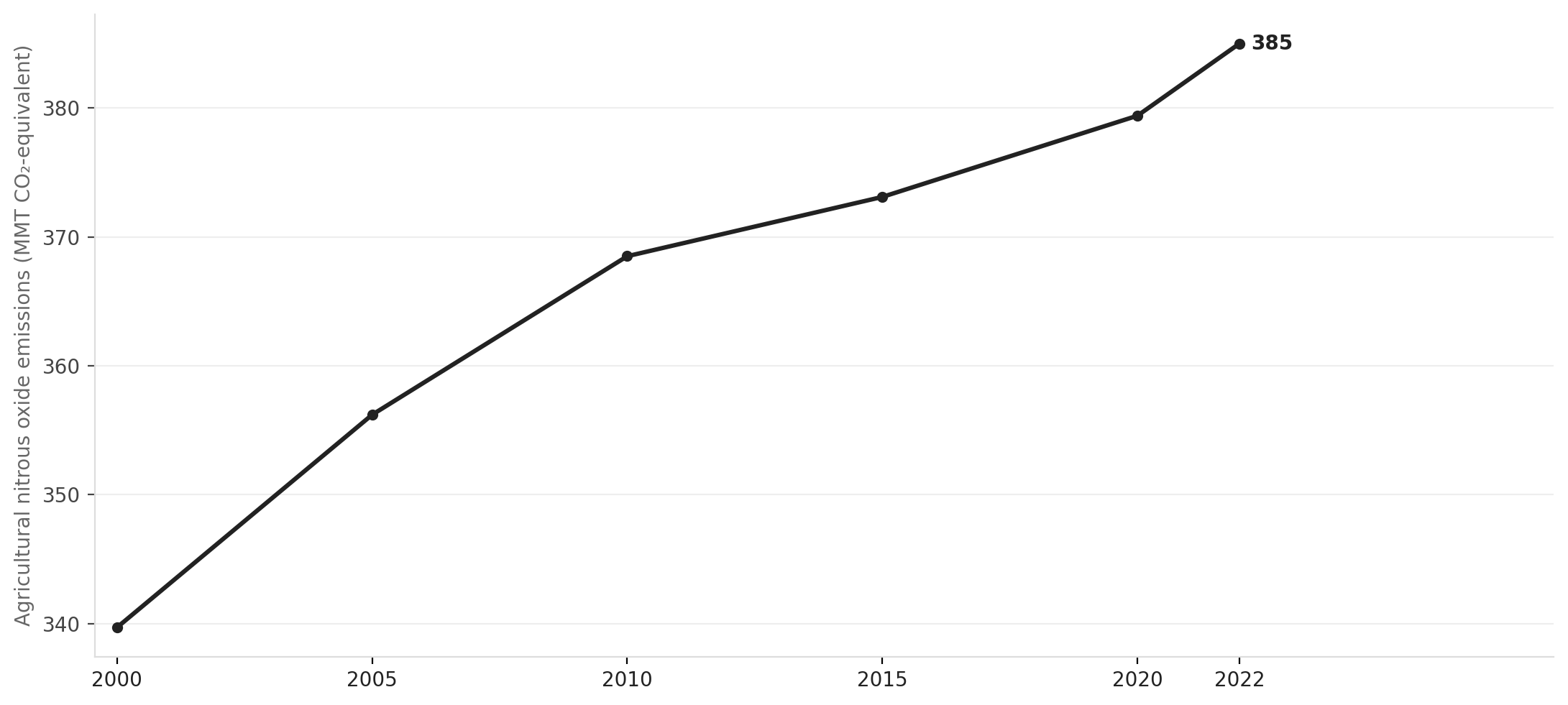
Nitrous oxide is the problem hiding inside the ethanol promise. When farmers apply synthetic nitrogen fertilizer to corn, soil microbes convert a portion of it into nitrous oxide, a greenhouse gas roughly 265 times more potent than carbon dioxide over a century. Agriculture accounts for about 74 percent of U.S. nitrous oxide emissions, and the massive expansion of corn ethanol under federal renewable fuel mandates has only made things worse. A landmark 2022 study in the Proceedings of the National Academy of Sciences concluded that corn ethanol's full lifecycle emissions, once agricultural nitrous oxide is properly counted, may be comparable to or worse than gasoline. The ethanol industry disputed those findings, but the underlying nitrogen problem has never gone away.
Source: NationGraph.
Illinois sits at the center of this tension. The state produces roughly 2 billion bushels of corn annually across about 11 million acres and operates more than 13 ethanol plants with a combined capacity exceeding 1.8 billion gallons per year. Illinois farmers also apply millions of tons of synthetic nitrogen fertilizer each year, making the state one of the largest agricultural sources of nitrous oxide emissions in the country. Nitrogen runoff from those same fields contributes to the Gulf of Mexico's hypoxic dead zone through the Mississippi River watershed.
The UIUC approach stacks three genetic traits in a single corn variety. One causes roots to exude compounds that suppress the soil microbes responsible for the first step in nitrous oxide production. A second inhibits a later conversion step where nitrate is transformed into nitrous oxide. A third, based on a novel mutation of a gene called NRT1.1B, makes the plant itself more efficient at absorbing nitrogen, leaving less in the soil for microbes to work with in the first place. Crucially, preliminary field trials have already shown more than 40 percent reductions in nitrification and nitrous oxide emissions with no yield penalty, giving the project real-world footing before the federal money even arrives.
The grant is part of ARPA-E's TEOSYNTE program, whose name is a deliberate nod to teosinte, the wild ancestor of modern corn, signaling the ambition to fundamentally re-engineer a crop that has been cultivated for thousands of years. The program targets a 50 percent reduction in nitrous oxide from corn and sorghum grown for ethanol, a threshold no agronomic practice has consistently achieved.
The stakes extend beyond climate. Federal clean fuel tax credits that took effect in 2025 reward fuels with lower carbon intensity scores, and Illinois's emerging sustainable aviation fuel industry depends on demonstrating that corn-based feedstocks can meet strict lifecycle emissions thresholds. If NSAVE maize delivers what early trials suggest, it would significantly improve ethanol's competitive position in a fuel economy increasingly organized around carbon accounting.
UIUC now moves into the next phase of developing and testing the stacked-trait variety, with the broader TEOSYNTE program's ambition of a commercializable solution still years away. Whether a genetically modified corn engineered to suppress soil microbes can achieve consistent results across the varied conditions of the Midwest's corn belt remains the central question researchers will need to answer.