California school districts issued 57 school-safety RFPs in the last 30 days, 3.8 times the trailing monthly average, flooding the procurement market with bids for perimeter fencing, school-bus camera systems, and security signage at a pace that dwarfs every other state. Georgia, the next-closest, logged 28 over the same period. Texas had 20.
The surge is not concentrated in one region or triggered by a single local incident. More than 30 distinct agencies across 20-plus counties, from San Joaquin and Sacramento to San Diego and the Bay Area, have issued RFPs in this window. That geographic diffusion points to a statewide policy mechanism at work, and there is one: Proposition 2, the $10 billion school facilities bond that California voters approved in November 2024 with 58.4% of the vote, is now forcing every district's hand at once.
Here is why the timing compresses the way it does. The State Allocation Board approved $745.6 million in Priority Funding Apportionments at its April 29, 2026 meeting, and set a fund-release authorization deadline of July 28, 2026, for those grants. Districts that did not have contracts in place risked forfeiting their apportionments entirely. At the same time, the SAB opened a new Small School District Program modernization application window on November 2, 2026, pulling a second cohort of districts into active procurement mode. Two deadlines, staggered by months, are producing a single visible spike in RFP activity as districts scramble to satisfy whichever window applies to them.
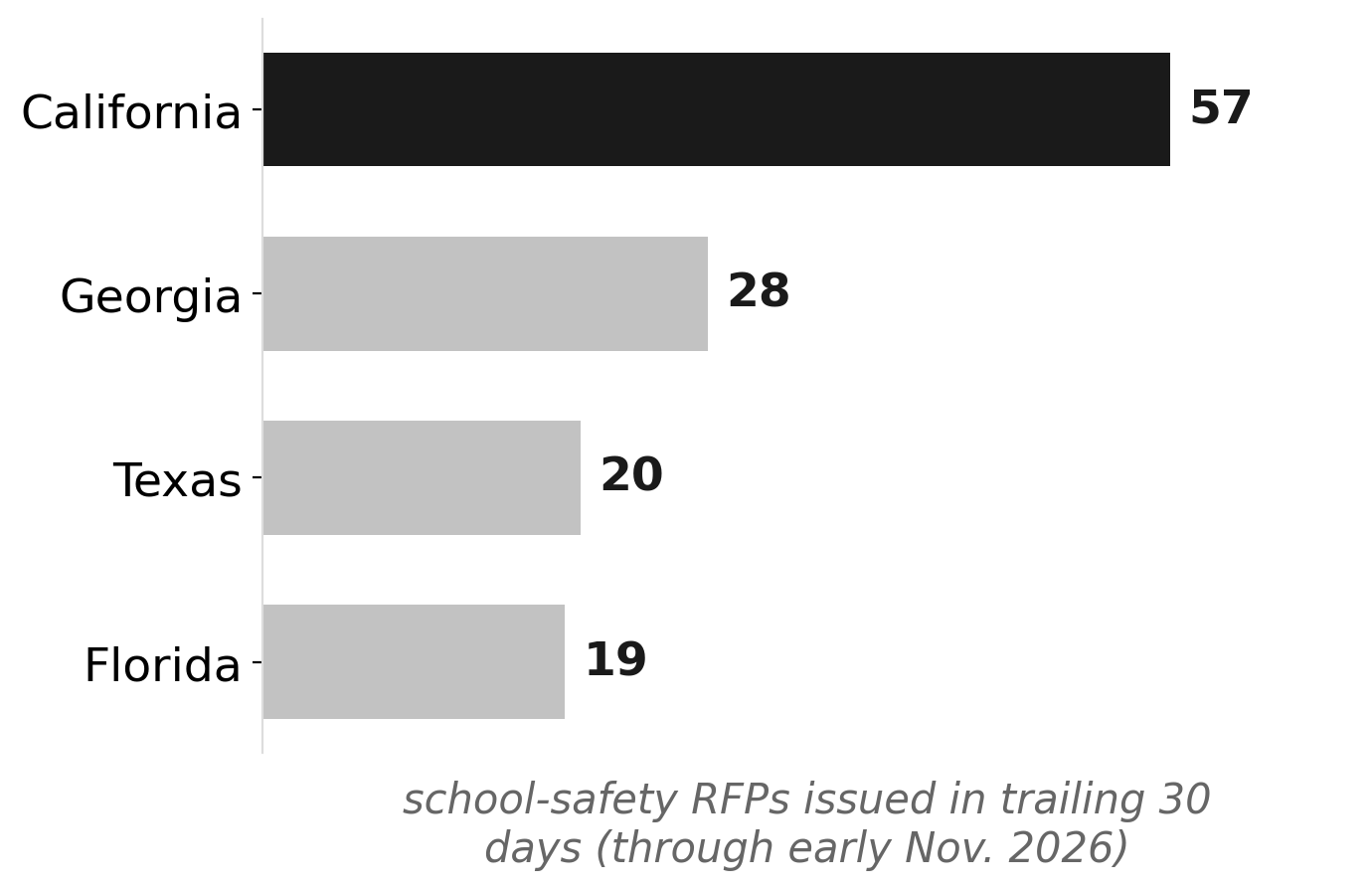
Source: NationGraph.
This is the first significant infusion of state school-facility money since California voters rejected a comparable bond in 2020. Because state and local bonds are the only mechanism for school facilities spending in California, districts that have deferred safety upgrades for years are now converting apportionments into physical contracts as quickly as procurement rules allow. The Public Policy Institute of California has estimated that at least 38% of California K-12 students attend schools that do not meet minimum safety standards, which helps explain why the pipeline of unfunded need is large enough to generate this kind of volume when money finally arrives.
Proposition 2 is the financial engine, but a separate law appears to have sharpened the urgency. SB 848, which took effect January 1, 2026, required districts to adopt written safe-environment and abuse-prevention policies by July 1, 2026, and broadened the definition of mandated reporters. The law does not fund physical upgrades and has no shared mechanism with Proposition 2. What it may have done is push district administrators to audit their physical safety posture at exactly the moment Prop 2 apportionments were coming available, surfacing infrastructure gaps that could now be addressed with bond dollars. The two laws are legally and operationally distinct; California School Boards Association coverage of SB 848 makes clear the compliance burden is primarily administrative, not capital. But the coincidence of a compliance audit cycle with an open funding window is not nothing.
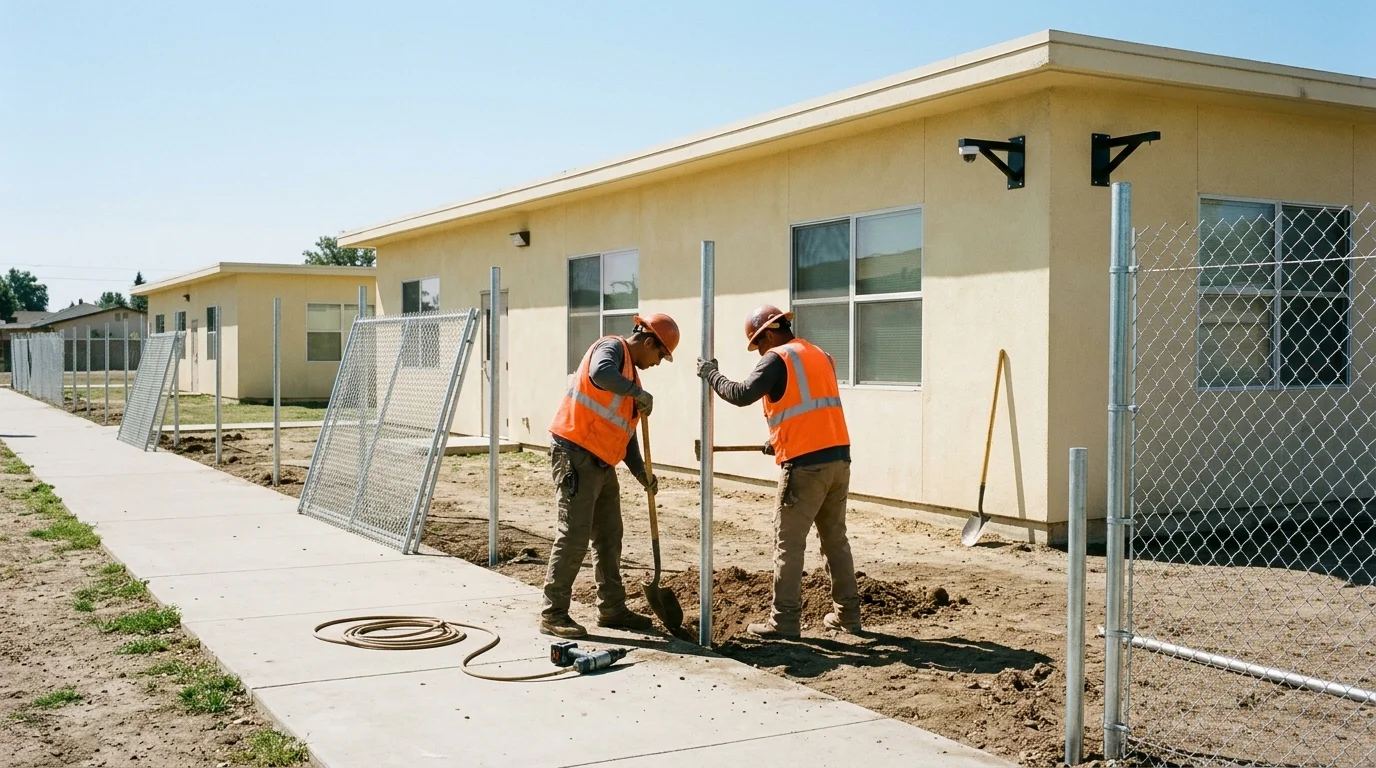
The RFP mix reflects what districts can actually spend Prop 2 money on. The bond authorizes funding for modernization, repair, new construction, and safety infrastructure, administered through the School Facility Program as matching grants. That definition covers perimeter fencing, camera systems, and security signage, which dominate the current RFP wave, as well as lab safety equipment and after-school safety programs under ASES and ELOP. Stockton Unified, San Francisco Unified, Colton Joint Unified, Folsom-Cordova Unified, and Merced County Office of Education are among the most active issuers in this window, each with two or three open solicitations.
For California residents, the near-term effect is visible and local: school construction and security vendors are being asked to bid simultaneously on contracts across dozens of districts, which puts pressure on contractor capacity and could affect bid prices or timelines for districts that move slowly. For districts themselves, the more consequential pressure is bureaucratic. Prop 2 requires a local matching contribution, which means districts that have not already secured local bond authority are racing to demonstrate eligibility while also meeting SAB's documentation and fund-release requirements.
The next marker to watch is whether the November 2 Small School District Program window generates a second RFP surge of its own over the following 60 days. If smaller districts, many of which lack in-house facilities staff, can navigate the application requirements in time, the current 57-RFP month may prove to be the leading edge of a larger wave rather than the peak. Districts that miss this cycle will need to wait for the SAB's next apportionment round, which, given the history of California school-facility funding, may not arrive on any predictable schedule.