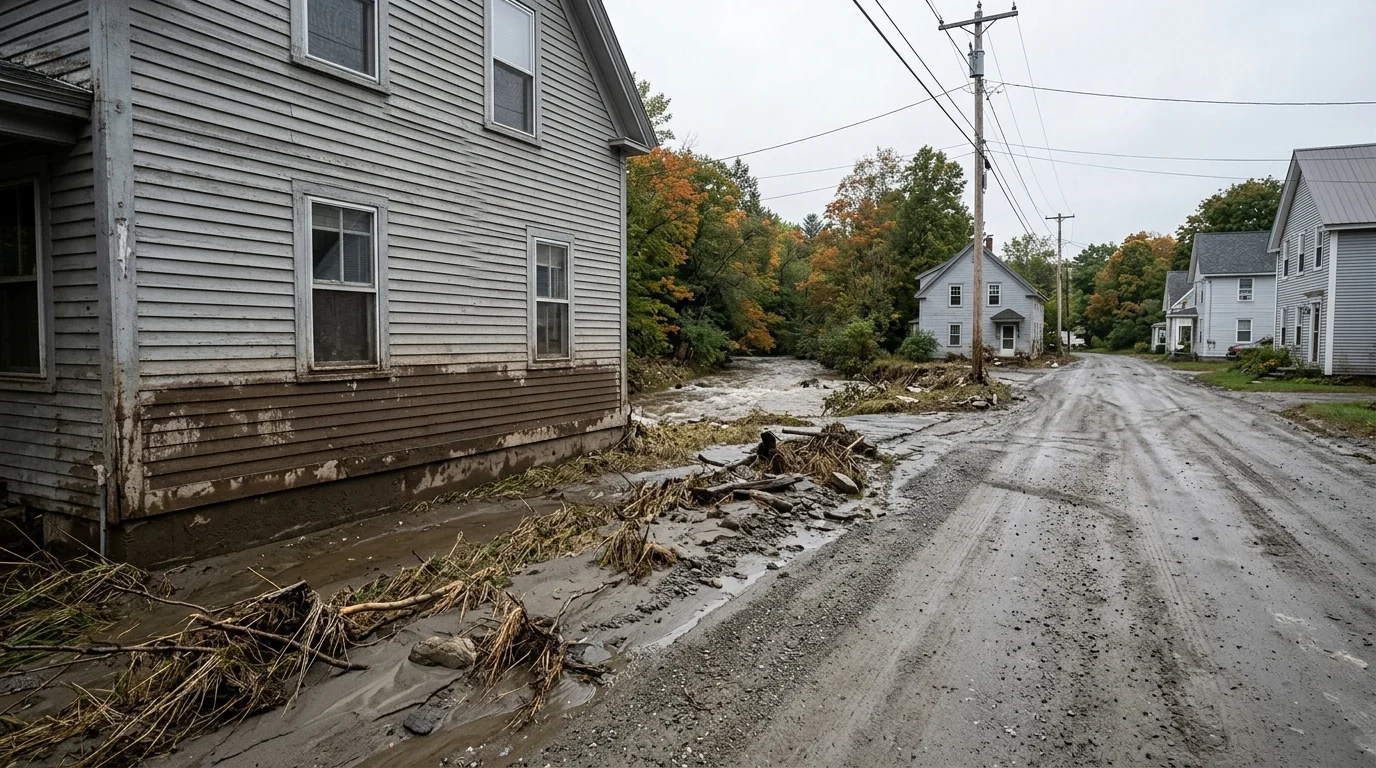
Federal flood control grants to Vermont have surged to $5.37 million in the past 90 days, up from $258,000 in the same window a year ago, a 1,978% increase driven entirely by a single competitive FEMA award. The Vermont Department of Public Safety secured the Flood Mitigation Assistance grant on September 10, 2026, covering a three-year performance period through 2029. The money is earmarked for buildings insured under the National Flood Insurance Program that have flooded repeatedly, a population that has grown sharply after three consecutive years of catastrophic flooding across the state.
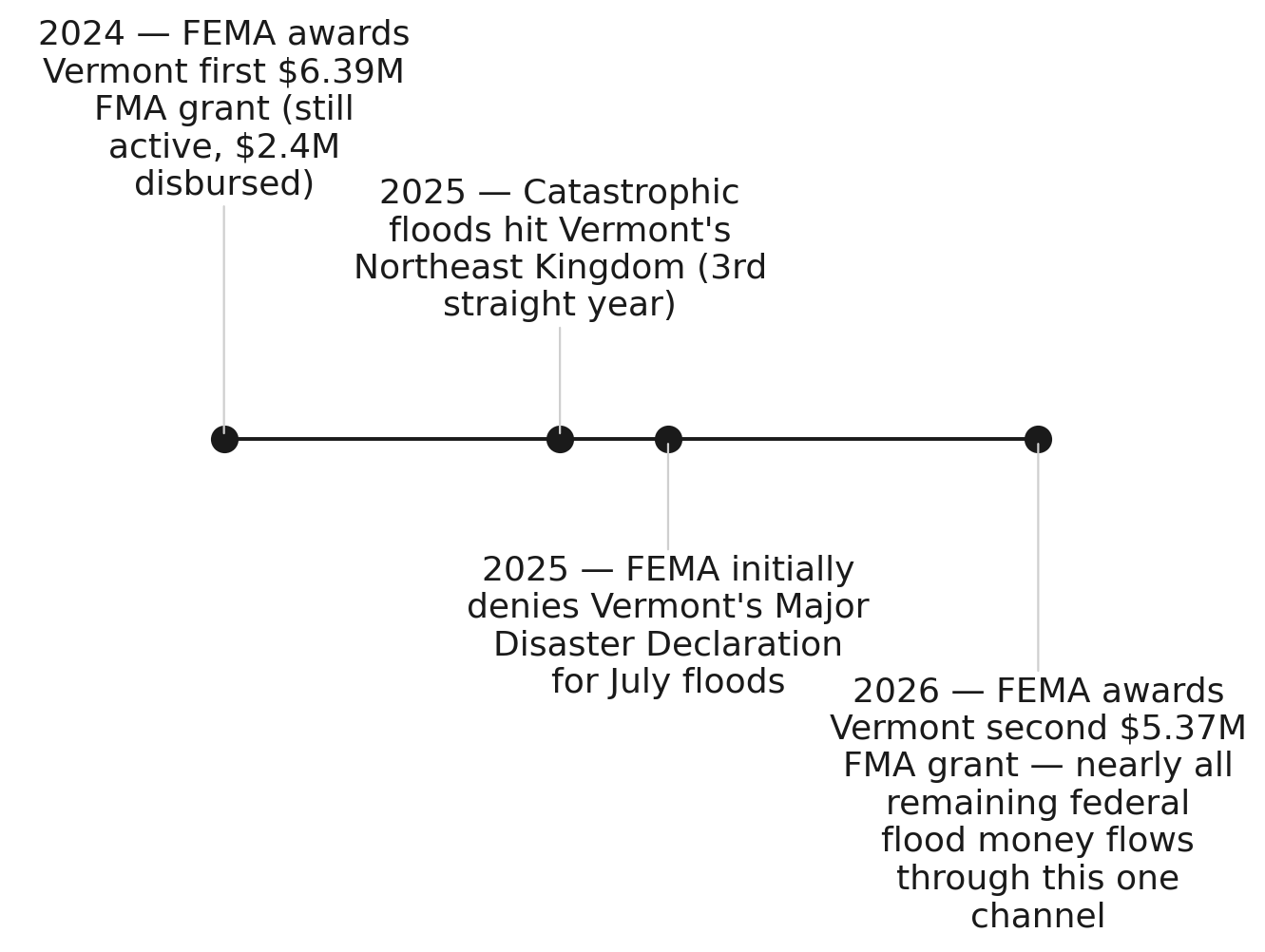
The paradox embedded in that number is worth pausing on. Vermont is winning competitive federal flood mitigation money at exactly the moment the federal government is telling it that its floods aren't severe enough to qualify for disaster relief. The Trump administration denied Governor Phil Scott's Major Disaster Declaration request for the July 2025 Northeast Kingdom floods in October 2025, upheld that denial on final appeal in February 2026, and never responded to the congressional delegation's written demand for an explanation, according to VTDigger reporting from February 2026. The documented damages from that storm exceeded $1.85 million, above the $1.2 million federal threshold, yet the declaration was rejected twice.
That denial matters beyond the immediate relief it withheld. Vermont's main pre-disaster mitigation pipeline, FEMA's Building Resilient Infrastructure and Communities program, was cancelled by the Trump administration on April 4, 2025. Vermont had 36 BRIC-selected projects worth more than $5 million at risk at the moment of cancellation, including Barre's floodplain restoration and a scoping study for Brattleboro's Whetstone Brook. Attorney General Charity Clark joined a 20-state coalition, won a temporary injunction in August 2025, and secured a full court victory in December 2025 requiring FEMA to restore BRIC funding, but the project cancellations had already occurred, and the program's long-term status remains unsettled.
Source: NationGraph.
With BRIC compromised, the Hazard Mitigation Grant Program pipeline locked to prior disaster declarations, and new declarations now being denied, the Flood Mitigation Assistance program has become one of the only remaining open federal channels for Vermont. The FMA program draws from a national pool of roughly $600 million and does not require a disaster declaration to access, it runs year-round through a competitive application process administered by Vermont Emergency Management. That structural independence from the declaration pipeline is precisely why it matters now.
This is the second consecutive FMA award to the Vermont Department of Public Safety. A $6.39 million grant from September 2024 is still active, with $2.4 million already disbursed, meaning Vermont is now running two overlapping FMA awards totaling nearly $11.8 million. That cumulative position puts Vermont second only to New York ($12.4 million) among New England states in flood-related federal grants over the trailing 90 days, well ahead of Massachusetts ($2.8 million) and Connecticut ($2.6 million), a striking figure for a state with fewer than 650,000 residents.
A separate tranche of federal money arrived alongside the FMA award. In September 2026, FEMA announced more than $2.3 million in Pre-Disaster Mitigation and Community Assistance Program funds directed to Vermont communities through congressionally earmarked spending. Montpelier received $1.4 million for housing elevation on Elm Street; Barre received $591,000 for Gunners Brook floodplain restoration; Hardwick received $70,000. These are distinct from the FMA award, separate program, separate eligibility criteria, separate application process, though all are administered through Vermont Emergency Management. They should not be read as a single federal commitment: they represent three different lifelines being used simultaneously because any one of them could be cut.
The urgency at the municipal level is visible in procurement data. Vermont towns have issued 20 flood-related RFPs in the past 180 days, spanning Montpelier, Barre, Richmond, Barnet, Royalton, Woodbury, Hardwick, and Hyde Park. Small towns in the Northeast Kingdom face repair bills on Class 3 gravel roads that are ineligible for Federal Highway Administration Emergency Relief funding and that can exceed their entire annual budgets. Vermont's Transportation Fund is already running a $317 million shortfall in FY2026. For those towns, federal mitigation grants are not supplemental funding, they are the only available funding.
Vermont's fiscal prudence, long a point of state pride, has become a structural liability under FEMA's per-capita damage assessment formula, which effectively penalizes low-debt states when calculating disaster declaration thresholds. The state is caught in a situation where careful budget management makes it harder to qualify for the emergency aid it needs, while the pre-disaster programs designed to reduce that need are being cancelled or contested in court.
The next signal to watch is whether BRIC's court-ordered restoration survives further federal challenge and whether Vermont's 36 at-risk projects can be reinstated. A second question is whether the FMA program itself remains intact, as VTDigger reported in April 2025, the administration's appetite for cancelling competitive mitigation programs has proven real. Vermont is using the open channels. The question is how long they stay open.