Authentic federal cybersecurity grants to Ohio totaled approximately $6.67 million in the last 90 days, roughly 2.4 times the comparable window a year ago, and the money is coming from three distinct federal programs that rarely move in the same direction at the same time.
The universities are collecting most of it. NSF awards landed at five Ohio institutions in a tight August-September 2026 window: Kent State received $2.59 million, Sinclair Community College $1.15 million through a Commerce Department congressional appropriation, Ohio State $634,000, Case Western $592,000, and Cleveland State and the University of Cincinnati $500,000 each. A separate $199,889 NIST RAMPS award went to Wright State University in October 2026 to build a Southwest Ohio cybersecurity workforce partnership spanning employers, high schools, and community colleges. These are not the same program doing the same thing. NSF's STEM Education and CISE directorates fund research capacity and curriculum; NIST's RAMPS program funds regional multistakeholder pipelines designed to move workers from education into jobs. Conflating them understates how broadly Ohio has positioned itself.
Under that university activity sits an older, larger commitment. Ohio's active portfolio under DHS and CISA's State and Local Cybersecurity Grant Program, SLCGP, the program Congress authorized at $1 billion over four years, now stands at $10.26 million across two grants to the Ohio Department of Public Safety and Emergency Management Agency, running through 2028 and 2029. These grants fund something entirely different from what the universities are doing: operational cyber defenses for state and local government information systems, not workforce pipelines or research. Ohio channels SLCGP dollars through its CyberOhio apparatus, which Governor DeWine built when he was attorney general, and which now coordinates the Ohio EMA, the state adjutant general's office, and the state's public university system under what SLCGP rules explicitly call a whole-of-state model.
Source: NationGraph.
That architecture is why the federal money is landing here now. CISA required all states to resubmit cybersecurity plans by January 30, 2026, a compliance step that forced states to demonstrate they had the governance structures in place to absorb competitive grants. Ohio had the structures. Round 3 SLCGP applications were due March 13, 2026, with awards expected in Q3 2026. States that missed the planning requirement couldn't compete. Ohio's pipeline was already built.
Wright State's role in that pipeline has become more visible this year. In May 2026, NSA extended the university's designation as a National Center of Academic Excellence in Cyber Defense through 2031, one of only a handful of such designations in the Midwest. The NIST RAMPS award that followed in October was not a coincidence: RAMPS selection criteria weight existing institutional infrastructure heavily, and Wright State's defense designation made it a credible anchor for a regional workforce partnership.
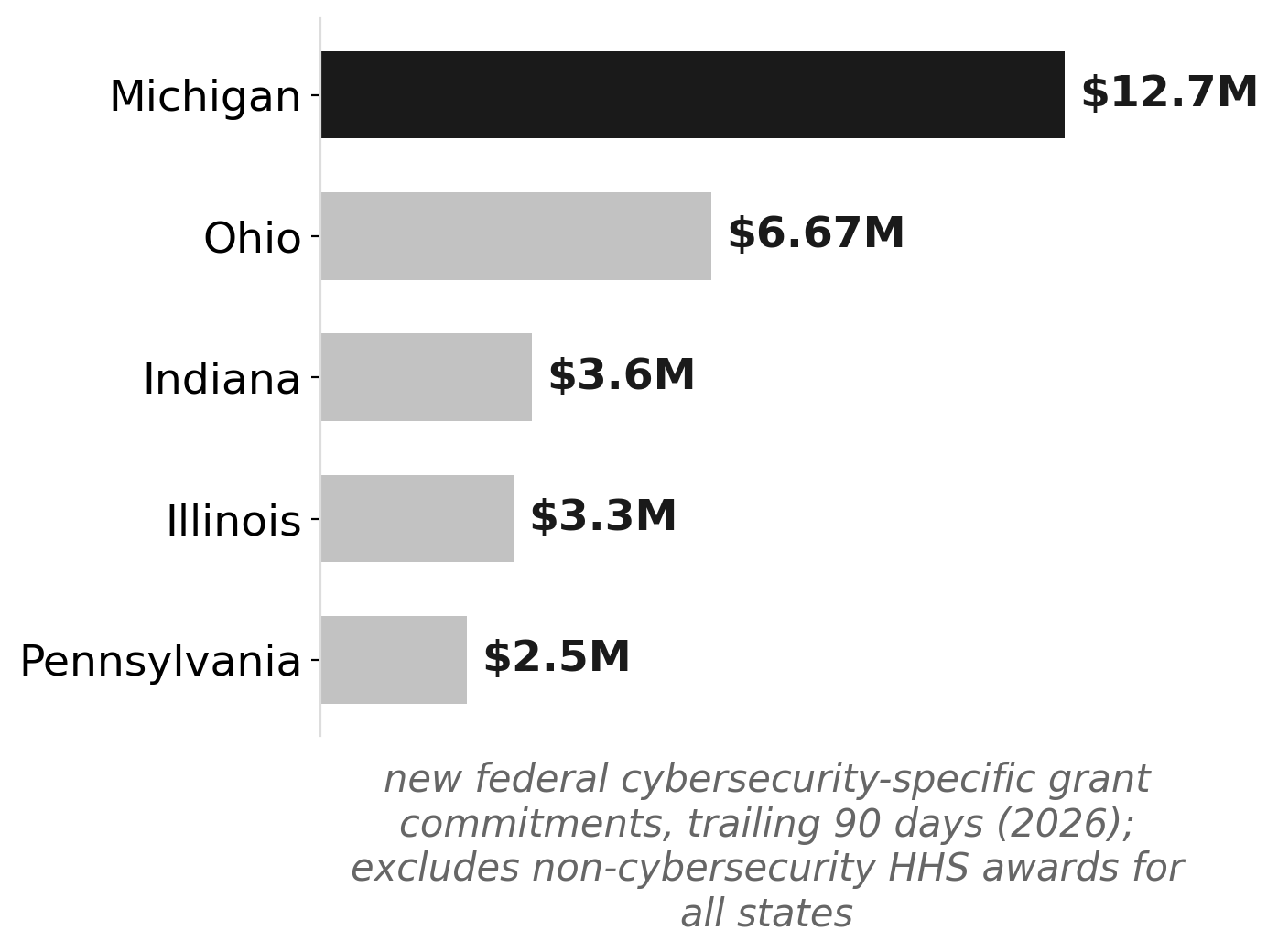
Ohio now leads Midwest peers in new 90-day cybersecurity grant commitments. Michigan sits closest at a comparable grant count, followed by Indiana at $3.6 million, Illinois at $3.3 million, and Pennsylvania at $2.5 million. The Midwest comparison matters because SLCGP is competitive at the state level, and DHS reviews state cybersecurity plans against one another when scoring grant readiness. Ohio's compliance-pacing ahead of federal deadlines has not gone unnoticed in that scoring.
One number in circulation deserves a correction before it gets repeated. The raw 90-day grant figure for Ohio, as captured in federal award databases, runs closer to $14 million, a 412 percent year-over-year spike. That figure includes a $7.29 million HHS award to the Ohio Department of Mental Health for 988 Behavioral Health Crisis Services, a program that likely matched a cybersecurity keyword in its grant description but has nothing to do with cybersecurity investment. Excluding it leaves the authentic cybersecurity-specific total at roughly $6.67 million, still a significant acceleration but a more honest one.
What changes for someone living in Ohio is less visible than a road project but more consequential for the governments that run daily services. SLCGP dollars flowing through Ohio EMA go to counties and municipalities for things like network segmentation, multi-factor authentication, and incident response planning, the unglamorous infrastructure that prevents ransomware attacks from shutting down a county health department or a water system. The workforce pipeline money, meanwhile, is building the local labor pool those same governments will hire from.
The next signal to watch is whether Q3 2026 SLCGP Round 3 awards confirm Ohio's positioning or reveal that peer states have closed the compliance gap. If Round 3 awards land before year-end, Ohio's 90-day totals will look different again, and the true test of the CyberOhio model will be whether the plumbing it built can handle the volume.