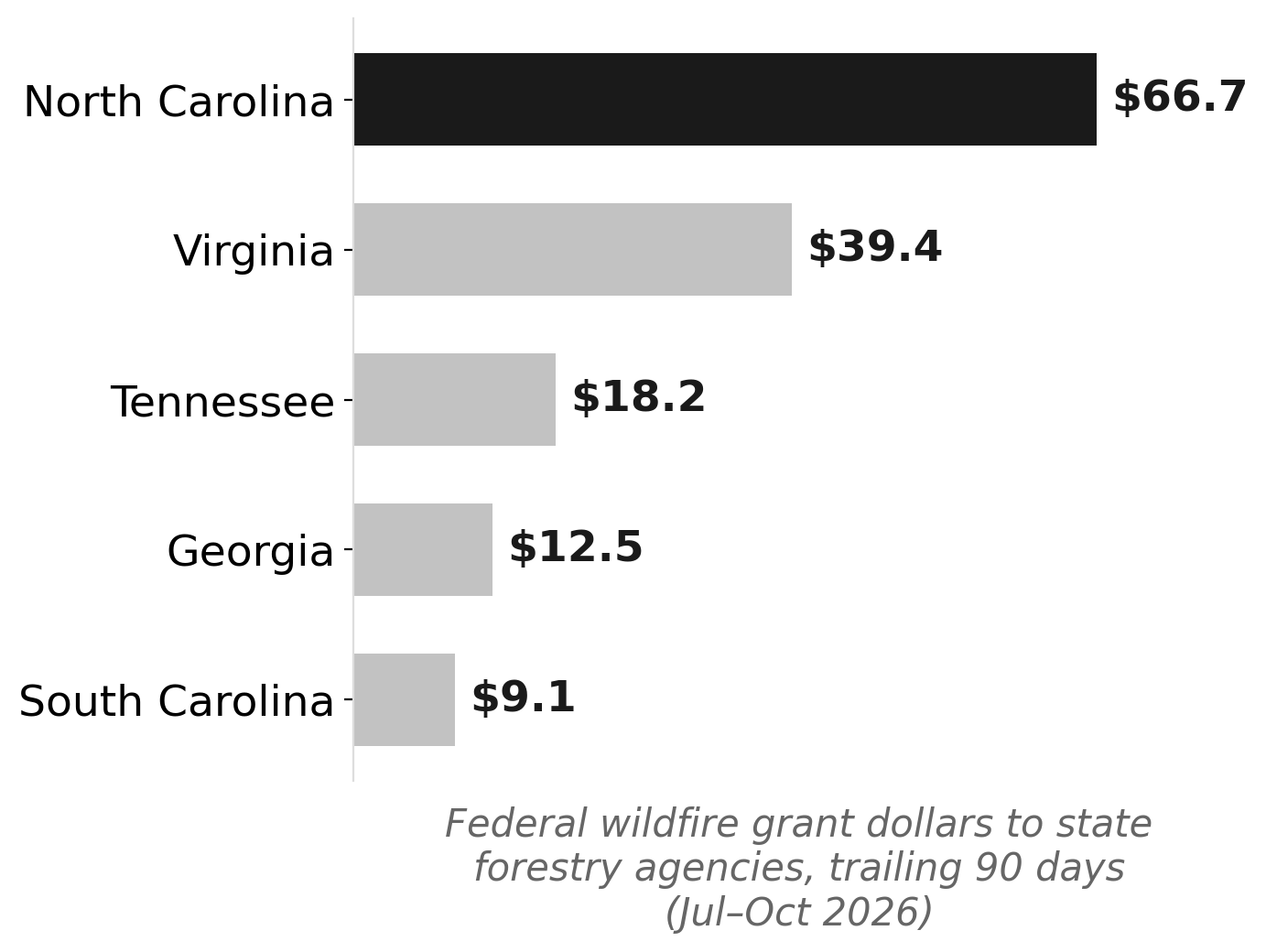
Federal wildfire grants to Virginia totaled $39.4 million in the 90 days ending October 2026, up from $1.9 million in the same window a year earlier, a 1,979% increase, and nearly all of it traces to a single agreement signed on September 8, 2026, between the USDA Forest Service and the Virginia Department of Forestry.
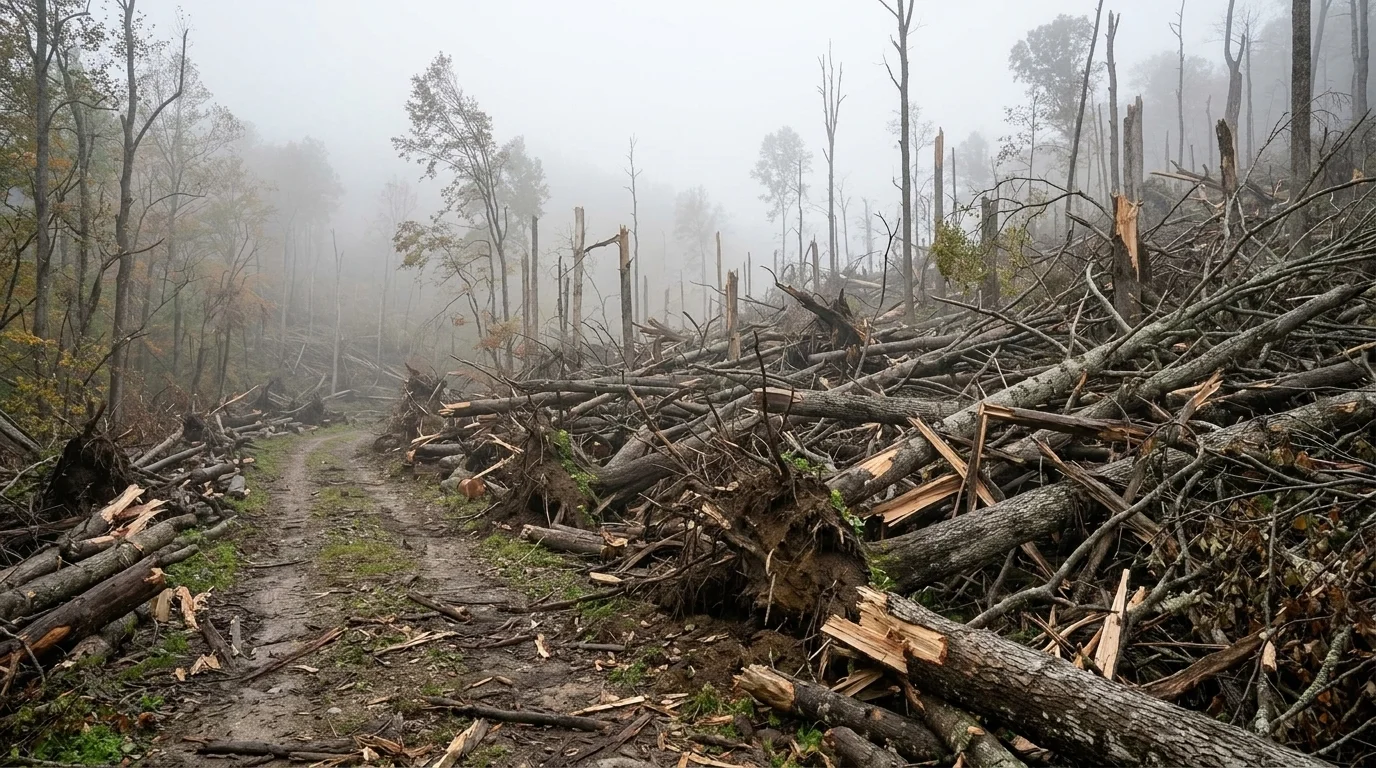
The grant that dominates the ledger is a $38.6 million, 10-year Good Neighbor Authority (GNA) agreement, and its stated purpose makes the origin of the money plain: Hurricane Helene recovery. When Helene made landfall as a Category 4 storm in September 2024 and drove its destructive track through the Appalachian interior, it downed thousands of trees across the George Washington and Jefferson National Forests in southwest Virginia. That blowdown created something the region had not historically faced, a landscape-scale accumulation of dry, tangled fuel across 1.8 million acres of mountain terrain. Virginia averages roughly 700 wildfires a year, mostly from escaped debris burning. Post-Helene, the risk profile is categorically different: about 80% of the current salvage timber sale areas on the GW&J National Forests fall within Forest Service-designated high-risk firesheds.
The urgency registered quickly. In May 2026, the GW&J National Forest issued fire restrictions along the Appalachian Trail at Mount Rogers, citing elevated fire danger. Virginia's spring 2026 fire season produced 411 wildfires burning more than 4,558 acres and damaging three homes. An ongoing drought has kept conditions dangerous well beyond the season's nominal end.
Source: NationGraph.
The GNA mechanism is what makes this response both fast and flexible. First authorized in 2001 and expanded under the 2018 Farm Bill, Good Neighbor Authority allows the USDA Forest Service to hire state forestry agencies to perform restoration work directly on federal land, and, critically, on adjacent private parcels in disaster-affected counties. That last point matters enormously in southwest Virginia, where the rural landscape is a mosaic of national forest and private timber holdings. State crews can move across that boundary; federal crews generally cannot without a separate process. The Virginia agreement mandates deployment of a dedicated wildfire hazard mitigation and prescribed burning crew, treatment of approximately 250 acres of hazardous fuels, and prescribed burning on approximately 1,000 acres of GW&J National Forest land, all within a 10-year performance window running through August 2036.
Virginia's agreement is part of a coordinated USDA push across the Appalachian corridor, not an isolated transaction. The North Carolina Wildlife Resources Commission signed a $290 million GNA in February 2026, the largest in Forest Service history at the time, and the NC Forest Service followed with a separate $65 million GNA on September 10, 2026, two days after Virginia's agreement was signed. Forest Supervisor James Melonas, speaking about the North Carolina agreement, said that "an unacceptable level of risk remains for families living in vulnerable communities" two years after Helene. Virginia's $38.6 million is the same instrument, applied to the same disaster, through the same mechanism, a regional strategy rather than a one-state decision.
The scale of the shift is worth stating plainly. Before this grant, Virginia's wildfire-related federal funding averaged under $400,000 per quarter in recent years. The September agreement is roughly 100 times that baseline, and it puts Virginia second nationally in wildfire-related federal grants for the trailing 90 days, behind only North Carolina. That ranking maps almost exactly onto the two states that absorbed the worst of Helene's inland destruction.
The remaining $880,000 in new grants, covering Cooperative Fire Assistance, Hazardous Fuel Reduction, and a Community Wildfire Defense Grant under the Infrastructure Investment and Jobs Act, represent the Virginia Department of Forestry's ongoing operational funding. These are separate programs with separate legal authorities and purposes: the Cooperative Fire Assistance and Hazardous Fuel Reduction grants support VDOF's own suppression and prevention capacity, while the IIJA community grant funds local wildfire mitigation planning. They run in parallel to the GNA, not as part of it.
For residents of southwest Virginia's mountain communities, the practical meaning of the GNA is that state forestry crews will be working the landscape adjacent to their properties for the next decade, treating fuel loads that were not there two years ago. The agreement also signals that the Forest Service has concluded the Helene blowdown cannot be managed on the federal land management timeline alone, the debris volume and the fire-season pressure both demand a faster instrument.
The next signal to watch is whether the USDA extends comparable GNA agreements to Tennessee, the third state along Helene's inland track where similar blowdown conditions exist. The Virginia and North Carolina agreements suggest a template is now established. Whether Congress continues appropriating at this scale as the immediate Helene emergency recedes will determine how much of the 10-year work plan VDOF can actually execute.