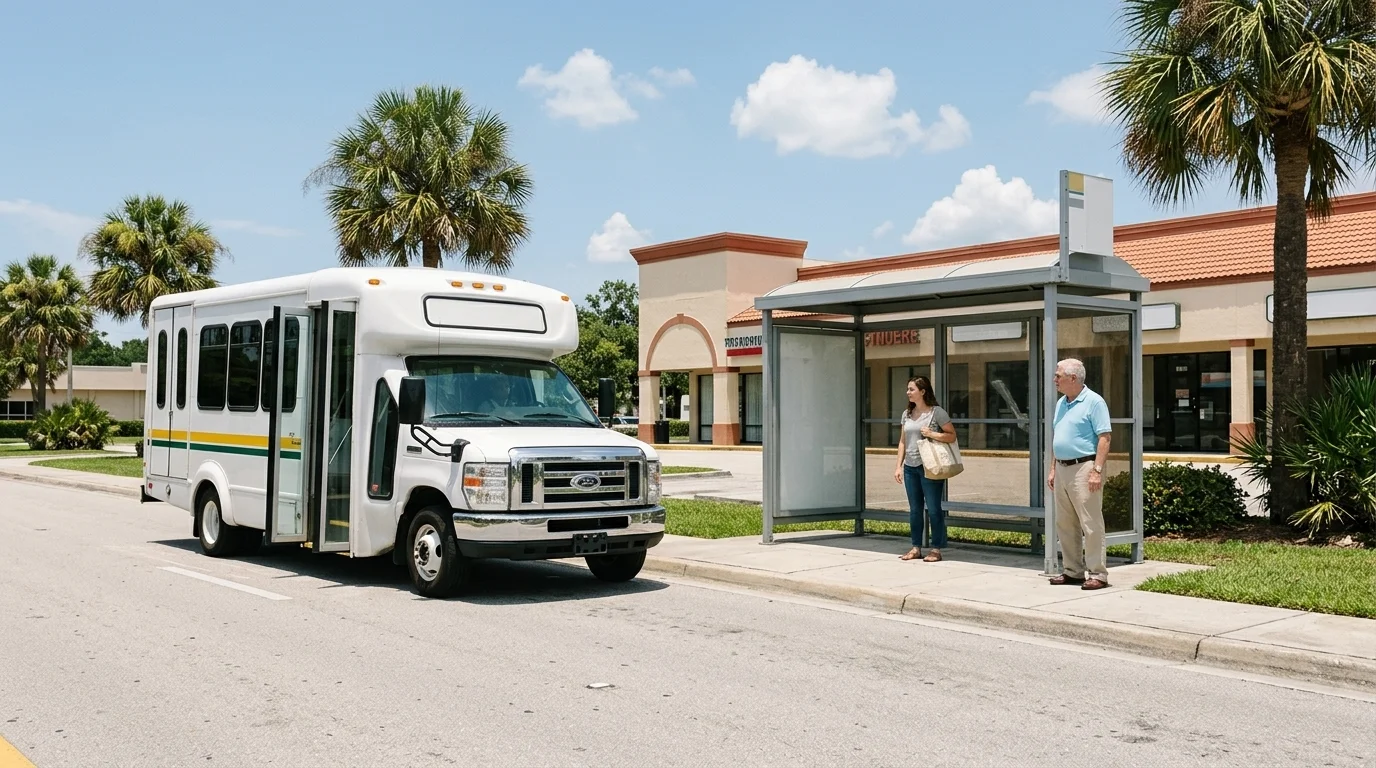
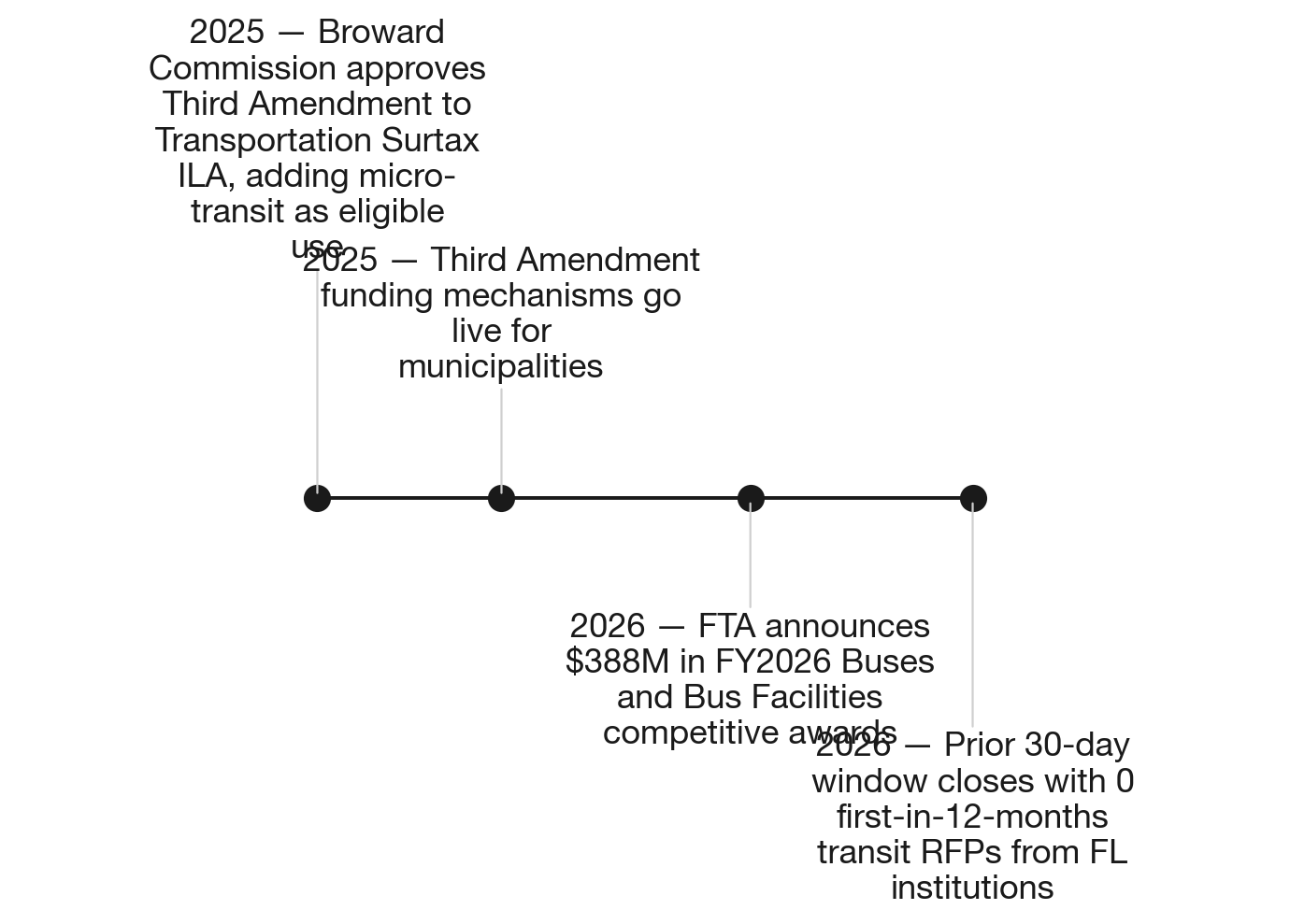
Six Florida institutions issued their first transit-related RFP in more than 12 months during the last 30 days. In the prior comparable window, the number was zero.
The shift is not a coincidence. On June 10, 2025, the Broward County Commission approved the Third Amendment to its Transportation Surtax Interlocal Agreement, adding micro-transit and on-demand transportation as eligible uses and activating formula-based annual allocations for every participating municipality. The new mechanisms went live on October 1, 2025. Cities that signed on got real dollars with a real spend-down obligation, and the procurement wave that followed is now measurable.
The clearest example is Lauderhill. A city of 74,000 that had gone silent on transit procurement for over a year, Lauderhill issued RFP #2026-041 last month seeking a contractor to operate its Community Shuttle Bus and Micro Transit Service: seven fixed routes, a three-year base contract with two renewal options, $761,276 in Transportation Surtax funding, and $1.72 million in annual operating funds. Before the Third Amendment, Lauderhill had no dedicated micro-transit funding pathway. Now it has one, a procurement deadline, and a contract to award.
Source: NationGraph.
Broward County Public Schools filed a separate RFP for a Program Manager and Strategic Advisor to oversee transit program development, its first such solicitation on record in this dataset. The school district's entry signals that the amendment's ripple effects are reaching institutions beyond city halls. Neighboring cities in Broward, including Hollywood, also re-entered the market, following the same formula: surtax allocation received, RFP issued, contractor selection pending.
The speed of uptake is striking. According to Broward County's 2025 annual report, the first Grant Match Program application cycle under the new amendment generated $16.7 million in requests within ten days and ultimately awarded $13 million to nine municipalities. The amendment didn't just open a door, it created an immediate queue.
Broward is the epicenter, but the procurement pressure extends beyond the county line. Lake County, which received $8.08 million in new FTA Formula Grants starting April 2026, re-entered the transit procurement market after a 12-month gap. Its situation reflects a parallel dynamic: federal capital arriving faster than local agencies can absorb it. Over the past 12 months, 65 new DOT transit and bus grants totaling $554.6 million were newly committed to Florida. In March 2026, the Federal Transit Administration announced $388 million in FY2026 Buses and Bus Facilities competitive awards nationally, with Florida agencies among the recipients. A separate FTA notice of funding opportunity is offering roughly $610 million more in Bus and Low-No Emission grants. That is a significant volume of federal capital chasing local procurement capacity.
The structure of Broward's surtax amplifies the urgency. The county operates a 415-bus fixed-route system serving 24.4 million riders annually, backed by the only dedicated 30-year, one-cent transportation sales surtax in Florida. MAP Broward, the program that administers the surtax, has committed over $2 billion to transit, public works, and municipal projects since 2019. But the Third Amendment is the first time micro-transit and on-demand services qualified as eligible uses. For smaller cities without the tax base to fund standalone shuttle operations, that change converted an abstract aspiration into a budgeted line item.
For residents in cities now issuing these RFPs, the practical question is when service actually starts. An RFP issued today typically yields a contract in three to six months; Lauderhill's seven-route shuttle network, if awarded on schedule, could be operating before the end of 2026. For Lake County and other non-Broward jurisdictions, the timeline depends on how quickly new FTA formula allocations clear local procurement processes.
The next signals to watch: whether Broward's second Grant Match Program cycle, likely to open later this year, produces a second procurement wave among the municipalities that didn't move in the first round, and whether the FTA's pending Low-No Emission NOFO draws Florida applicants into electric bus procurement for the first time at scale. The amendment created the mechanism; the federal capital is providing the fuel. How many more cities join the queue in the next 90 days will determine whether this is a single-cycle surge or a durable shift in how Florida municipalities think about transit.