Texas state agencies issued roughly six distinct AI-related solicitations in March 2026 alone, compared to near-zero per month before mid-2025. The jump is not driven by ambition or budget windfalls. It is driven by a deadline.
The Texas Responsible AI Governance Act, known as TRAIGA and signed by Governor Abbott on June 22, 2025, took effect January 1, 2026. As Latham & Watkins summarized after the signing, the law places specific obligations on government entities: agencies must inventory all AI systems in operation, implement formal governance programs, maintain documentation, and issue transparency disclosures when members of the public interact with AI. Violations carry penalties of up to $200,000 per instance, enforced by the Texas Attorney General, who is already described as the first state AG to bring an AI-specific consumer protection enforcement action. For agency procurement officers, that is not an abstract legal risk.
The result is a procurement wave unlike anything Texas's public sector has seen on this topic. TRAIGA does not appropriate money for compliance. It simply creates legal obligations that agencies must satisfy, either by building governance infrastructure internally or by buying it. Most are buying it.
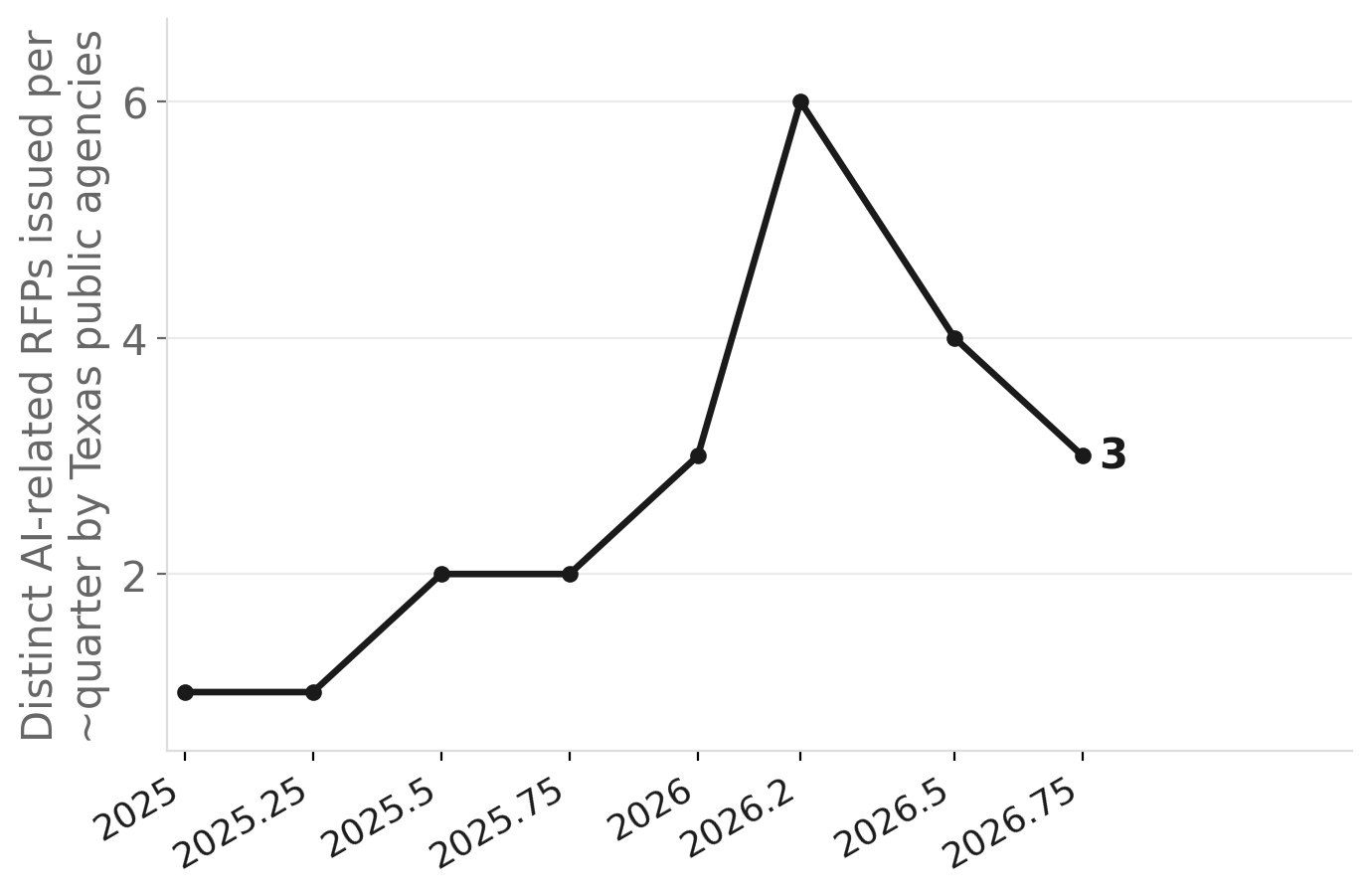
Source: NationGraph.
No single agency illustrates this more clearly than the Teacher Retirement System of Texas. Managing roughly $200 billion in pension assets for more than 2 million members, TRS has issued at least four distinct AI-related solicitations since March 2026. The list runs from an AI Developer and Quality Assurance Assistant Platform in March, to an AI Agent Testing and Evaluation Platform issued in July and updated in August, to an AI and Information Technology Technical Support and Advising Services RFP issued in September. A February 2026 TRS board meeting explicitly framed AI as "a business transformation imperative" and walked trustees through live use cases. By April, TRS's board summary confirmed AI governance as a named priority in the 2027-2031 strategic plan. The agency's CIO told trustees that "artificial intelligence was a major focus and that AI continues to be an internal priority." TRS is not a technology agency. Its aggressive procurement posture signals that TRAIGA's compliance pressure is landing well beyond the agencies most people would expect.
Other institutions are moving along the same timeline, if not yet at TRS's pace. Texas State University issued an AI-Powered Student Advising Platform RFP in September and October 2026. Texas A&M issued an AI Center of Excellence RFP. Tarrant County, not a state agency but subject to the local-government provisions of TRAIGA, put out a contract for AI Development Services. The common thread across all of them is timing: the procurement activity began accelerating in early 2026, within weeks of the law's effective date, and has not slowed.
The Texas AI Advisory Council, created by the same legislation and housed within the Department of Information Resources, adds another layer. The seven-member body, appointed by the Governor, Lt. Governor, and Speaker, is charged with conducting AI training programs for all state agencies and local governments. That training mandate extends TRAIGA's compliance surface to the full breadth of Texas government, which means the current wave of procurement may represent the early, most urgent phase of a much longer cycle.
None of this was inevitable. The version of TRAIGA that eventually became law was substantially narrowed from an earlier draft that would have imposed EU-style obligations on private-sector companies. Texas legislators stripped those provisions. What remained were public-sector requirements, which means the state created a demanding governance framework that binds government directly while leaving most of the private sector comparatively free. Texas is only the second state to pass comprehensive AI legislation, after Colorado, and its law took effect one month before Colorado's own statute.
The broader infrastructure surrounding these procurements matters for understanding what agencies will actually be able to buy. UT Austin holds a $376 million active NSF computing grant running through 2028, which anchors the state's AI research capacity. The Stargate data center consortium has its flagship site in Texas. Agencies procuring AI governance tools in 2026 are doing so in a state that is simultaneously becoming a global AI compute hub, which raises the sophistication ceiling for what compliant systems can look like.
For Texans who interact with state agencies, TRAIGA's transparency provisions are already in effect: agencies are required to disclose when an AI system is involved in a consumer-facing interaction, and prohibited from using AI for social scoring or unconsented biometric identification. The practical question going forward is whether the governance programs agencies are now buying will be mature enough to meet those obligations at scale. The Texas AG's enforcement posture suggests the answer will be tested. The next signal to watch is whether the DIR begins issuing formal compliance guidance, and whether smaller agencies, those without TRS's resources or board-level attention, can keep pace with the procurement cycle the larger institutions are already running.