Two state procurement actions issued in July and August 2026 expose a gap that Montana's charter school law could not close on its own: the state now needs to buy the machinery to oversee schools that are already teaching students.
Montana's procurement portal shows a Public Charter School Dashboard RFP, soliciting a contractor to build a centralized data platform for charter school oversight, issued at almost exactly the moment first-year charter operators face their Q4 financial compliance deadline of August 14, 2026. A second RFP, for a Special Education Policy framework covering what the state calls "Community Choice Schools," asks a contractor to design the federal IDEA compliance infrastructure that any functional charter authorization system requires from day one. No neighboring Western state issued comparable school-choice procurement actions in the same 30-day window, making Montana the only government in the region currently buying its way into this administrative capacity.
The timing is not a coincidence. It is the predictable consequence of a legislative sequence that moved faster than bureaucracies typically can.
Source: NationGraph.
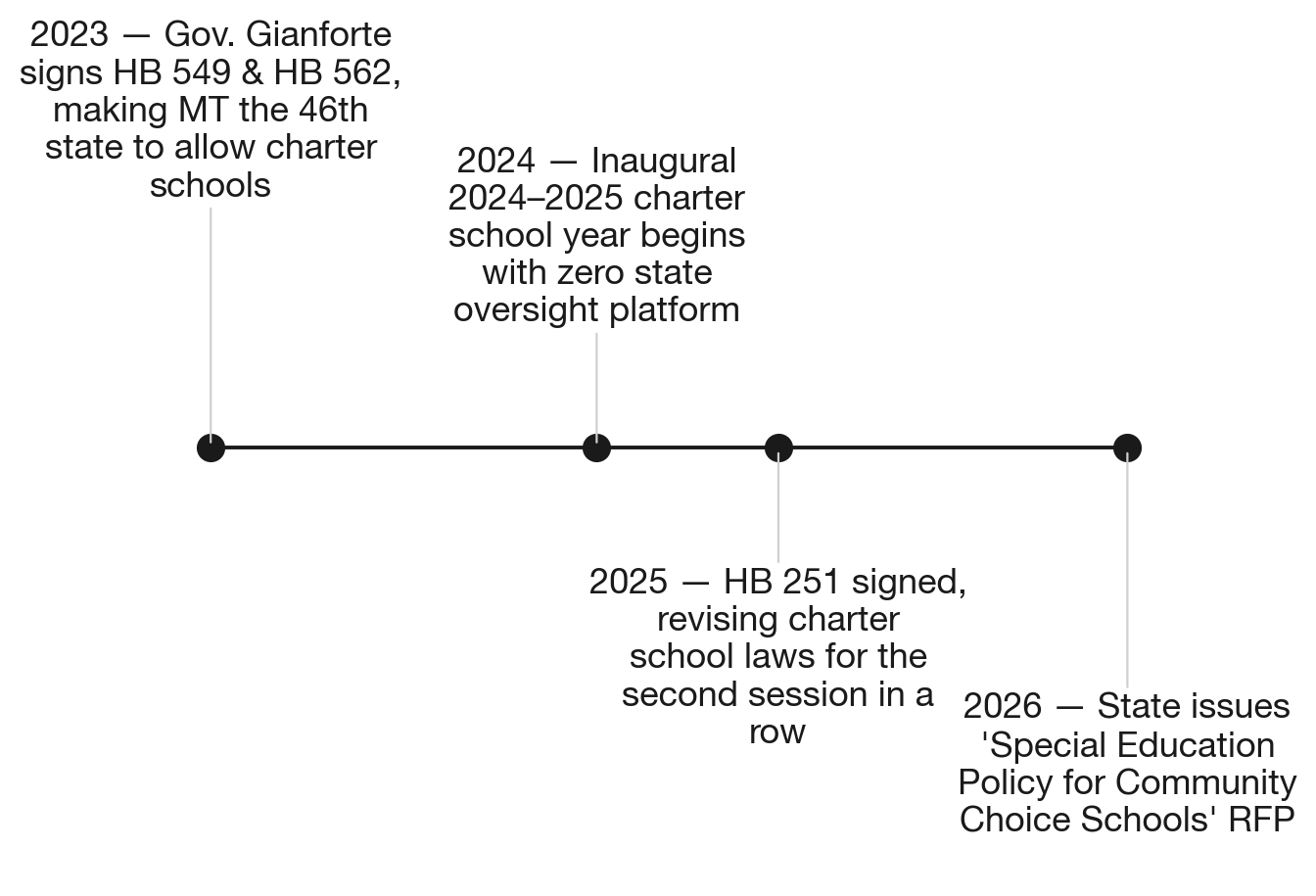
Gov. Greg Gianforte signed HB 549 and HB 562 in May 2023, making Montana the 46th state to allow public charter schools. The two laws created parallel authorization tracks: local school boards oversee schools under HB 549, while a state charter commission manages the "Community Choice Schools" created under HB 562, funded at roughly $6,300 per elementary student and $8,000 per high school student redirected from the general per-pupil formula. The legislature came back in 2025 to pass HB 251, revising the charter laws for the second consecutive session. The Montana Board of Public Education published its first-ever annual charter school legislative report in 2025, covering the inaugural 2024–2025 school year, and simultaneously released a compliance calendar that set the August 14 financial reporting deadline.
What the laws did not create was the technology to watch any of it. Montana has roughly 400 school districts spread across one of the least densely populated states in the country. There was no existing charter oversight infrastructure to adapt or extend, no dashboard inherited from a predecessor program, no compliance portal borrowed from an adjacent agency. The state is building the foundation and the house at the same time.
That sequencing is unusual even among late-adopting states. Most of the 45 states that preceded Montana had years, sometimes decades, to layer accountability tools onto their charter sectors as enrollment grew. Montana's Office of Public Instruction and Board of Public Education are procuring foundational technology and federal policy architecture during the same fiscal quarter that first-year schools are submitting their first financial reports. The dashboard the state is now trying to buy should, under a more conventional build-out schedule, have been operational before those schools opened.
Advocates tracking the sector have flagged Billings, Flathead, Bozeman, and Missoula as the most active early markets, according to reporting on the law's passage. A 2024 Lewis and Clark District Court ruling resolved an OPI dispute over HB 549's approval process, clearing the authorization path for 18 schools. Those schools are now operational. The state's oversight capacity is still catching up.
The special education RFP adds a second layer of complexity. Federal IDEA requirements do not pause for states that are new to charter authorization. Community Choice Schools must demonstrate compliance with individualized education program obligations, and the state agency responsible for oversight needs a policy framework to verify that compliance at scale. Procuring that framework from a contractor, rather than having built it internally, signals how compressed Montana's administrative timeline has been.
This is not a story about whether Montana's charter school experiment is working. The Board of Public Education's first annual report will eventually answer questions about enrollment, academic outcomes, and financial health. What the July–August procurement record reveals is something more structural: the hardest part of becoming the 46th charter school state was never the legislation. The 2023 bills passed. The 2025 revision passed. A court challenge was resolved. Schools opened.
The hard part is what comes after the ribbon-cutting, the data systems, the compliance calendars, the federal policy frameworks, the audit trails. Montana is buying all of that now, in real time, while the schools it is supposed to be watching are already in their second year of operation.
The August 14 financial reporting deadline will be the first real test of whether the state's oversight apparatus, assembled on the fly, can do what the law assumed it would.