Texas pulled in $49.6 million in new federal AI grants over the trailing 90 days, a 129% jump from $21.7 million in the same window last year. The biggest recipient is not UT Austin, not Texas A&M. It is Prairie View A&M University, a 10,085-student historically Black land-grant institution founded in 1876, whose $12.1 million in new awards puts it ahead of UT Austin ($8.6 million) and Texas A&M ($3.4 million) for the period.
The reason this happened now comes down to two distinct federal programs arriving at the same institution in the same fiscal-year-end sprint. On September 9, 2026, the U.S. Army Materiel Command announced a nearly $10 million COMMAND-AI grant to PVAMU, $9.86 million over five years through July 2031, to establish a new defense AI research center covering cybersecurity, resilient communications, AI-enabled advanced manufacturing, and intelligent systems. University officials described it as one of the largest federal research grants in PVAMU's 150-year history. Separately, NSF's HBCU-Excellence in Research program seeded at least six additional Prairie View AI projects in the same window, with individual awards ranging from $250,000 to $1 million and covering topics from AI-enabled power grid optimization to 6G network design to biomimetic engineering.
These are not one program. The Army Materiel Command award is a defense-specific, institution-building grant aimed at creating a national-security workforce pipeline and advancing PVAMU's case for R1 doctoral research classification. The NSF HBCU-EiR program is a separate, NSF-managed capacity-building mechanism designed to make HBCUs more competitive in the broader federal grants ecosystem. Both programs target PVAMU and share the underlying goal of elevating HBCU research infrastructure, but they operate through entirely different funding channels, serve different federal missions, and are not triggered by each other.
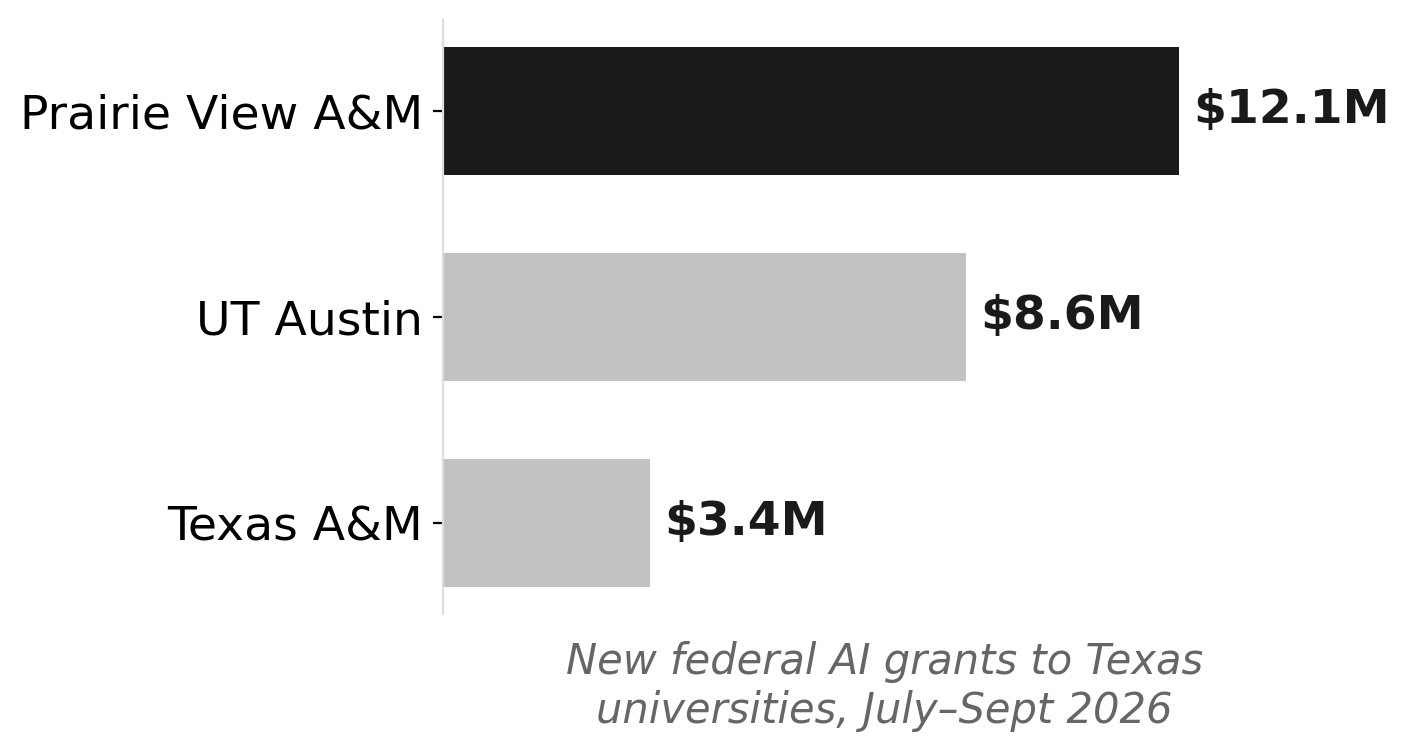
Source: NationGraph.
What is not a coincidence is the timing. August and September mark the end of the federal fiscal year, when agencies push out remaining obligated funds before the books close. The concentration of awards in those two months is consistent with the annual grant sprint that research offices at every major university plan around. PVAMU's grant office was positioned to receive from both streams simultaneously.
PVAMU President Tomikia P. LeGrande has been explicit about the institution's five-year R1 ambition. The Carnegie Classification of Institutions of Higher Education places R1 status, very high research activity, on a small set of universities that produce significant doctoral output and external research funding. PVAMU's current classification sits well below that threshold, but the COMMAND-AI award materially improves the trajectory. LeGrande framed the Pentagon grant as part of a deliberate strategy to, in her words, "compete at the highest levels." The MacKenzie Scott gift of $63 million announced in November 2025, the largest single gift in PVAMU's history, adds philanthropic momentum to the federal push.
The broader Texas AI grant picture is substantial. NSF accounts for 64% of the state's new awards ($31.8 million across 46 awards), with DoD at 20% ($9.9 million), HHS at 7.2% ($3.6 million), and the Department of Energy at 6.6% ($3.3 million). Texas ranks second nationally in new 90-day AI grant volume, behind California's $86 million and ahead of North Carolina ($45.7 million) and New York ($37.7 million). The new money also lands on an already large base: Texas currently carries 293 active AI grants totaling $1.03 billion in obligated value.
On the state policy side, Texas Governor Greg Abbott signed the Texas Responsible Artificial Intelligence Governance Act on June 22, 2025. The law took effect January 1, 2026, making Texas the second state after Colorado to pass comprehensive AI regulation. It established the Texas Artificial Intelligence Council and a regulatory sandbox for AI products. TRAIGA does not fund or unlock any of the federal grants flowing to Texas universities, but it signals institutional legitimacy for AI as an investment category. That signal is complicated by President Trump's December 2025 executive order on AI policy, which created federal-state regulatory tension around state-level AI laws like TRAIGA, leaving the enforcement landscape unsettled.
For students and faculty at PVAMU, the practical consequence is a new research center with Pentagon backing, expanded graduate research opportunities in AI and defense-relevant engineering, and an institution that is now, by federal grant volume, the leading AI research destination in Texas for this fiscal window. Whether that ranking holds depends on whether PVAMU can convert two years of concentrated investment into the doctoral production and sustained external funding that R1 classification requires.
The next signal to watch is the NSF NAIRR Operations Center competition (NSF 25-546), which will award a single organization up to $35 million over five years to run national AI computing infrastructure. Texas universities, newly flush with federal relationships and demonstrated capacity, are plausible contenders. The selection will signal which states are being written into the permanent architecture of federally funded AI research.