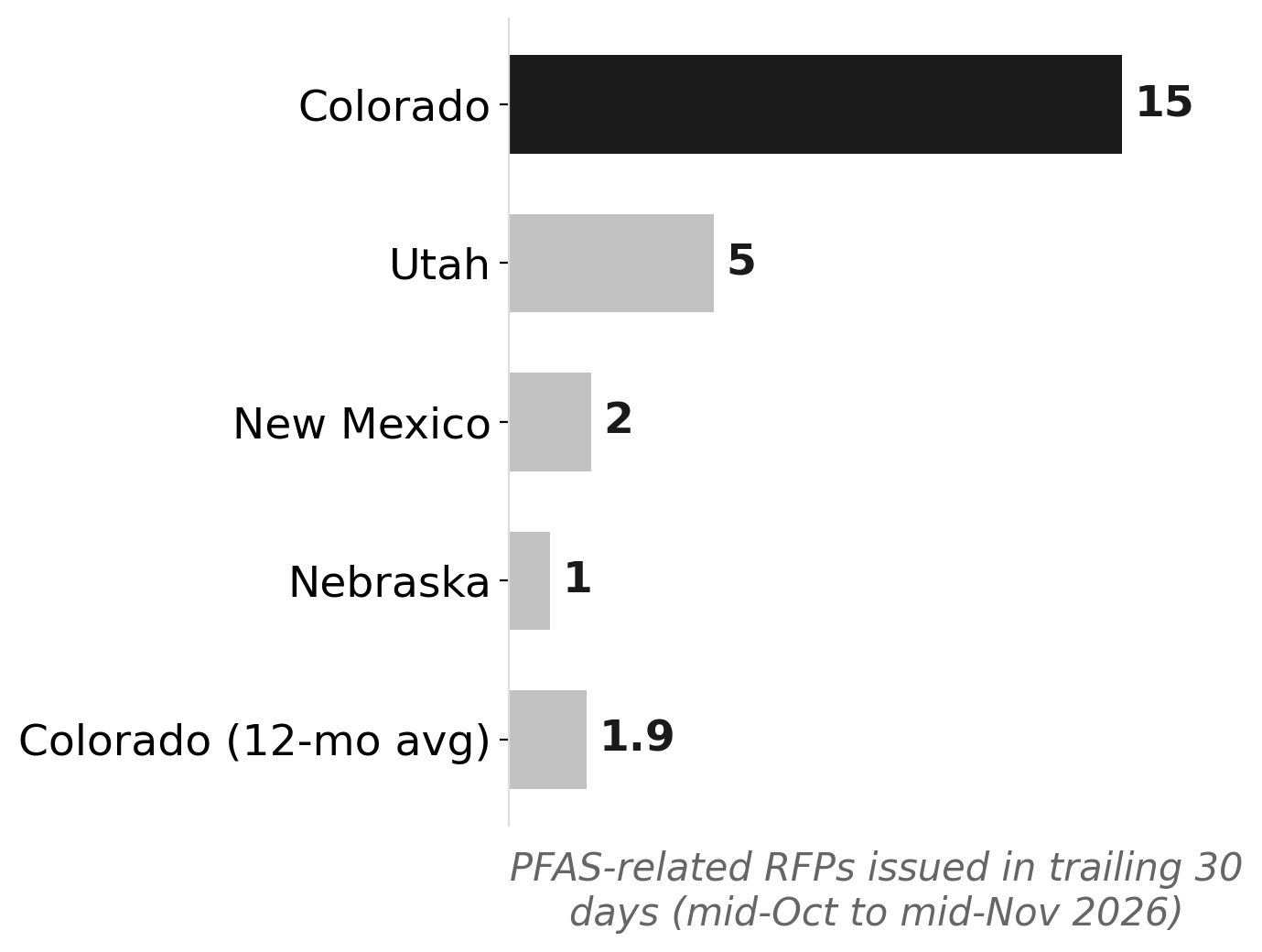
Colorado water utilities issued 15 PFAS-related procurement notices in the last 30 days, against a 12-month monthly average of roughly 1.9. That 7.8x surge is not a coincidence of timing. It is the first visible consequence of a state regulatory deadline that Colorado wrote specifically to survive whatever Washington does next.
The driver is Colorado Regulation 11, Section 11.15, adopted by the Water Quality Control Commission on August 11, 2025 and effective October 15 of that year. The rule sets two hard dates: April 1, 2027 for all public water systems to complete initial PFAS monitoring, and April 1, 2029 for full maximum contaminant level compliance. Both deadlines sit ahead of the federal trajectory. The EPA's May 2026 Comprehensive PFAS Strategy proposed extending the federal PFOA/PFOS compliance deadline from 2029 to 2031 and rescinding MCLs for four additional PFAS compounds. CDPHE explicitly declined to follow, stating that Colorado's rule would remain at least as stringent as federal standards regardless of what EPA finalizes. The state's motive was structural: by holding an earlier deadline, Colorado retains primacy over Safe Drinking Water Act enforcement, meaning state inspectors, not federal ones, oversee compliance.
The April 2027 monitoring deadline is the near-term pressure point activating procurements right now. Utilities cannot design or size treatment systems until they have completed initial monitoring, so the monitoring deadline is effectively the starting gun for the construction phase. A utility that delays sampling into late 2026 will have almost no runway before the 2029 MCL line arrives.
Source: NationGraph.
Layered on top of the regulatory clock is a financing signal that is hard to ignore. CDPHE holds a $41.8 million EPA WIIN Act Emerging Contaminants grant, awarded in April 2025 and running through March 2030, administered through CDPHE and competitively sub-granted to public water systems for PFAS testing and treatment infrastructure. As of the most recent data pull, only $303.72 of that $41.8 million has been disbursed. That gap between awarded and outlayed is a spend-it-or-lose-it signal to utilities: the money exists, the deadline is fixed, and the design and construction timelines are long enough that waiting another six months means real risk of non-compliance. The WIIN Act grant and Regulation 11 are distinct instruments doing distinct things, one is an enforceable state rule, the other is a federal competitive grant disbursed through a state agency, but they are pointing utilities in the same direction at the same moment.
The procurement activity spans the full state and the full treatment stack. Cherokee Metropolitan District in El Paso County is pursuing water treatment facility construction; its October 2026 board minutes reference active pursuit of Department of Defense infrastructure grants tied to PFAS contamination near Schriever and Peterson Air Force Bases. Aurora and Thornton, two of the Front Range's largest water providers, have issued RFPs covering groundwater sampling and treatment upgrades. The Town of Frederick in Weld County and Boulder County are procuring on the smaller-utility end of the spectrum. Snake River Water District in Summit County is evaluating treatment options for a system serving a mountain resort corridor with a very different contamination profile than the Front Range agricultural and military sources.
The geographic and typological diversity matters. Colorado sits at the intersection of two PFAS contamination sources that rarely overlap at this scale: legacy military AFFF foam use around multiple Front Range Air Force installations, and industrial and agricultural contamination concentrated in Weld and Adams counties. That means the procurement surge is not a single cluster of similarly affected utilities, it is a statewide response to a statewide rule, with each utility facing its own source chemistry and its own treatment engineering problem.
No neighboring state is close to Colorado's current pace. Utah issued 5 PFAS-related RFPs in the same 30-day window; New Mexico issued 2; Nebraska issued 1. Colorado's total is three times the nearest neighbor. That gap reflects the absence, in those states, of a comparable state-level regulatory mandate with an imminent monitoring deadline.
As states increasingly diverge from the federal PFAS posture, Colorado is among the clearest cases of a state that wrote its rule with the rollback in mind. The WQCC language explicitly anticipates federal changes and holds the 2029 line regardless. For Colorado water system operators and the engineering firms now fielding RFPs, the practical implication is straightforward: the federal compliance calendar no longer governs their work. The state one does.
The next signal to watch is the CDPHE sub-grant award cycle for the WIIN Act funds. When the agency begins competitively disbursing portions of that $41.8 million to utilities, the construction procurement wave currently visible in RFP volume will shift into signed contracts. The April 2027 monitoring deadline is now 17 months out.