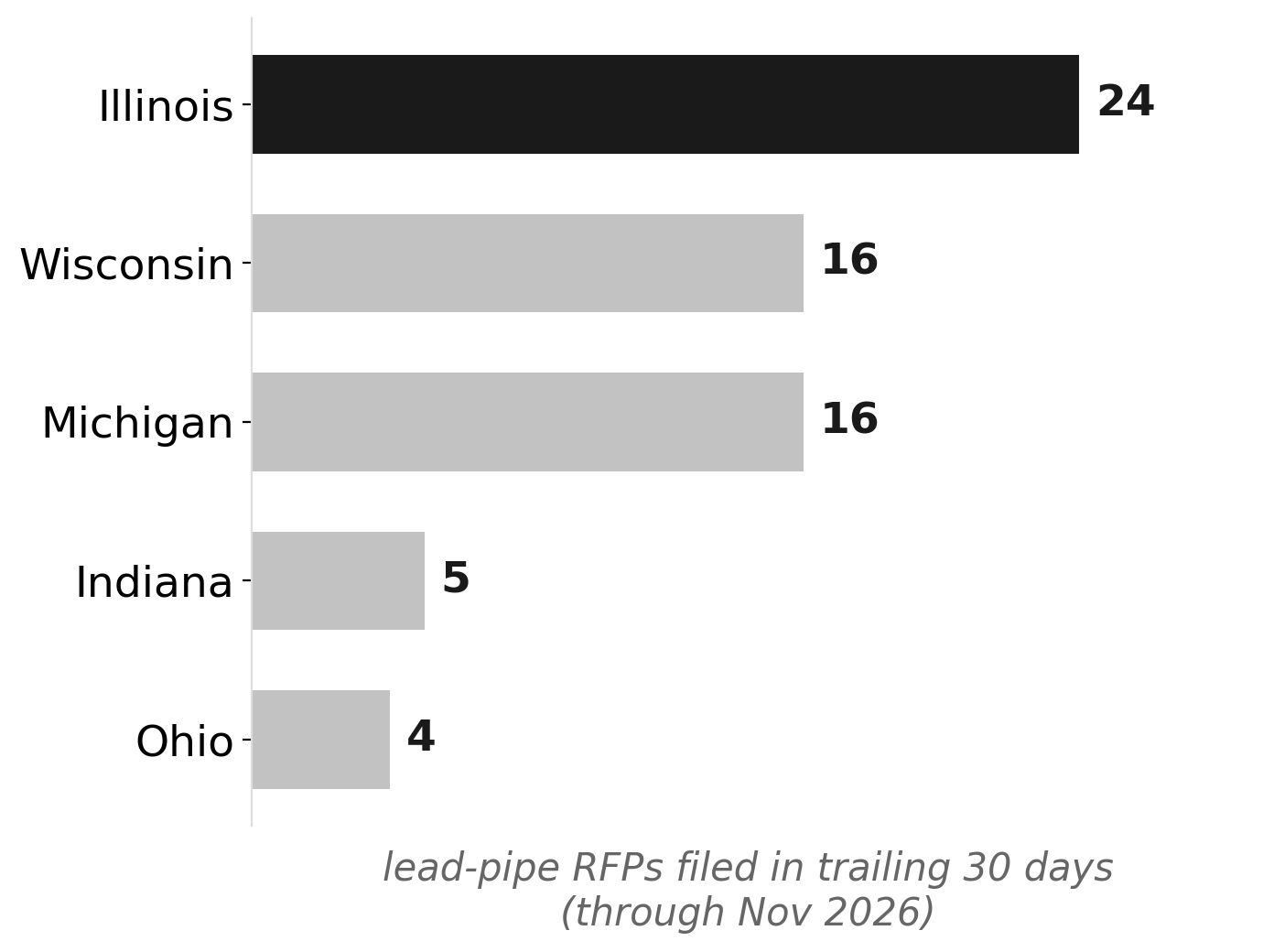
Illinois municipalities filed 24 requests for proposals on lead-pipe replacement work in the past 30 days, against a monthly average of roughly 2.7 over the prior year. That 9x surge is not a coincidence of timing. It is the sound of two deadlines colliding in the same five-month window.
The first deadline is federal. The EPA's FY2026 IIJA lead-pipe allocation sent $295.6 million to Illinois through the federal Drinking Water State Revolving Fund, the single largest state share nationally, at nearly 11 percent of the $2.875 billion total. According to a WaterWorld report on the 2026 allotments, FY2026 is explicitly the final year of the Infrastructure Investment and Jobs Act's $3 billion annual supplemental for lead-pipe replacement. No guaranteed federal program follows. Those dollars flow through the Illinois EPA to municipalities as loans and grants, and the fiscal year closes September 30, 2026.
The second deadline is Illinois's own. Public Act 102-0613, the Lead Service Line Replacement and Notification Act, requires every community water supply in the state to submit a final, binding replacement plan to IEPA by April 15, 2027. On that date, mandatory annual replacement schedules begin, calculated from each utility's pipe inventory. The two clocks, federal money running out, state mandate switching on, are not formally linked, but they create a practical squeeze: municipalities that have not yet contracted work face the prospect of mandatory replacement schedules starting in five months with no guaranteed funding behind them.
Source: NationGraph.
The geographic footprint of the surge is concentrated in Chicagoland, which is exactly where the pressure is greatest. Cook County accounts for 11 of the 24 recent RFPs, with active procurements from Homewood, Skokie, Evanston, Maywood, Bellwood, La Grange Park, and the Oak Park Housing Authority. Kane County has contributed 5, including two Aurora on-call contracts running through 2028. DuPage adds 3 more. Rockford, the state's second-largest city by population, is running Phase 11A and 11B of its replacement program simultaneously. Illinois outpaces every comparable Midwest state in 30-day RFP volume: Wisconsin and Michigan each logged 16, Indiana 5, Ohio 4.
The concentration in the Chicago suburbs is not arbitrary. Illinois carries an estimated 1.5 million lead service lines, more than any other state, and Chicago's situation is especially acute, the city has 412,000 confirmed or suspected lead lines, more than any city in the country, and as of late 2025 had drawn only $70 to $90 million of a $325 million federal loan extended in 2023. Chicago officials pledged to accelerate spending in 2026, and the suburban procurement surge likely reflects cities that do not want to be caught waiting while the larger municipality absorbs available capacity.
Full statewide replacement is estimated to cost between $6 and $10 billion. The federal DWSRF funding available covers roughly $1 billion of that gap. The Illinois General Assembly has not passed dedicated, sustained appropriations to close the remainder. That arithmetic is part of what makes the April 2027 deadline politically loaded: a mandatory replacement schedule that arrives without a funded path to meet it creates a compliance problem that falls first on smaller utilities with the least fiscal flexibility. A March 2026 report from Great Lakes Now found that full statewide replacement could generate 90,000 jobs over a decade, an argument that has given the issue traction in Springfield even as the gap in state appropriations remains open.
The federal picture has also grown less stable. Earlier this year, Congress proposed cutting $125 million from lead-pipe SRF appropriations, and the Chicago Sun-Times reported in January that state officials were lobbying against those cuts while trying to obligate committed FY2026 dollars before the year closed. IEPA currently holds an active $245.9 million EPA Drinking Water SRF grant running through June 2029, which serves as the primary conduit for federal disbursements to Illinois municipalities, but that grant disburses existing commitments; it does not represent new money.
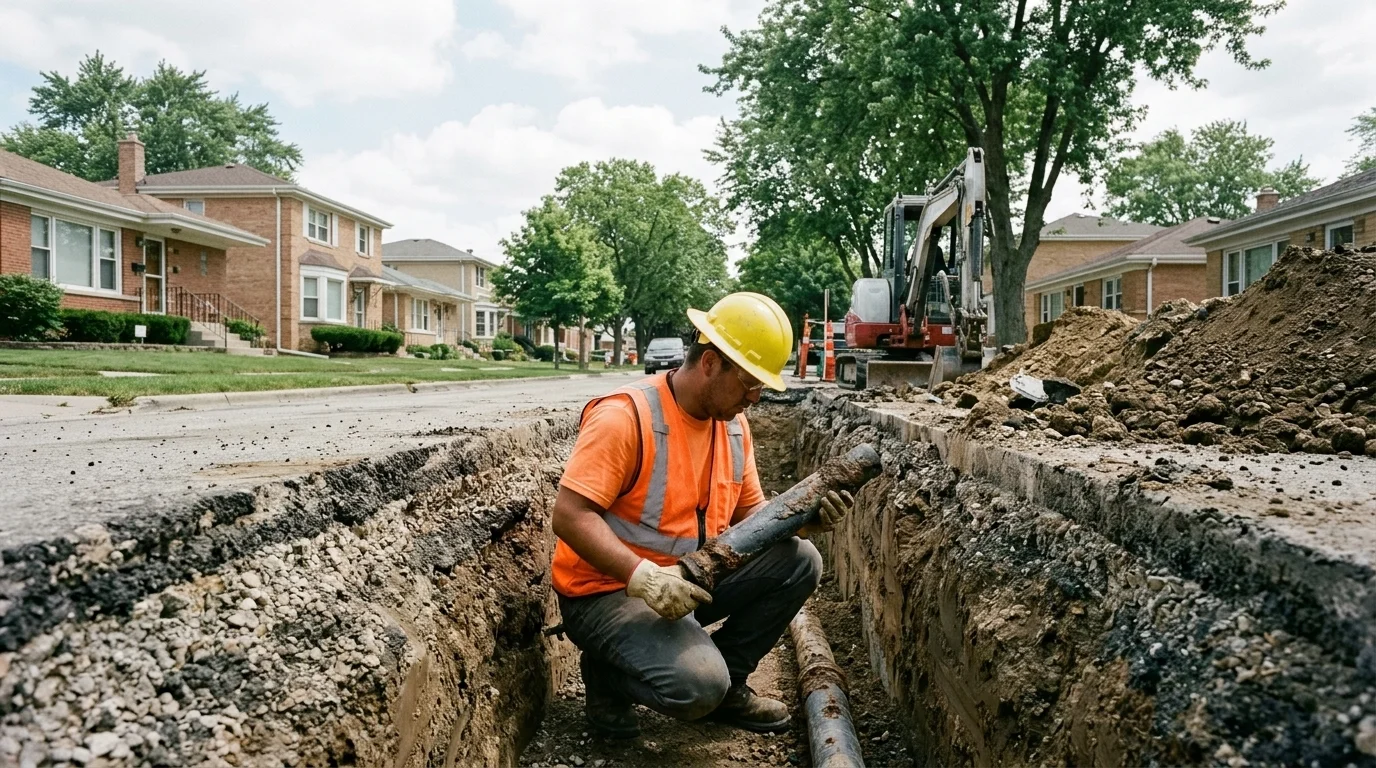
For residents in the communities now procuring contractors, the practical implication is straightforward: construction activity on lead-pipe work will accelerate through 2026 and 2027. For utilities that have not yet filed a credible plan, the April 2027 deadline is now closer than a typical municipal procurement cycle, meaning some communities may enter mandatory replacement schedules without contracted work in place.
The next signal to watch is what the Illinois General Assembly does in its spring 2027 session. The state's replacement mandate will be running by then, and municipalities will know exactly how wide the funding gap is between what federal money covered and what mandatory schedules require. Whether Springfield steps in to fill that gap, or leaves utilities to manage the shortfall through rate increases and deferred schedules, will determine whether the current contracting surge becomes the leading edge of full replacement, or only a down payment on a much longer backlog.