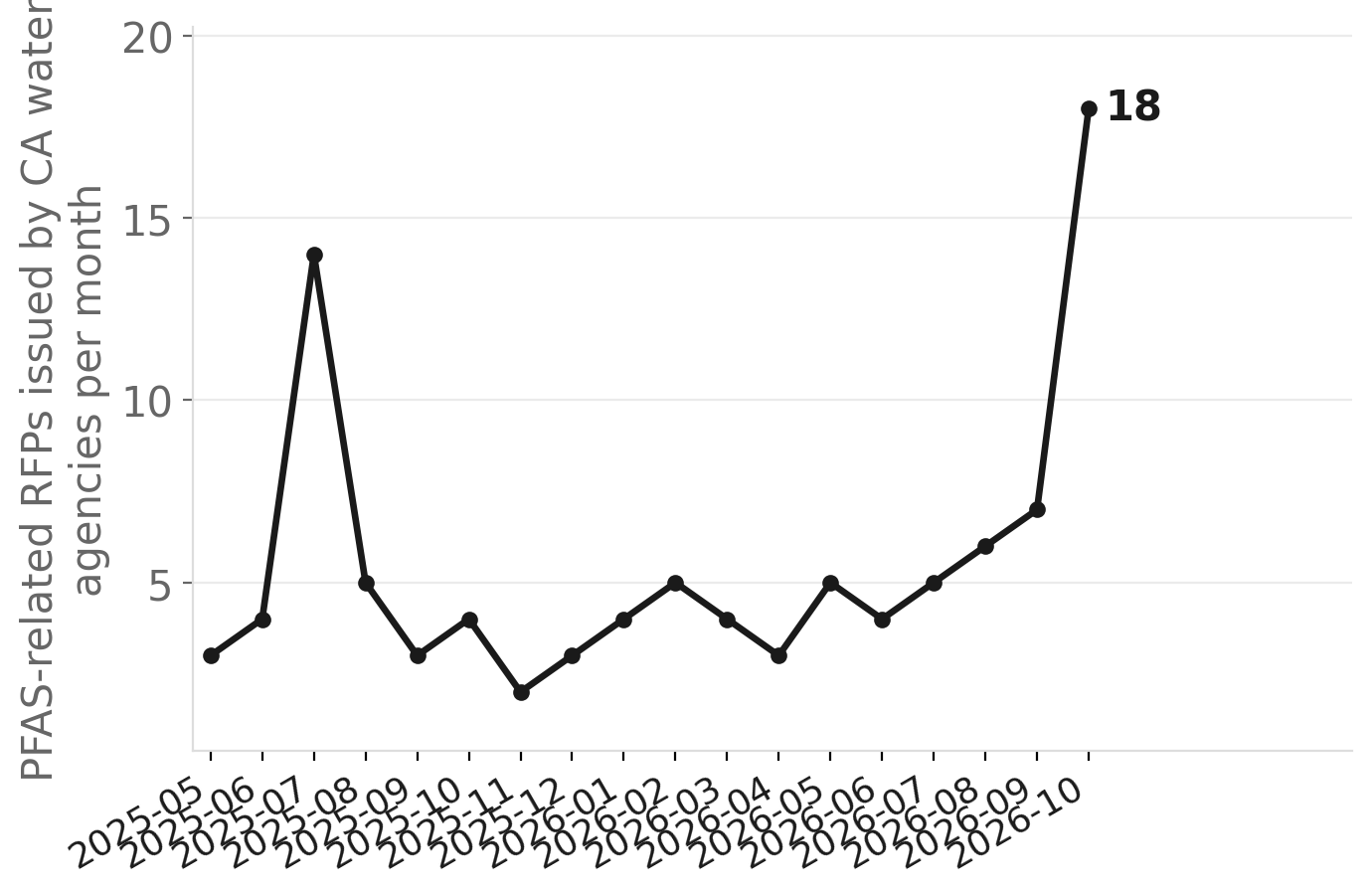
California water agencies issued 21 PFAS-related procurement solicitations in the past 30 days, 4.6 times the 12-month monthly average of about 4.6. October 2026 alone produced 18 RFPs, the highest single-month total in the 18-month dataset. Every one of those solicitations is for engineering design, construction management, or treatment system procurement, not planning studies. The agencies are past the question of whether to act. They are racing to build.
The proximate cause is money. In August 2026, the EPA announced $945.7 million in Emerging Contaminants in Small or Disadvantaged Communities grants for fiscal year 2026, with California receiving $77.3 million, the largest single-state allocation in the program. That announcement landed on top of two rounds of EPA Drinking Water State Revolving Fund capitalization grants, totaling roughly $197 million, that flow through the California State Water Board to individual utilities as low-interest loans and principal forgiveness. A third distinct channel, Congressionally mandated project earmarks, delivered money directly to named agencies: Western Municipal Water District received $6.45 million for contamination tied to March Air Reserve Base, and the City of Riverside received $960,000 for its Palmyrita Water Treatment Plant, both named in a May 2026 EPA announcement of $15.7 million for seven Southern California projects. Those two agencies are now the most active RFP issuers in the current spike: Western Municipal has put out five solicitations for its Arlington Desalter Plant, and Riverside has issued three for Palmyrita.
The concentration is not coincidental. Of the 14 agencies issuing RFPs, nearly all are in the Inland Empire and LA Basin, the same geography directly downstream of military installations whose AFFF firefighting foam contaminated groundwater for decades. California's water infrastructure is also unusually fragmented, with hundreds of small and mid-size districts that lack in-house engineering staff. An RFP for design services is their mandatory first step before a shovel enters the ground.
Source: NationGraph.
What makes the procurement surge notable is that the federal regulatory deadline is not actually close. The EPA's 2024 MCL rule set a 2029 compliance date for PFOA and PFOS, and a May 2026 proposed rule would push that to 2031 for systems requesting additional time, while simultaneously rescinding MCLs for four other PFAS compounds. Daniel Newton, assistant deputy director of California's Division of Drinking Water, has stated publicly that his office is not certain California systems would even be eligible for the two-year extension, or that the state would permit them to take it.
That ambiguity is itself the driver. California has 466 of its 2,363 tested water systems above federal PFOA/PFOS limits, the largest absolute count of any state, and no binding state MCLs of its own, only non-regulatory advisory notification levels. The State Water Board's Resolution 2026-0008, adopted in March 2026, designated PFAS rulemaking a top priority for the year. AB 794, authored by Assemblymember Jesse Gabriel of Encino, would require the board to adopt state MCLs at least as strict as federal limits, insulating California from federal rollback but also creating an independent compliance obligation that could arrive on its own schedule. On October 30, 2026, the California Office of Environmental Health Hazard Assessment opened a Proposition 65 consultation to add three more PFAS compounds, with public comments due November 30. The regulatory floor is not fixed; it is more likely to rise than fall at the state level regardless of what Washington does next.
Against that backdrop, the procurement math is straightforward. California currently holds $284.4 million in active federal PFAS grants across 36 awards. Only about $26.1 million has been outlayed, meaning the overwhelming majority of committed money is not yet under construction contract. Grant clocks run. Engineering, permitting, and procurement for a treatment system at a facility the size of Arlington Desalter or Palmyrita typically takes 18 to 36 months before construction begins. An agency that waits for regulatory clarity before issuing RFPs risks letting grant dollars expire or watching the political appetite for federal PFAS spending narrow.
Separately, the Army Corps of Engineers awarded a $9.5 million remedial investigation contract for PFAS contamination at Travis Air Force Base in Fairfield in September 2026, a signal that military-site remediation work, which runs on a parallel federal contracting track, is also accelerating.
The next signals to watch are the November 30 Proposition 65 comment deadline, which will indicate how quickly California moves to list additional PFAS compounds, and AB 794's trajectory through the state legislature in early 2027. If that bill passes, water agencies that have not yet locked in engineering contracts will face a binding state compliance clock with no federal safety valve. The 21 agencies that have already moved are betting the window is shorter than the deadline on paper.