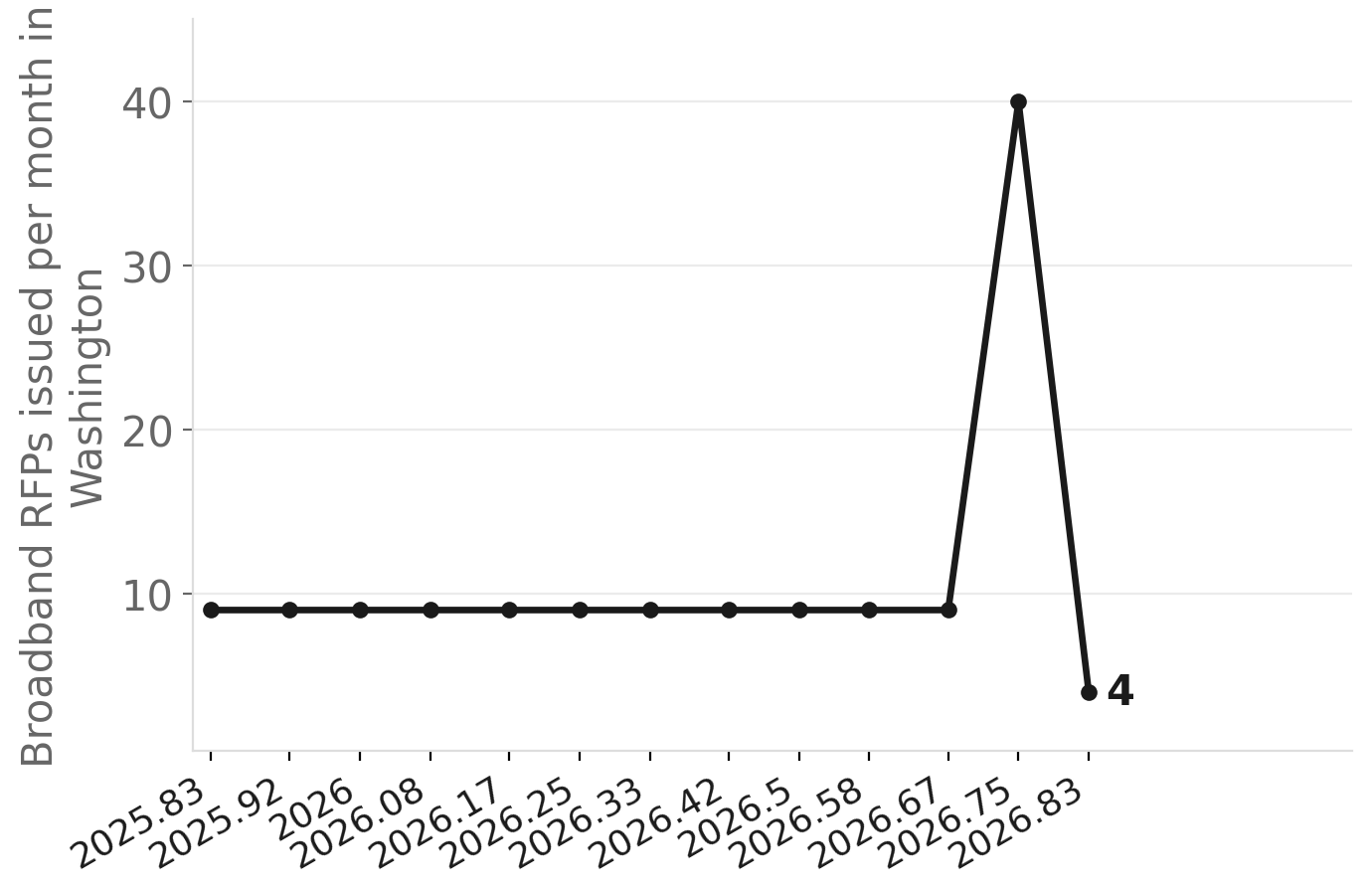
Washington State issued 31 broadband RFPs in the last 30 days, against a monthly average of roughly 9. October 2026 alone produced 40 solicitations, the highest single-month total on record. This is not a gradual ramp-up. It is the procurement signature of a hard deadline.
On October 8, 2026, the Washington State Broadband Office required all 26 of its BEAD subgrantees to execute federal contracts simultaneously. That deadline, set by WSBO Director Jordan Arnold, was the controlling event. When two dozen public entities, ranging from rural ports and county governments to federally recognized tribal nations, must each sign a federal agreement on the same day, they each need engineering specs, vendor quotes, and construction partners in hand before the ink dries. The result is visible in the solicitation data: a procurement avalanche that compressed what would ordinarily be months of staggered activity into a single October spike.
The legal calendar amplified the pressure further. Under federal environmental review rules, NEPA and NHPA assessments, which must be completed before any ground can be broken, cannot begin until subgrantee contracts are executed. Signing the contract is not the finish line; it is the starting gun for the next required sequence. Every week of delay in executing agreements is a week subtracted from the construction window before winter weather closes mountain and coastal job sites.
Source: NationGraph.
WSBO signed the first seven subgrantee contracts on September 24, representing $165 million in investment and commitments to connect 28,452 households. That signing itself followed a cascade: NTIA approved Washington's final BEAD proposal on February 26, 2026, authorizing $736 million in federal funding and $112 million in state match across 238 project areas, covering roughly 166,500 unserved or underserved homes and small businesses. The approved plan had been years in the making. Its approval set the clock running.
The top RFP issuers in the last 30 days illustrate how broadly the pressure is distributed. Northwest Open Access Network, known as NoaNet, issued six solicitations. The Washington State Department of Commerce issued four. Port of Columbia, Pierce County, and Lummi Public Works each filed two or more. The titles are specific: fiber-to-the-home construction, passive optical network equipment and installation, broadband engineering and project management. These are not planning documents. They are construction procurement.
A secondary layer of solicitations is coming from tribal entities operating under a parallel federal program. The Tribal Broadband Connectivity Program, administered separately by NTIA and distinct from BEAD in its eligibility rules and funding mechanism, has directed more than $88 million in active grants to more than ten Washington tribes, including the Spokane Tribe, Lummi Nation, Tulalip, Swinomish, Makah, and Lower Elwha. Those grants carry their own deadlines and procurement obligations, which is why tribal public works departments are appearing alongside ports and counties in the solicitation data. Washington's 29 federally recognized tribes are not incidental to this buildout; they are a substantial part of it.
The jurisdictional makeup of Washington's subgrantee pool matters for understanding why RFP volume here is higher than in states with comparable BEAD allocations. Twelve of the 26 subgrantees are public entities: public utility districts, ports, cities, counties, and tribal governments. Public contracting law requires competitive solicitation for procurement above relatively low thresholds. A private ISP can call a known construction partner and move. A port authority or a tribal government must post a public RFP, wait out a response period, evaluate bids, and document its selection. The same dollar of federal money generates more visible procurement activity when it flows through public entities.
The November data suggest the acute phase is passing. After 40 RFPs in October, the first two weeks of November produced roughly 4. The wave crested.
But it was the first wave. Approximately 23 percent of Washington's $1.2 billion BEAD allocation, roughly $276 million, remains unallocated, pending NTIA guidance on how remaining funds may be used. When that guidance arrives, the 26 current subgrantees and potentially additional entities will face a new round of contract deadlines and the procurement cycle will restart. Washington's broadband buildout, as the state's own BEAD spending plan makes clear, is not a single program but an overlapping sequence of federal commitments with different timelines, different grantee populations, and different environmental review clocks.
The number to watch now is not RFP volume but construction start notices. NEPA and NHPA reviews in mountainous and coastal terrain routinely take months. How many of October's newly contracted subgrantees clear environmental review before spring, when ground in Washington's higher elevations becomes workable, will determine whether the $1 billion-plus investment stays on schedule or begins accumulating delays.