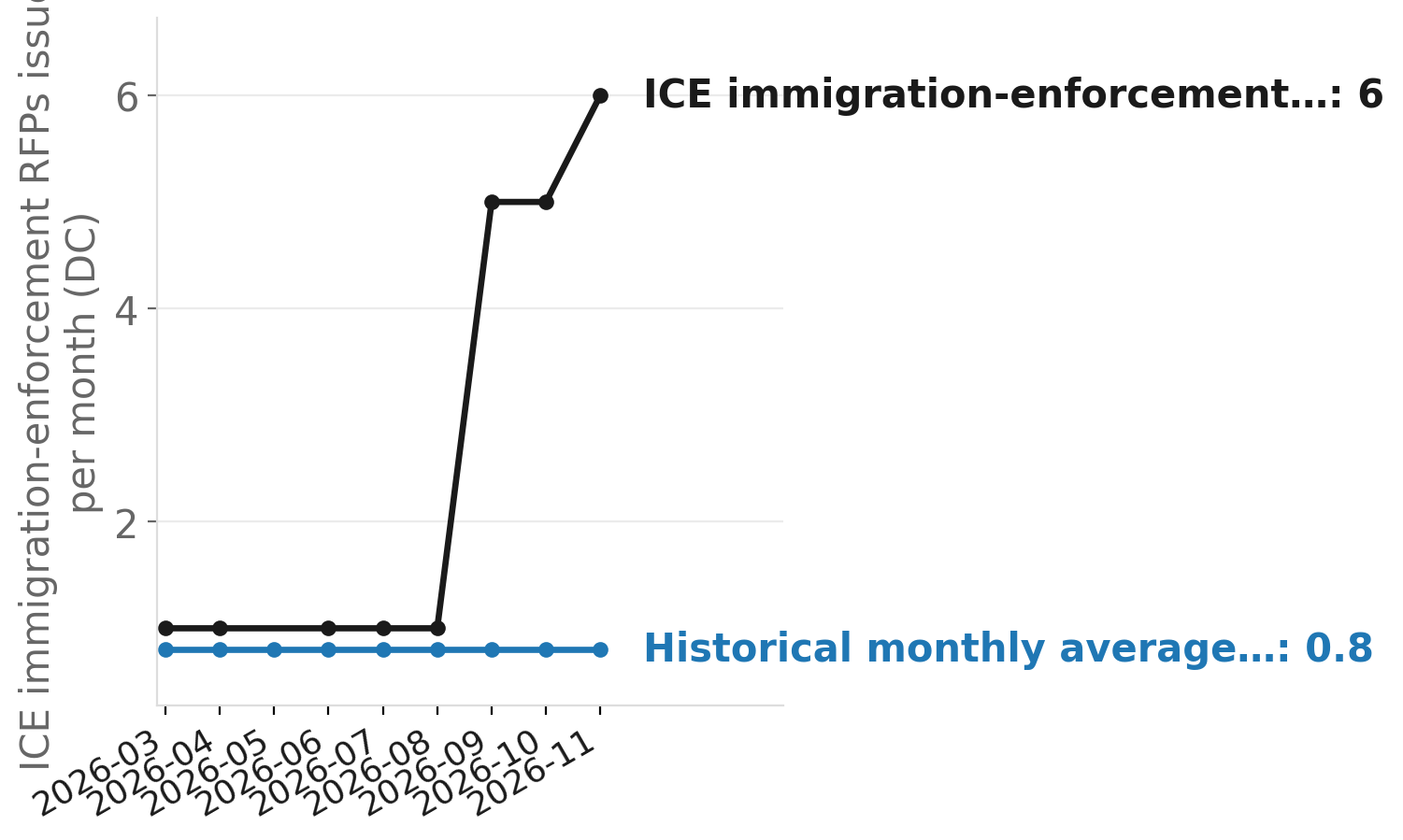
ICE issued 9 immigration enforcement-related solicitations through its DC acquisition footprint in the last 30 days, against a historical average of roughly 0.8 per month. That is a 10.8-times spike, and the composition of those nine requests matters as much as the volume: a license plate reader subscription, a law enforcement investigative database, a multi-service processing center market survey, a fiscal year 2027 recruitment and applicant portal, a firearms training facility access contract, and food supply and shredding services for detention operations. Each item, read alone, sounds like routine federal housekeeping. Read together, issued inside a single 30-day window at nearly 11 times the normal rate, they describe an agency assembling the full operational stack required to sustain mass enforcement at a scale the federal government has not previously attempted.
The driver is not a single policy but three distinct funding instruments now working in sequence. The One Big Beautiful Bill Act, signed in July 2026, allocated $45 billion specifically for detention expansion, funding ICE's internal Detention Reengineering Initiative, a $38.3 billion program targeting 24-plus converted warehouse facilities with a combined capacity of 92,600 beds. That is the capital layer. A separate appropriation under the Working Family Tax Cut Act funded the hiring of more than 10,000 new ICE law enforcement officers, generating the downstream procurement demand now visible in the DC solicitation set: training range access, investigative databases, HR platforms. And the start of the FY2027 budget cycle on October 1 triggered ICE's annual acquisition calendar, releasing the third funding stream, a $10 billion operations and support appropriation, into active contracting. The three instruments are complementary and sequential: one builds physical capacity, one staffed it up, one sustains the ongoing tempo. They should not be read as a single program, because they are not.
The timing confirms this is a sustained acceleration, not a one-month anomaly. The spike began in September 2026 with five RFPs, held at five in October, and is tracking six or more in November with weeks remaining in the month. According to a GAO report, ICE had already purchased more than $2.5 billion in warehouse and detention facilities through July 2026, with 11 warehouse acquisitions completed between January and April alone at a cost of approximately $1.07 billion. The procurement now visible in DC follows that capital deployment: once facilities are under acquisition, the agency needs surveillance infrastructure, staffing pipelines, food logistics, and investigative tools to operate them.
Source: NationGraph.
DC's concentration in the data is structural. ICE's Office of Acquisition Management centralizes federal contracting through its national headquarters, which registers in DC, meaning the city's solicitation volume functions as a leading indicator of ICE's national operational tempo. Nine of the 13 nationally geolocated immigration enforcement RFPs in the last 30 days originated there. A spike in DC does not reflect a single field office ramping up; it reflects decisions made at the top of the acquisition apparatus, with operational consequences distributed across every ICE area of responsibility in the country. Project Saltbox's September 2026 procurement tracker separately documented ICE pursuing single-award construction contracts for detention space at 13 national locations and turnkey facility RFPs for the Denver, Miami, Philadelphia, and Seattle areas of responsibility, activity that the DC solicitations are now beginning to supply with operating infrastructure.
The RFP set also includes at least one sole-source notice, the license plate reader subscription, procured outside competitive channels. A March 2026 House Homeland Security minority brief flagged that ICE is increasingly relying on sole-source contracts and expedited procurement procedures, a pattern that compresses public visibility into what the agency is acquiring and from whom. The FY2027 DHS budget justification lists 41,500 detention beds as the planning floor for FY27, with ICE leadership acknowledging that surge authorities from FY26 remain available above that figure.
For residents and institutions in the DC metro area, the practical stakes are limited: most of what ICE is soliciting here will be executed elsewhere. The significance of the DC concentration is what it reveals about national intent. A recruitment portal means the agency expects to keep growing its officer count beyond the initial 10,000-hire surge. A multi-service processing center market survey signals the agency is still mapping gaps in its detention geography. A food supply contract for detention operations means someone has to provision facilities at the scale of a small city.
The next signal to watch is the November 30 target date ICE's Detention Reengineering Initiative set for opening 24 warehouse facilities. If that deadline holds, the December procurement calendar should shift from capital acquisition toward operational sustainment contracts: medical services, transportation, legal processing, and staffing. If the deadline slips, expect a second wave of facility and construction solicitations. Either outcome will be visible first in DC.