Nine Florida institutions have issued their first flood-related procurement solicitations in more than a year, all within the past 30 days, and none of it has anything to do with a new storm. The driver is older paperwork finally clearing: the $4 billion in Community Development Block Grant Disaster Recovery funds that Congress approved in December 2024 for damage from Hurricanes Idalia, Debby, Helene, and Milton has now survived its mandatory planning gauntlet, and the counties that received it are entering the active contracting phase with spend-down clocks already running.
The named re-entrants span nine jurisdictions: Lee, Pasco, Sarasota, Volusia (Port Orange), Martin, Polk, Orange, Parker in Bay County, and the Cedar Key Water and Sewer District in Levy County. Several RFPs make the funding source explicit. Lee County's solicitation is titled "CRS Watershed Planning Study – CDBG-DR." Polk County posted "Rifle Range Road Drainage Improvements (CDBG)." Cedar Key's filing reads "CDBG-DR Potable Water System Hardening." These are not coincidentally timed procurements; they are the predictable output of a federal pipeline that typically takes 12 to 18 months to move from a presidential disaster declaration to a contractor's bid portal.
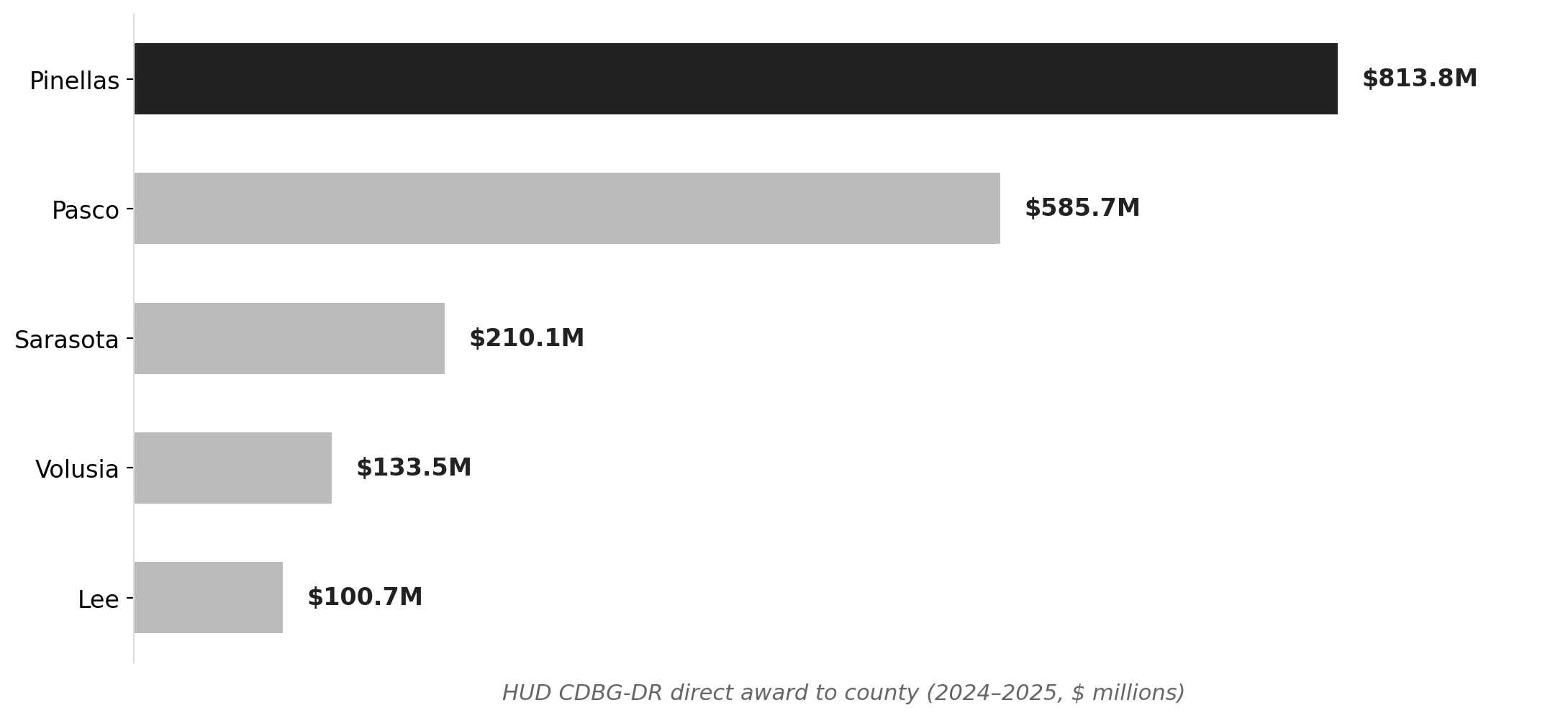
The HUD allocation, confirmed in January 2025, went to the counties hit hardest by the 2023-2024 storm cycle. According to HUD's CDBG-DR program, Pinellas County received $813.8 million, Pasco $585.7 million, Sarasota $210.1 million, Volusia $133.5 million, and Lee $100.7 million. Every one of those counties now has an active flood solicitation on the street. Pinellas, the largest recipient, publicly noted that infrastructure investments would follow in 2026, aligned with FEMA hazard mitigation data, a timeline that has now arrived. The mandatory sequence that consumed most of 2025 (needs assessment, action plan drafting, HUD approval, program guideline development) is structurally required before a dollar can reach a contractor; mid-2026 is simply when that sequence ends for the bulk of Florida's allocations.
Source: NationGraph.
A second accelerant arrived on March 25, 2026, when FEMA restored the BRIC program, injecting $1 billion in FY2024-25 pre-disaster mitigation funds with a federal application deadline of July 23, 2026. BRIC had been terminated in April 2025, making its restoration both unexpected and urgent. County sub-applicants that had shelved mitigation proposals suddenly had a narrow window to compete, and the deadline fell directly inside the 30-day window when the RFP spike appeared. FEMA separately announced more than $235 million in Flood Mitigation Assistance awards on April 22, 2026, and the Florida Division of Emergency Management received a $4.99 million Flood Mitigation Assistance grant from DHS the same month, a signal that federal engagement at the state level has not slowed even as BRIC's political future remains contested.
The broader federal flood portfolio flowing to Florida is substantial. The Florida Department of Environmental Protection currently holds $1.69 billion in active EPA flood-related grants running through 2030, providing a long baseline of federal engagement that the CDBG-DR surge is now layering on top of. Against that backdrop, the monthly average of Florida institutions active on flood procurements over the prior 12 months was 16.9. The current 30-day window's nine first-time re-entrants represent a distinct cluster of governments returning to the market after a year of silence, not simply a continuation of normal volume.
For residents in the affected counties, the practical consequence is that flood infrastructure decisions deferred during the planning phase are about to be made quickly and under deadline pressure. Watershed studies, drainage improvements, and potable water hardening projects will move from solicitation to award to construction within windows shaped by federal spend-down requirements, not local engineering timelines. Sarasota and Lee, both direct Helene and Milton impact zones, are issuing RFPs while storm-damaged infrastructure in some neighborhoods has not yet been fully restored, meaning the same contractors being solicited for new CDBG-DR work may already be engaged on repair contracts in the same geography.
The next signal to watch is award velocity. CDBG-DR grantees face ongoing HUD reporting requirements and risk losing unobligated funds if procurement timelines slip. The RFP wave establishes intent; contract awards over the next 60 to 90 days will show whether the planning-phase delays have given way to genuine execution speed, or whether a new bottleneck, this time on the contractor side, slows the pipeline again.