
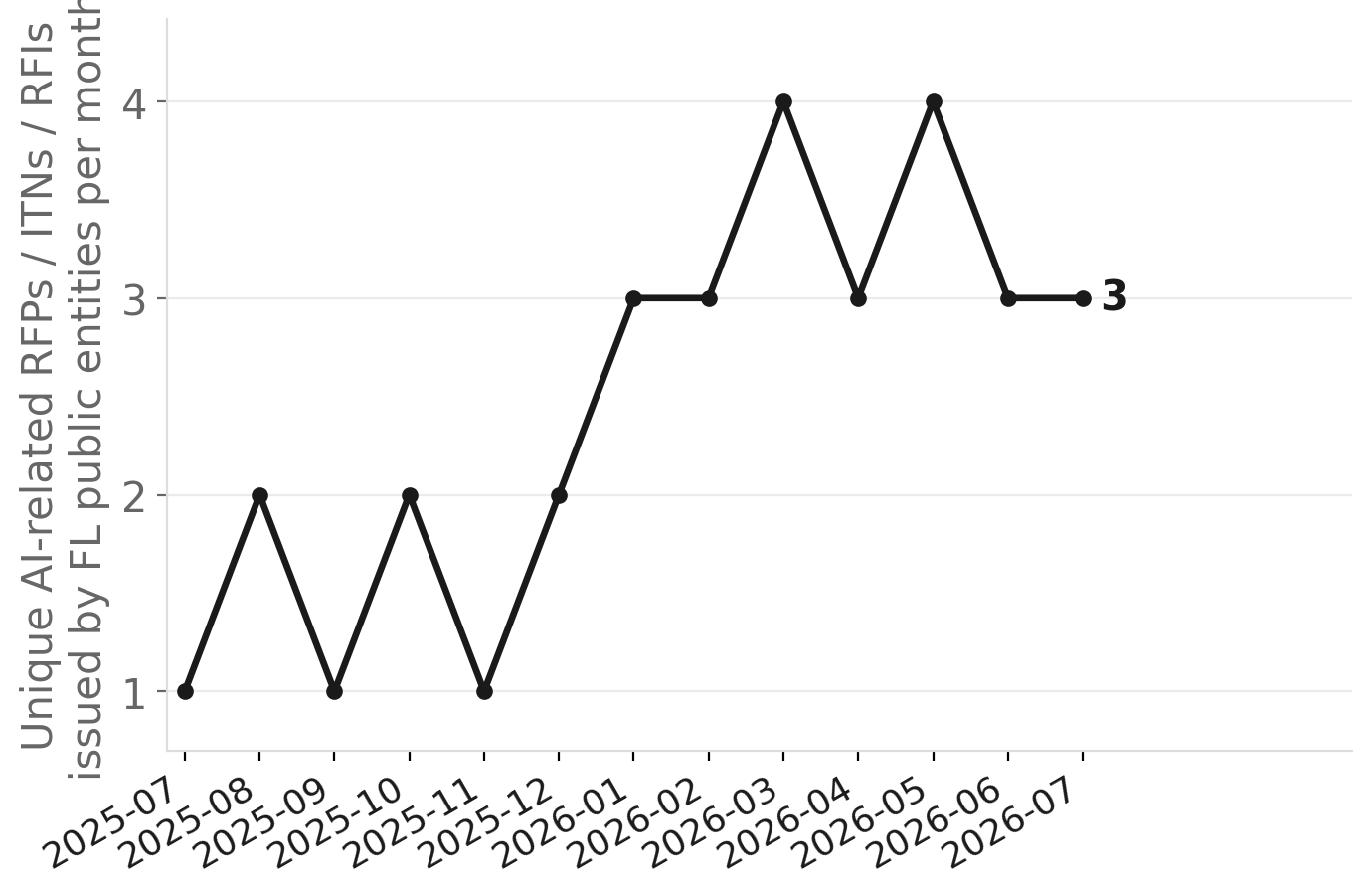
Florida's public sector issued roughly three to four unique AI-related procurements per month in the first quarter of 2026, double the pace of the second half of 2025, and the acceleration has nothing to do with a state mandate, because Florida has none. The rules for how 22 million Floridians' government interacts with artificial intelligence are being written, piecemeal, by county budget offices and a university cooperative purchasing desk.
The vacuum at the center of this story has a precise date: March 13, 2026. That is when Florida SB 482, Governor DeSantis's proposed "AI Bill of Rights," died in the House after Speaker Daniel Perez declined to advance it. Perez's stated rationale was federal preemption, President Trump's Executive Order 14365, signed December 11, 2025, directed federal authorities to challenge state AI laws that conflicted with the administration's deregulatory posture and contemplated limiting federal funding to noncompliant states. DeSantis pushed back publicly, arguing Florida retained the right to regulate AI, but could not move the legislation over his own legislature's resistance. The result: Florida entered mid-2026 as one of the largest states in the country without a statutory AI governance framework for public-sector use.
What filled the gap is visible in procurement records. Florida State University launched ITN 6769-4, a cooperative AI systems and services contract with a response deadline of October 21, 2026. The structure is significant: the contract is explicitly open to all Florida public entities, including every state agency, K-12 district, local government, and nonprofit in the state. No law required FSU to build this vehicle, and no law requires any other entity to use it. But in the absence of a state purchasing standard, a cooperative master contract from a major public university becomes the closest thing Florida has to a unified AI procurement framework, assembled by a university office rather than a legislature.
Source: NationGraph.
At the county level, Pinellas County's Bureau of Technology Services has twice gone to market for an enterprise AI strategic roadmap and governance framework, first as RFP 26-0564 and then as a re-bid under 26-0732, with proposals evaluated in August 2026. The scope of the Pinellas solicitation is telling: it asks vendors to assess current-state AI readiness, draft a responsible-use policy, build a three-to-five year roadmap, and produce an ROI analysis. That is not a county adding a software tool. That is a county writing the governance infrastructure that, in most states, arrives from the statehouse. The contract is funded from local operating funds, Clearwater's property tax levy, not a federal grant or state bond.
St. Petersburg issued an AI solutions request for information in May 2026. North Miami Beach put out an AI-enabled utility management RFP in July. USSOCOM at MacDill Air Force Base solicited AI autonomous solutions the same month. The pattern across Tampa Bay and South Florida is not coordinated, each procurement reflects an independent local decision, but they share a common condition: every one of these entities is operating without statewide guidance on what responsible public-sector AI use looks like.
This is not without precedent elsewhere. Florida's research universities are already deeply embedded in the federal AI ecosystem: the University of Florida secured a $4.7 million Air Force contract for AI-driven decision-making at Eglin AFB, and NSF AI grants to UF, FSU, UCF, USF, and Embry-Riddle collectively exceed $15 million in active awards. The research infrastructure exists. What does not exist is the statutory layer that would tell a county commissioner in Clearwater or a school superintendent in Pensacola what constraints apply when they deploy an AI system against public records or student data.
For a resident of Pinellas County, the practical effect of the legislative failure is that their county's AI policies will be written by whichever consulting firm wins RFP 26-0732, a firm that will also, almost certainly, be writing similar frameworks for other Florida counties without the internal capacity to run their own competitive solicitations. The Pinellas scope will likely become a template whether or not it was intended to be one.
The next signal to watch is FSU's October 21 deadline. If the cooperative contract draws broad participation from state agencies and smaller counties, the entities least equipped to run independent AI procurements, it will function, in practice, as the statewide AI vendor framework that the legislature chose not to create. That outcome was not designed by any statute. It emerged from a political standoff between a governor, a house speaker, and a federal executive order, with Florida's county IT departments left to fill in the rest.