Federal AI-related grants flowing into Nebraska hit $7.71 million in the last 90 days, a 313% increase over the same window a year ago, and nearly all of it traces back to a single policy decision Congress made in 2022 and NSF finished implementing this summer.
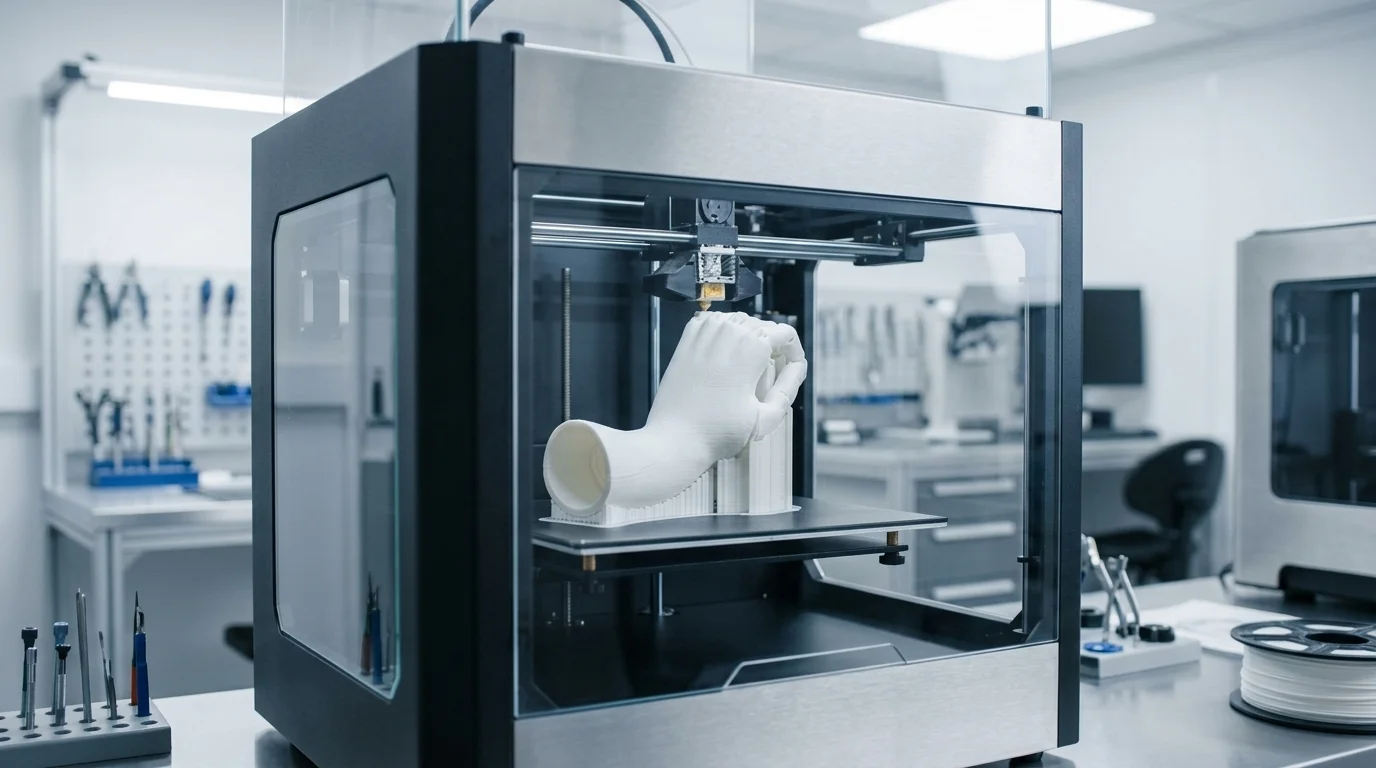
The anchor award is a $5.89 million NSF E-RISE grant to the University of Nebraska at Omaha, establishing the Nebraska Center for 3D Innovation, known as NE3D. The center opened officially on August 15 at UNO's Biomechanics Research Building. It is a statewide network linking UNO, the University of Nebraska-Lincoln, the University of Nebraska Medical Center, Children's Hospital's Mammel Innovation Center, Clarkson College, Metropolitan Community College, and industry partner Shabri LLC. Its research focus is AI-enhanced healthcare and additive manufacturing: using machine learning to design and produce customized medical devices, prosthetics, and tissue-adjacent structures for patients, including those in rural areas with limited specialist access.
The project's lead researcher, Dr. Jorge Zuniga, began developing the NE3D concept in 2016. For a decade, it existed as a research direction in search of the funding scale to become an institution. According to UNO, the E-RISE award, capped at $8 million over four years nationally per grant, is near that ceiling, giving NE3D a runway through 2030 to build facilities, train graduate researchers, and develop industry partnerships.
The reason the money arrived now, rather than in 2019 or 2022, is structural. The CHIPS and Science Act of 2022 (P.L. 117-167) authorized NSF to redesign its EPSCoR program, which for decades has directed research capacity toward states historically underrepresented in federal R&D funding. NSF replaced the old Track-1 structure with two distinct vehicles: E-RISE, which funds a focused multi-institutional incubator around a specific scientific topic, and E-CORE, which funds broader, jurisdiction-wide research ecosystem infrastructure and STEM career pipelines. Both carry an explicit equity-in-research mandate. Nebraska's prior Track-1 award, a $20 million quantum-materials project called EQUATE, expired May 31, 2026, clearing the eligibility window for UNO to compete under the new rules.
NSF awarded Nebraska an E-CORE grant as well, under the NSPIRE project, making Nebraska one of only four states nationally to receive both a new E-RISE and a new E-CORE award in the same cycle. The two programs are not the same thing: E-RISE funds NE3D's specific AI-health research incubator, while E-CORE funds statewide infrastructure and career pathways that cut across multiple institutions and disciplines. The distinction matters because the two awards represent NSF deepening its Nebraska footprint across parallel tracks simultaneously, not a single large grant being counted twice.
The remainder of Nebraska's 90-day surge comes from NSF's Computer and Information Science and Engineering program: $782,000 for bacteria-inspired AI edge computing and $433,000 for multi-modal transfer learning applied to breast cancer detection, both at University of Nebraska institutions, plus a $307,000 HHS grant for cancer-treatment AI. These are individual investigator awards, not EPSCoR vehicles, and they reflect ongoing activity in the state's AI research base rather than the new program structure. The prior-year baseline was four CISE grants averaging under $470,000 each, solid but unremarkable.
Nebraska's total active AI-related federal grant portfolio now stands at $18 million across 16 grants. Only $304,000 of that has been disbursed so far. The commitment is real; the execution is just beginning.
For context, Nebraska's $7.7 million 90-day total briefly puts it in the same range as Colorado ($7.8 million, 14 grants) and Missouri ($7.5 million, 15 grants), larger research states with more established federal R&D pipelines. That parity is almost certainly temporary: those states draw from broader, more diversified grant portfolios, while Nebraska's surge is concentrated in a small number of large awards that won't recur on the same timeline. The more durable signal is the institutional network NE3D is building. Centers of this kind, networked across a public university system, a medical center, community colleges, and an industry partner, tend to generate follow-on grants, workforce pipelines, and corporate R&D relationships that outlast any single federal award cycle.
NSF's E-RISE cohort in the same window includes Boise State ($6 million) and Puerto Rico ($4.8 million), confirming this is a nationally distributed push rather than anything Nebraska-specific. The program was designed to route AI and advanced-tech capacity to places that have historically been crowded out of the federal research economy by the concentration of NSF dollars in a handful of coastal research universities.
The next signal to watch is disbursement. Nebraska's $18 million portfolio has barely started spending. NE3D's first full operating year will reveal whether the institutional network Zuniga spent a decade assembling can absorb and deploy resources at the pace NSF's new program structure assumes.