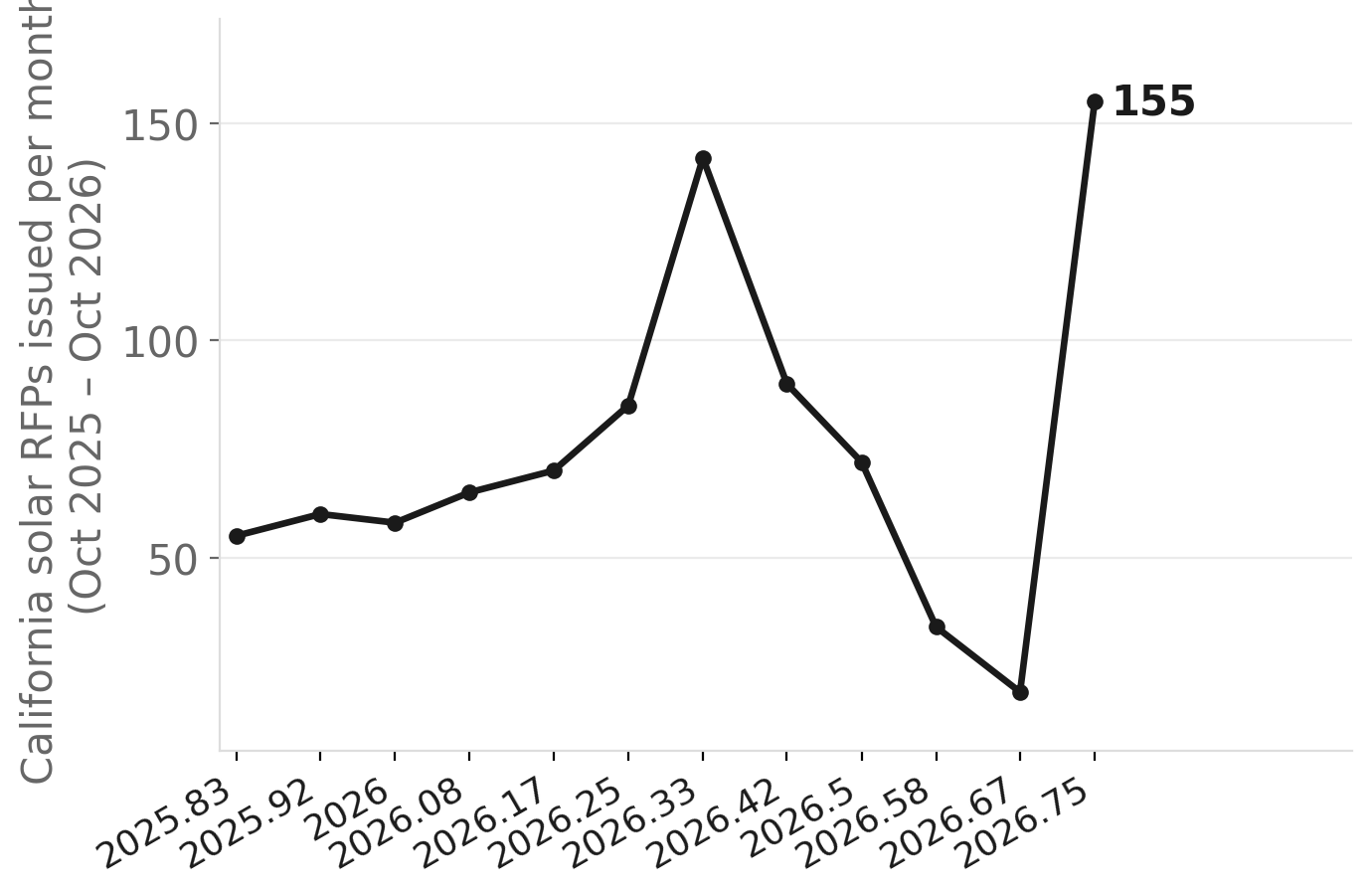
California's public agencies issued 155 solar procurement requests in October 2026, the highest single-month count in the trailing 13-month record and 2.4 times the prior monthly average of roughly 63. The buyers range from water treatment districts in the Central Valley to school districts in the Inland Empire to statewide umbrella solicitations from the California Department of General Services. The unifying force is a single federal deadline: December 4, 2026.
On August 6, President Trump signed a Section 232 proclamation imposing a $0.38-per-watt minimum import price on solar modules and a 15% ad valorem tariff on cells and modules, effective December 4. For agencies that execute contracts before that date and take delivery of pre-tariff modules, the math still pencils. For those that miss the window, it almost certainly doesn't. Anza Renewables tracked median imported module prices hitting $0.38/W for post-December 4 delivery in late September, up from $0.27/W before the proclamation. That is a 41% increase, applied uniformly, with no federal Investment Tax Credit to absorb it: the 30% ITC expired December 31, 2025 and was not renewed.
The October RFP surge is almost certainly the market internalizing those numbers. The data shows why: after the proclamation landed in August, California solar RFP volume collapsed to 34 in August and 19 in September, the two lowest months in the record. Agencies paused to assess what the tariff would cost and whether pre-tariff procurement was viable. The answer, apparently, was yes, and October became a controlled sprint. The prior monthly peak, May 2026, reached 142 RFPs. October surpassed it by nine percent.
Source: NationGraph.
The breadth of buyers is striking. The California Department of General Services issued an umbrella request for qualifications explicitly covering solar, wind, battery storage, microgrids, and other clean energy technologies, a solicitation structure designed to let dozens of state agencies piggyback on a single competitive process. School districts, including Porterville Unified, Chino Valley Unified, and Santa Cruz City Schools, issued their own standalone RFPs. So did municipal utilities and general services departments in Pasadena, Redding, and West Sacramento, alongside water and wastewater agencies in Manteca. Every tier of California's public sector appears to be moving simultaneously.
A second, structural force is amplifying the urgency without creating it. CPUC Decision D.26-02-057, issued February 26, 2026, requires California's electricity providers to procure 6,000 megawatts of new zero-carbon generation and storage capacity by 2032, with at least 25% from firm or long-duration resources. That mandate is generating institutional solicitations from utilities and Community Choice Aggregators that cascade into the local government procurement market. Clean Power Alliance's 2026 Clean Energy and Reliability RFO is one direct example. The CPUC obligation explains why California's RFP volume was already elevated in early 2026; it does not, by itself, explain why October spiked to 2.4 times the average. The December 4 tariff deadline does.
The geographic specificity of the surge matters. California's 155 October RFPs are 2.2 times New York's 71 and 5.7 times Texas's 27 in the same 30-day window. New York's count is itself elevated, likely for related reasons, but the California-to-Texas gap alone suggests this is not a generic national procurement uptick. It reflects California's particular combination of the most extensive public-sector solar mandate infrastructure in the country, Title 24's solar-plus-battery requirements for new construction (expanded under AB 130, effective January 1, 2026), and a public agency market sophisticated enough to move fast when pricing signals change.
For taxpayers and ratepayers in California, the practical stakes are real. Public agencies that lock in contracts before December 4 can potentially save tens of thousands to millions of dollars per project depending on system size. A school district installing a 500-kilowatt system at $0.27/W for modules versus $0.38/W represents roughly $55,000 in direct material cost difference before installation and soft costs. Multiplied across dozens of school districts and municipal projects, the aggregate is significant. Agencies that miss the window face the same 2032 compliance obligations under the CPUC mandate, the same Title 24 building code requirements for new construction, and a cost structure that has shifted structurally higher.
The next signal to watch is whether contract awards follow the RFP volume at the same pace. An RFP is a procurement intent; a signed contract is the cost lock-in. Agencies typically have 60 to 90 days between solicitation and award, which means October RFPs should be resolving into contracts in December and January, straddling the tariff effective date. Whether California's suppliers and procurement offices can execute that volume in that compressed timeline will determine how much of this October sprint actually converts to pre-tariff savings.