North Carolina received $66.5 million in federal wildfire grants in the last 90 days, a 6,069% increase over the $1.1 million it drew in the same window a year ago, making it the largest recipient of wildfire-tagged federal dollars of any state in the country for that period. Virginia, also battered by Helene, ranked second at $39.4 million. The distance between North Carolina and everywhere else reflects something that has no real precedent in the region's history: a hurricane turned a wet mountain forest into a slow-burning fuse.
The anchor award driving those figures is a $64.5 million, 10-year USDA Forest Service Good Neighbor Authority agreement signed September 2, 2026 with the NC Forest Service, housed within the NC Department of Agriculture and Consumer Services. The agreement funds hazardous fuel reduction in the wildland-urban interface of the Pisgah and Nantahala national forests, and, critically, extends eligibility to private property in disaster-affected counties, a significant expansion of the program's usual reach. As Agriculture Commissioner Steve Troxler framed it, the money is designed to protect "homes, property and timber resources" across the region still rebuilding from Helene's flooding.
That September agreement is additive to, not a replacement for, a separate $290 million Good Neighbor Authority deal signed February 5, 2026 with the NC Wildlife Resources Commission, described by the USDA Forest Service as the largest such agreement in the agency's history. The two agreements serve distinct purposes under the same statutory authority: the Wildlife Resources Commission agreement focuses on the national forest interior, covering debris removal, road and recreation area repair, watershed restoration, and wildlife habitat; the Forest Service agreement targets the interface zone where forest meets community and where fire risk translates most directly into property loss. Together they represent more than $350 million in USDA commitments to Western NC since February.
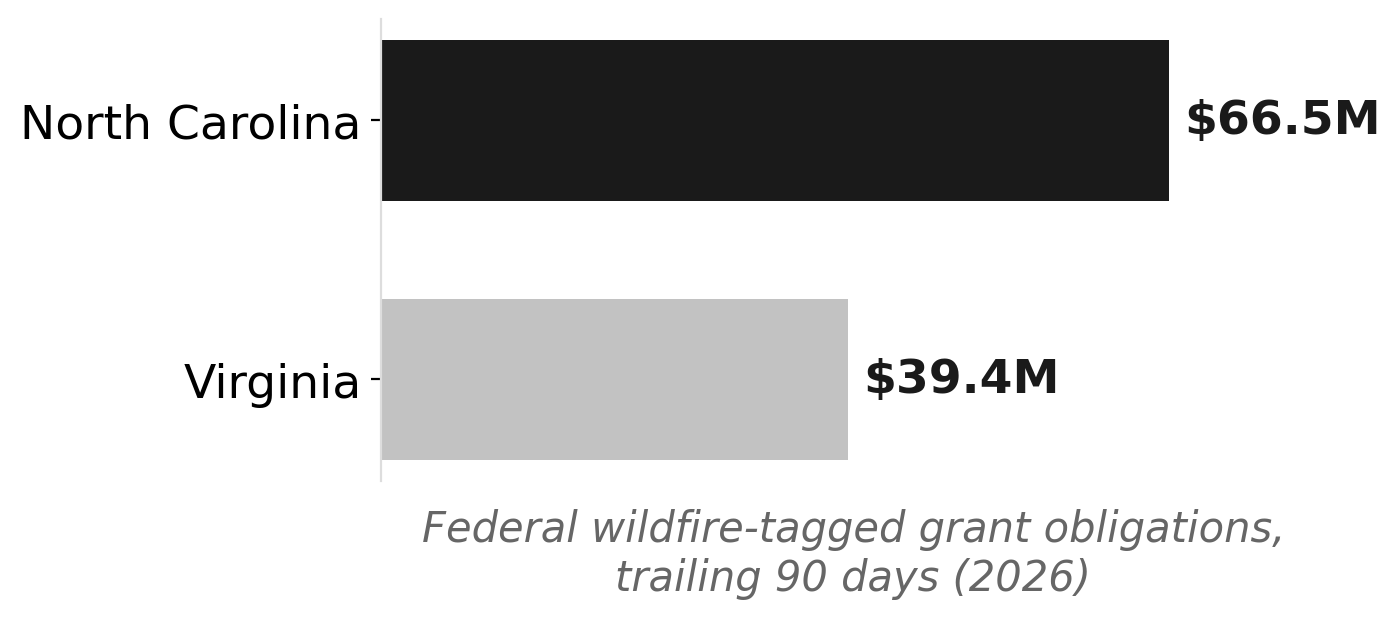
Source: NationGraph.
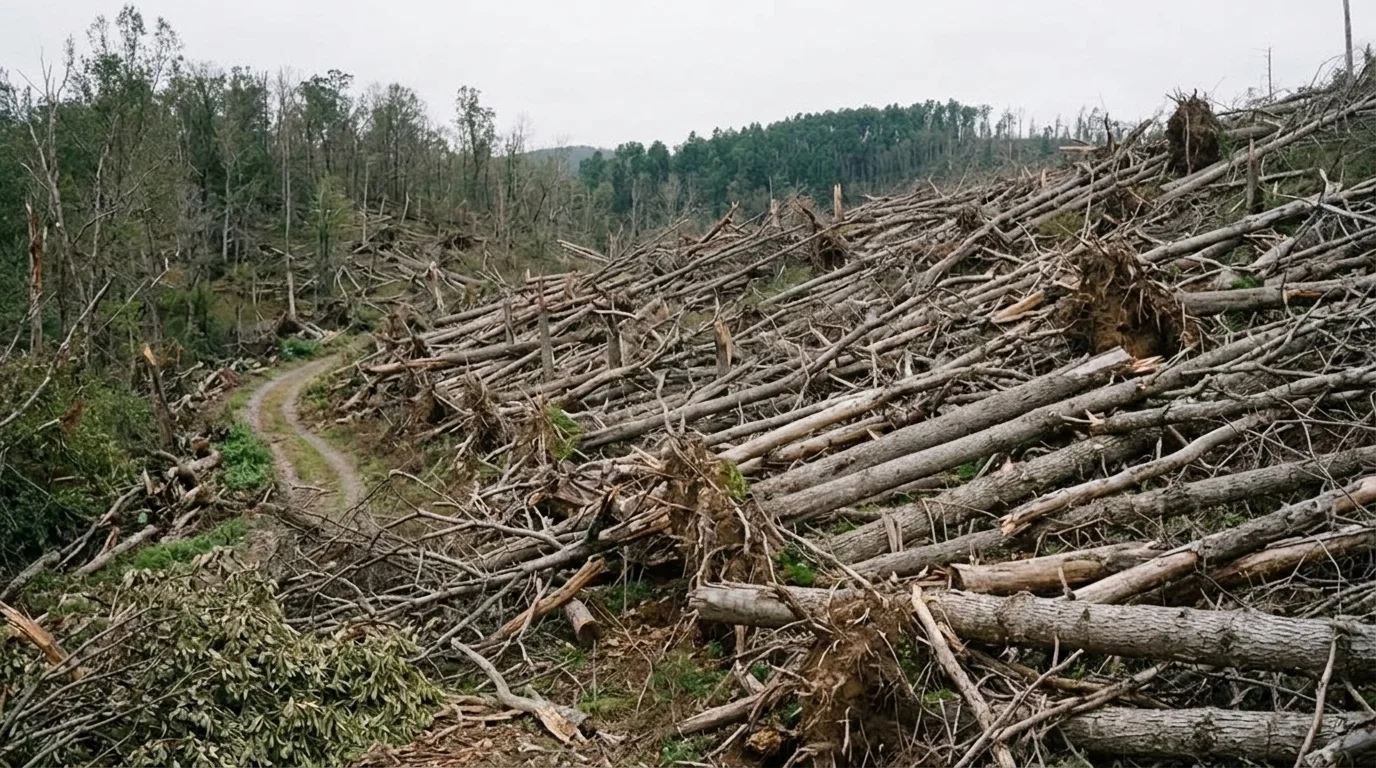
The reason for the urgency is what happened to the forest itself. According to the USDA Forest Service's own assessment, Hurricane Helene deposited a massive volume of fallen timber across roughly 822,000 acres in 25 western North Carolina counties. That material has been drying for two years. What was waterlogged debris in late 2024 is now seasoned fuel sitting on steep terrain with limited road access, the same terrain that makes it difficult to get logging crews and fire equipment in quickly. NC Forest Service officials have warned that some of the most heavily damaged areas may remain at elevated fire risk for 10 to 20 years before natural decay reduces the fuel load.
The state got an early signal of what that risk looks like in practice. Governor Josh Stein declared a state of emergency for Western NC wildfires in spring 2025 after the Black Cove fire burned in Polk County, fueled by Helene-deposited debris. The National Interagency Fire Center has since forecast above-normal wildfire risk for the region. At a March 2026 legislative hearing, NC Deputy Forester Kevin Harvell and the state fire marshal told lawmakers the state needed significantly greater wildfire preparedness capacity, a warning that preceded both major GNA agreements by weeks.
The Good Neighbor Authority, first enacted in 2001 and expanded under the 2018 Farm Bill, allows the Forest Service to partner with state agencies for fuel reduction and forest restoration work that crosses jurisdictional lines, public and, in disaster-affected areas, private. It has historically been used most heavily in Western states. That North Carolina now sits at the top of the national wildfire grant rankings reflects how thoroughly Helene reorganized the risk map. The Carolina Journal and NC State University researchers flagged this shift as early as late 2025, noting that Appalachian terrain, once protective against large fire spread due to humidity and topography, had been fundamentally altered by the volume and distribution of the blowdown.
For residents of the 25 affected counties, the practical implication is that federally funded crews will be working in the interface zone for years. The NCFS agreement explicitly covers invasive species management and forest restoration alongside fuel removal, meaning the work extends beyond fire prevention into longer-term land recovery. The $571,000 in USDA Cooperative Fire Assistance and $460,000 in Hazardous Fuel Reduction grants awarded in August and September 2026 represent smaller but operationally immediate supplements to that effort.
What remains unresolved is the workforce constraint. As the News from the States reporting on NC forestry has documented, the region lacks the trained logging crews, sawmill capacity, and fire personnel to move at the pace the fuel load demands. Federal dollars can authorize the work; they cannot instantly build the labor infrastructure to execute it. How quickly the state can scale up that capacity, and whether it can do so before the next high-risk fire season, is the open question the next 12 months will answer.