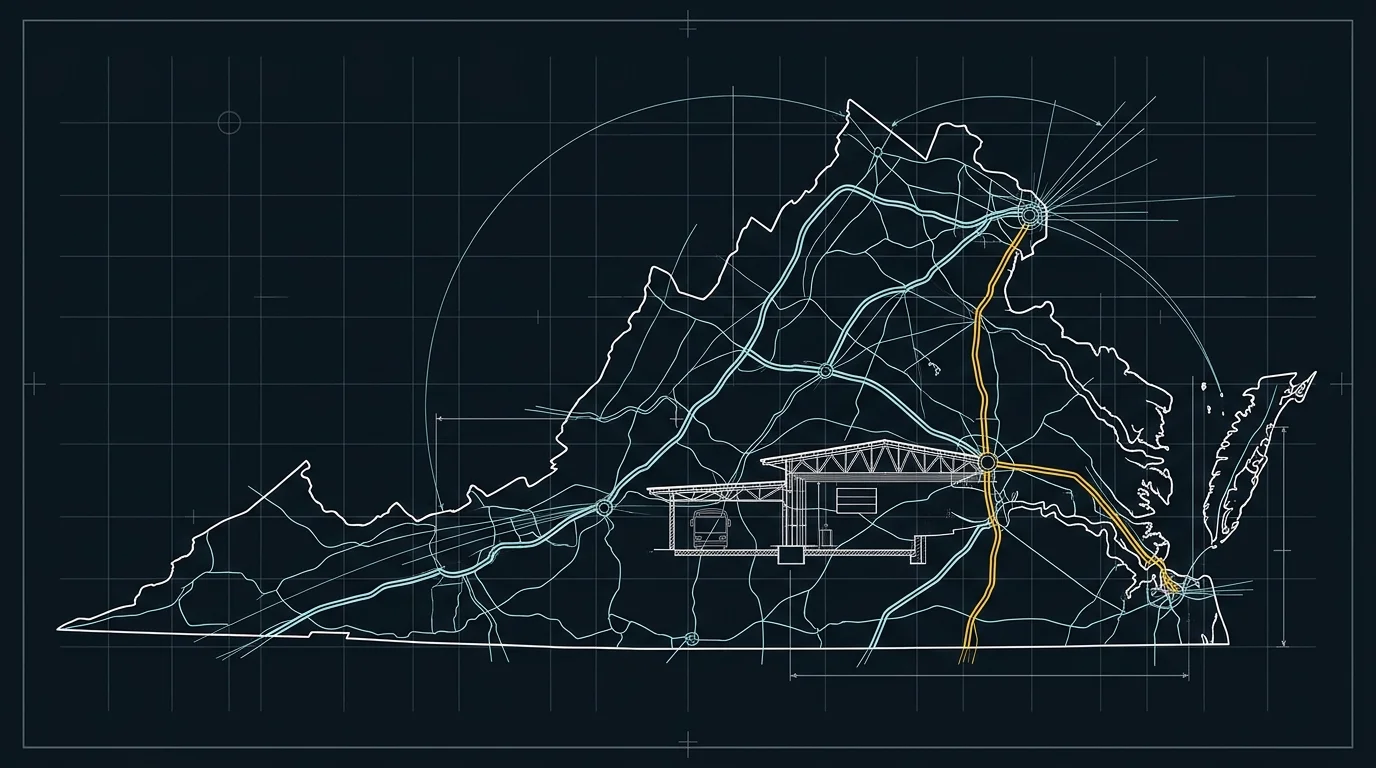
Virginia transit agencies issued roughly 97 legitimate public-transit procurement requests in the last 30 days, 2.7 times the trailing 12-month monthly average, and the volume has been running hot since February, with some months topping 150. This is not a single large agency accelerating one signature project. It is dozens of small and mid-size operators across the state reaching the execution phase of capital plans at the same time, because the money that funds them all arrived at the same time.
The synchronized wave has two engines. Virginia's Department of Rail and Public Transportation finalized a record FY2026 transit budget of $1.003 billion, with Year One Six-Year Improvement Program allocations of $879.9 million, a $27.6 million increase over FY2025. That state appropriation increase, drawn from the Commonwealth Mass Transit Fund, triggers matching requirements that pull federal formula dollars into Virginia simultaneously. Over the past 12 months, U.S. DOT has obligated $235 million in FTA grants to Virginia transit entities through separate programs covering urban service, rural access, bus replacement, and low-emission fleet conversion. State appropriations and federal formula grants are legally distinct streams, but when both increase in the same fiscal year, local agencies receive the capital authorization they need to move deferred projects to construction and acquisition all at once.
The starkest illustration is the Williamsburg Area Transit Authority. WATA, which serves a metro area of roughly 100,000 people and handles the seasonal demands of one of Virginia's most-visited tourist corridors, is simultaneously managing the two largest capital projects in its nearly 50-year history. The agency broke ground in April 2025 on a Northern Transfer Center valued at $11 to $13.3 million, targeting an August 2026 completion. Concurrently, it is completing an $18.9 million Operations and Maintenance Facility renovation scheduled for December 2026. WATA's executive director has described managing both at once as 'a bit much' for an agency of its size. That candor captures the statewide condition: the funding is real, the projects are authorized, and transit operators built for steady-state management are now running capital programs that would tax agencies twice their size.
The procurement breadth at WATA reflects how a single strategic plan converts into execution-phase activity. The agency approved a ten-year Transit Strategic Plan in June 2024, and that document is now generating RFPs across every functional area at once, construction management, architectural design, trolley bus procurement, ADA eligibility determination, facility operations consulting, and transit strategic planning services. Forty-six RFPs from WATA and James City County alone account for a significant share of the statewide surge.
At the other end of the scale, Hampton Roads Transit is expanding the geography of its OnDemand microtransit service, which launched in Hampton and Chesapeake in January 2026 and now targets 13 zones for eventual regional coverage. HRT has issued six recent RFPs covering fleet management, operator uniforms, and security, backed by more than $25 million in new federal grants and state TRIP competitive funding. In Roanoke, a $3.26 million DRPT MERIT grant is funding the MetroFLX microtransit demonstration. Virginia Beach issued an updated microtransit operations RFP as recently as October 2026.
The structural reason this wave is statewide rather than concentrated is Virginia's unusually fragmented transit landscape. The state funds dozens of independent agencies, WATA, Blacksburg Transit, Greater Lynchburg Transit, FRED in Fredericksburg, HRT, and others, through formula allocations rather than concentrating capital in one or two flagship systems. When DRPT's budget increases, every agency on the formula receives a proportional lift. When FTA formula grants flow to the state, they distribute across the same fragmented map. The result is that a single budget-year increase produces a procurement surge that looks statewide because it actually is.
For riders, the near-term signal is new and upgraded infrastructure arriving across the next 12 to 18 months: a new transfer center in Williamsburg by next summer, expanded on-demand coverage in Hampton Roads through 2027, and newer rolling stock in markets that have deferred fleet replacement for years. For local governments, the question is whether small agencies that have historically operated with lean administrative capacity can absorb the project management load that comes with managing multiple capital contracts simultaneously.
The next checkpoint to watch is DRPT's FY2027 Six-Year Improvement Program, which the Commonwealth Transportation Board will finalize in spring 2027. If the transit allocation holds at or above the FY2026 level, the procurement cycle will not end when current projects close, it will reload.