Five Massachusetts water agencies and municipalities issued their first water infrastructure procurement solicitations in over a year during the past 30 days, a quiet sign that the state's water sector is entering a compressed sprint driven by one hard deadline: an October 2, 2026 loan application cutoff that determines whether communities can access the most heavily subsidized federal water financing since the Clean Water Act.
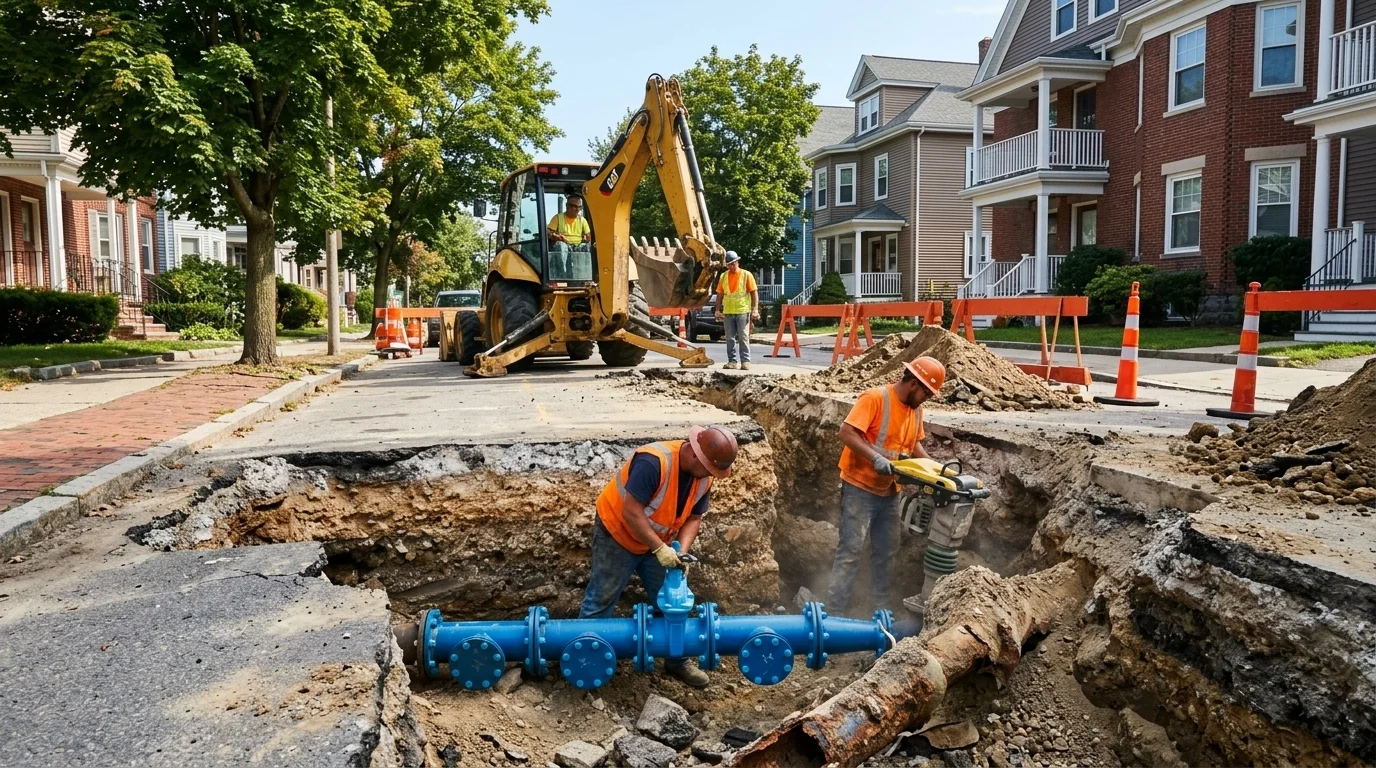
The five institutions, Boston, Marlborough, the Dennis Water District, MassDEP's Bureau of Water Resources, and the Town of Northbridge, collectively represent years of deferred procurement that is now coming off the shelf at once. Their RFPs cover work as varied as a utility registered apprenticeship program, on-call sewer repair, advanced metering infrastructure, drinking water infrastructure engineering pre-qualification, and road and water main reconstruction. The variety matters: this is not a single program triggering a single wave of bids. It is a convergence of needs that municipalities kept postponing, now forced to the surface by a common expiration date.
The underlying clock is the Infrastructure Investment and Jobs Act, which added roughly $50 billion nationally to federal Clean Water and Drinking Water State Revolving Funds over five years. That authorization expires September 30, 2026, and no reauthorization bill has been introduced in Congress. In Massachusetts, the Healey-Driscoll Administration announced in April that more than $1 billion in SRF financing was available for 70 water projects statewide, with a two-part condition: communities had to appropriate local matching funds by June 30, and completed loan applications are due to MassDEP and the Massachusetts Clean Water Trust by October 2. Miss that window and a municipality goes to the back of a much shorter line.
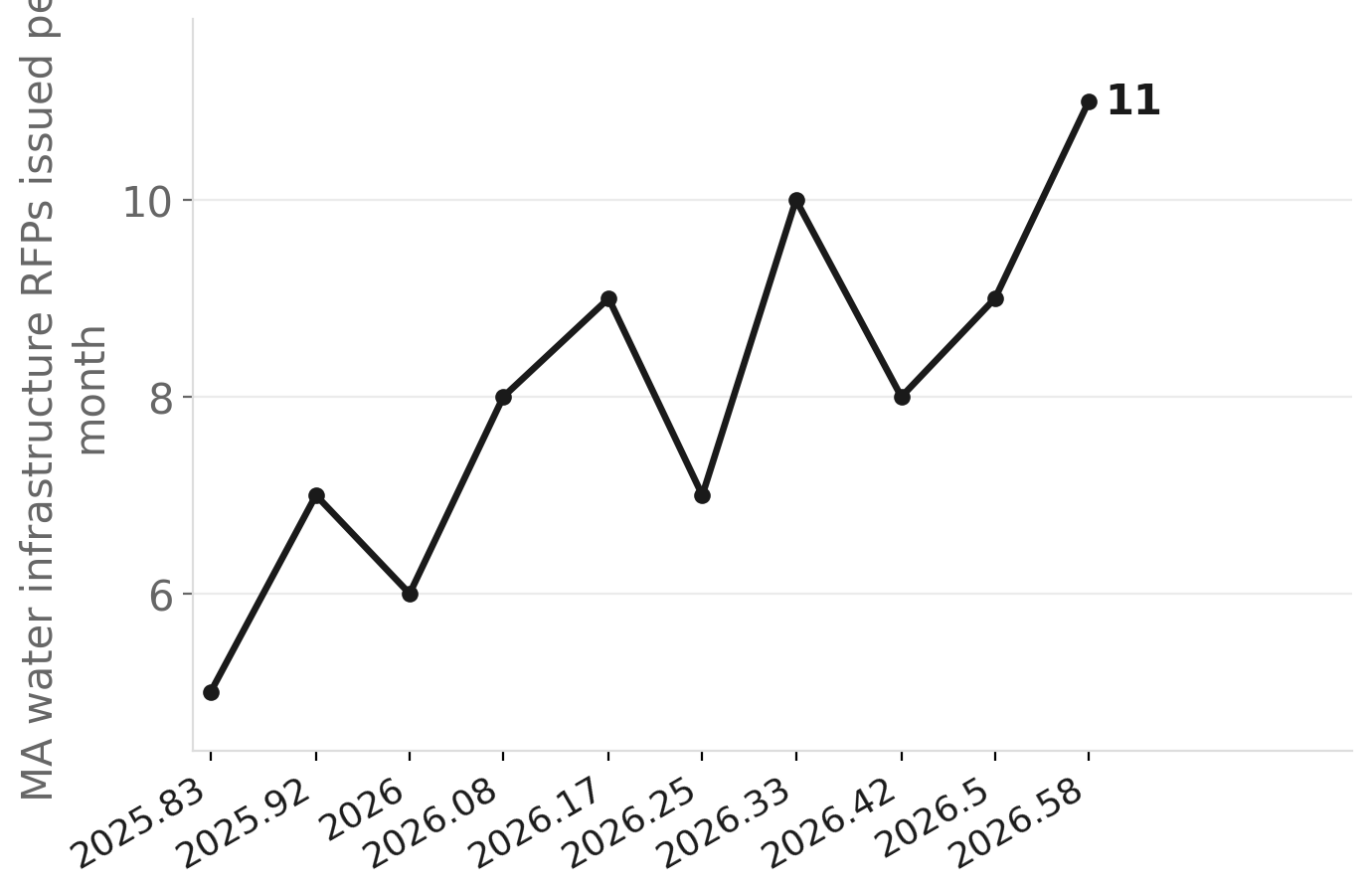
Source: NationGraph.
The scale of what is at stake sharpens the urgency. MassDEP's 2026 Intended Use Plans carry $433.7 million in Drinking Water SRF financing, including $103.4 million earmarked for lead service line replacement, and $728 million in Clean Water SRF financing. Those figures represent the high-water mark of federal capitalization; MassDEP's own 2026 IUP warns explicitly that IIJA funding is set to expire and that federal base grants have continued to decrease. Communities that assumed another cycle would come have less margin than they thought.
A third program adds a separate but parallel deadline. The EPA's Emerging Contaminants in Small or Disadvantaged Communities grant program, which funds PFAS testing, planning, and remediation for eligible water suppliers, has delivered roughly $77 million to Massachusetts cumulatively through fiscal year 2025. The EPA announced an additional $18.6 million in EC-SDC funding for Massachusetts in May 2026. Unlike the SRF programs, which move capital through subsidized loans and principal-forgiveness grants via the Clean Water Trust, EC-SDC money flows as a direct sub-grant from MassDEP to water suppliers, with its own eligibility and application path. A community pursuing PFAS remediation funding is navigating a different process than one financing a new water main, even if both face the same federal expiration trigger.
The procurement numbers suggest the acceleration is real and still building. Monthly water infrastructure RFP activity in Massachusetts ran between five and thirteen solicitations per month from late 2025 through the spring. August 2026 spiked to eleven RFPs across seven institutions. That trajectory, combined with five first-timers in a single 30-day window, points toward a fall closing surge rather than a plateau.
The stakes are high for communities that let procurement capacity go dormant. Massachusetts distributes SRF financing through a joint MassDEP, Clean Water Trust, and State Treasurer structure that requires communities to clear multiple eligibility and documentation steps before a loan can close. Municipalities that have not issued water infrastructure solicitations in over a year may be filing RFPs now precisely because they need to demonstrate project readiness to meet the October 2 application deadline. The system rewards preparation; a town that cannot show a viable procurement path by early October will not see 2026 SRF financing.
Jennifer Peterson of the Massachusetts Water Works Association told the legislature's bonding committee in January 2026 that the state faces roughly $37 billion in water investment needs over the next 20 years. The IIJA's five-year run addressed a fraction of that gap. Once the supplemental appropriations close, the state returns to base SRF capitalization levels that advocates and agency officials have both described as inadequate for a system with aging pipes, widespread PFAS contamination, and a lead service line replacement mandate still underway.
The October 2 application deadline is the next visible signal to watch. Communities that clear it will lock in subsidized financing at terms that may not be available again for years. Those that miss it will face a harder conversation about how to fund deferred work from a thinner pool. The bids going out now are the opening move in that calculation.