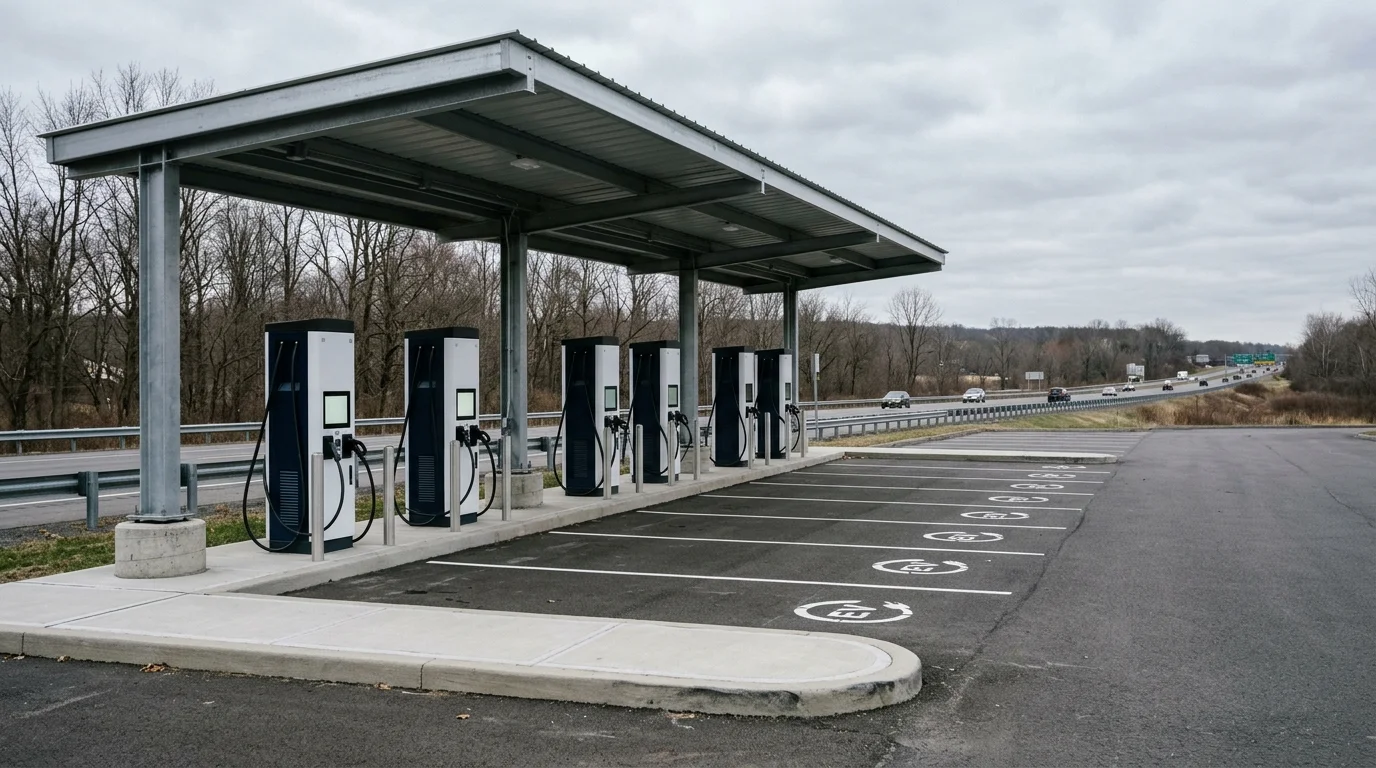
New York received $105.4 million in federal electric vehicle grants in the 90 days ending November 2026, a 143% increase over the same window last year, but the surge is less a sign of electrification momentum than a compressed release of obligations that were legally frozen for seven months and are now racing to clear before the program's clock runs out.
Nearly all of it, $102.3 million across 21 grant actions, is NEVI Formula Program money flowing exclusively to the New York State Department of Transportation. The NEVI program, created under the Bipartisan Infrastructure Law, allocated $5 billion nationally over FY2022–FY2026 to build out EV charging along designated highway corridors. What it did not anticipate was a seven-month legal standstill.
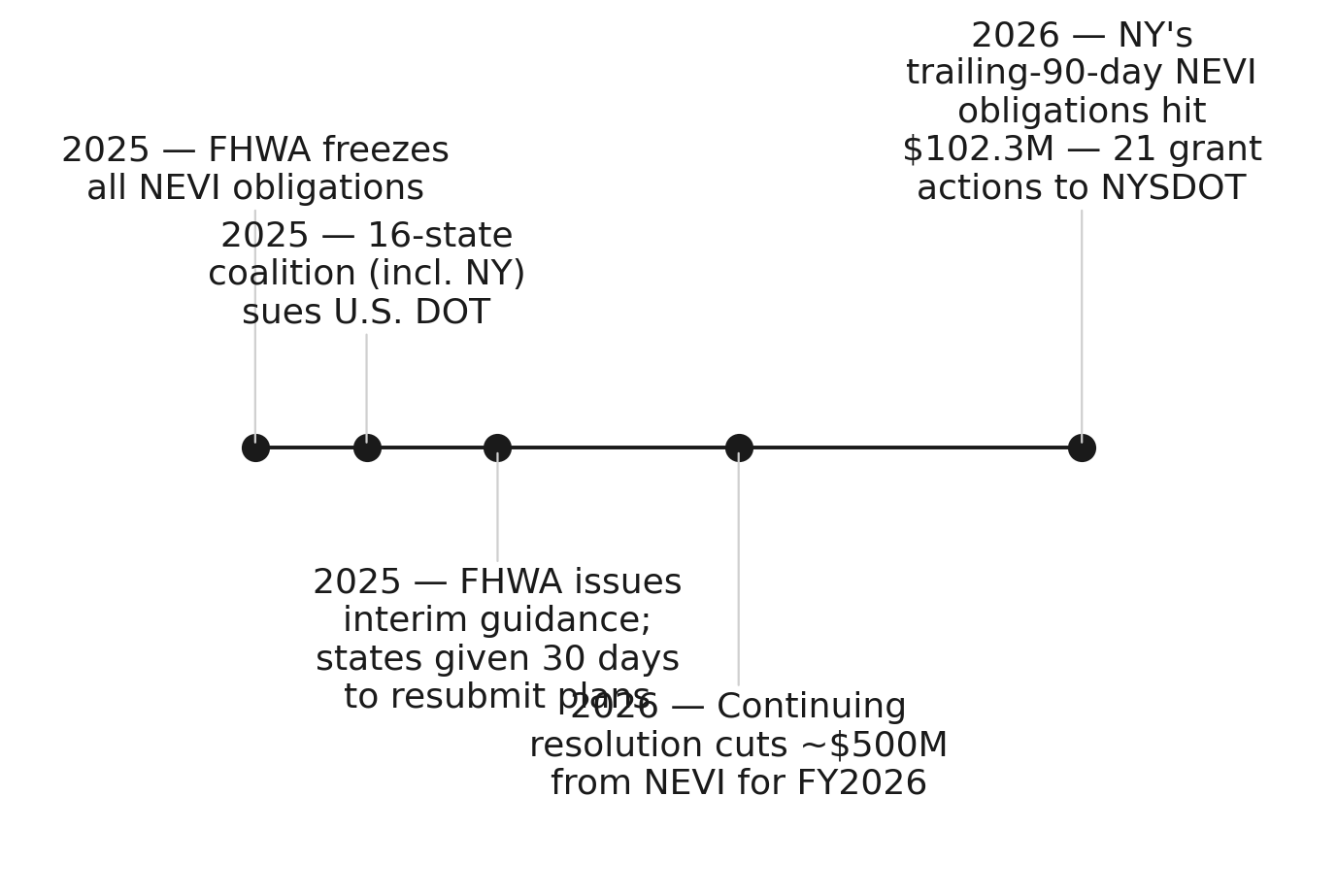
On February 6, 2025, the Federal Highway Administration froze all NEVI obligations and rescinded its approvals of state deployment plans, acting on direction from an Inauguration Day executive order targeting EV subsidies. New York was one of 14 states that sued. A federal court ruled the freeze illegal on January 30, 2026, in Washington v. U.S. Department of Transportation, and the Department of Transportation declined to appeal. FHWA then issued new interim guidance on August 11, 2025, requiring states to resubmit their deployment plans within 30 days to unlock access to their FY2022–FY2026 backlog. NYSDOT complied, and what followed was a wave of multi-year corridor-charging obligations hitting the books in a compressed window.
Source: NationGraph.
The 143% year-over-year gain is, if anything, understated. The comparison period, the same 90-day window a year earlier, was itself elevated because it captured the first post-guidance obligations after August 2025. The true pre-freeze baseline for new NEVI activity was near zero through most of 2025. The statistical spike visible in the data today reflects accumulated pressure from more than half a year of inactivity, not an acceleration of ambition.
What makes New York's position notable is the size of its backlog. The state's total active EV federal grant portfolio stands at $782.8 million obligated across 52 grants. Of that, just $17 million, or 2.2%, has been disbursed. That ratio tracks with the national picture: as of early 2026, states collectively had spent roughly $94 million, about 2%, of the $4.4 billion available under NEVI. The bottleneck is not funding. It is execution.
Several factors compound that challenge in New York specifically. NEVI implementation here is split between two agencies: NYSDOT handles highway corridor charging, while NYSERDA manages community and gap-filling charging through the complementary Charging and Fueling Infrastructure grant program, a separate federal program under the same IIJA statute but administered differently and targeting different geography. The coordination requirement adds procurement steps. The individual NEVI grants now hitting the books carry 10-year performance windows, running to 2035–2036, a signal that construction is expected to lag obligation by years even under favorable conditions.
Governor Hochul has set a mandate for 100% zero-emission vehicle sales by 2035, and New York's total NEVI allocation of approximately $175 million over five years is central to that buildout. But the state had large unobligated balances at the time of the freeze, precisely because its deployment pipeline was still forming when FHWA pulled the plug. The court victory and the August guidance unlocked the money; whether the procurement and construction machinery can absorb it quickly enough is a separate question.
There is a time pressure beyond the program's internal deadlines. A February 2026 continuing resolution cut approximately $500 million from NEVI nationally, reducing FY2026 available funding to roughly $300 million. The five-year IIJA authorization expires at the end of FY2026, and congressional surface-transportation reauthorization poses a future threat to any NEVI balances that remain unobligated. States that move slowly risk watching Congress claw back funds they technically won in court.
For New York residents, the practical effect of the obligation surge will not be visible at highway rest stops for some time. The NYSERDA NEVI program page describes a multi-stage process: site selection, environmental review, procurement, construction, and inspection, each carrying its own timeline. Experts and state officials expect the construction wave to peak in 2027–2028, as the obligations now being signed translate into contracts and shovels.
The number to watch is not how much New York obligates next quarter. It is how much it disburses. If the disbursement rate remains near 2% while the obligation clock runs, the gap between the state's EV commitments and its EV charging reality will stay wide regardless of what the grant ledger shows.