Federal USDA grants for hurricane recovery in Virginia reached $38.6 million in the last 90 days, a 425% jump over the same window a year ago, and almost all of it is committed to a single agreement that will not finish its work until 2036.
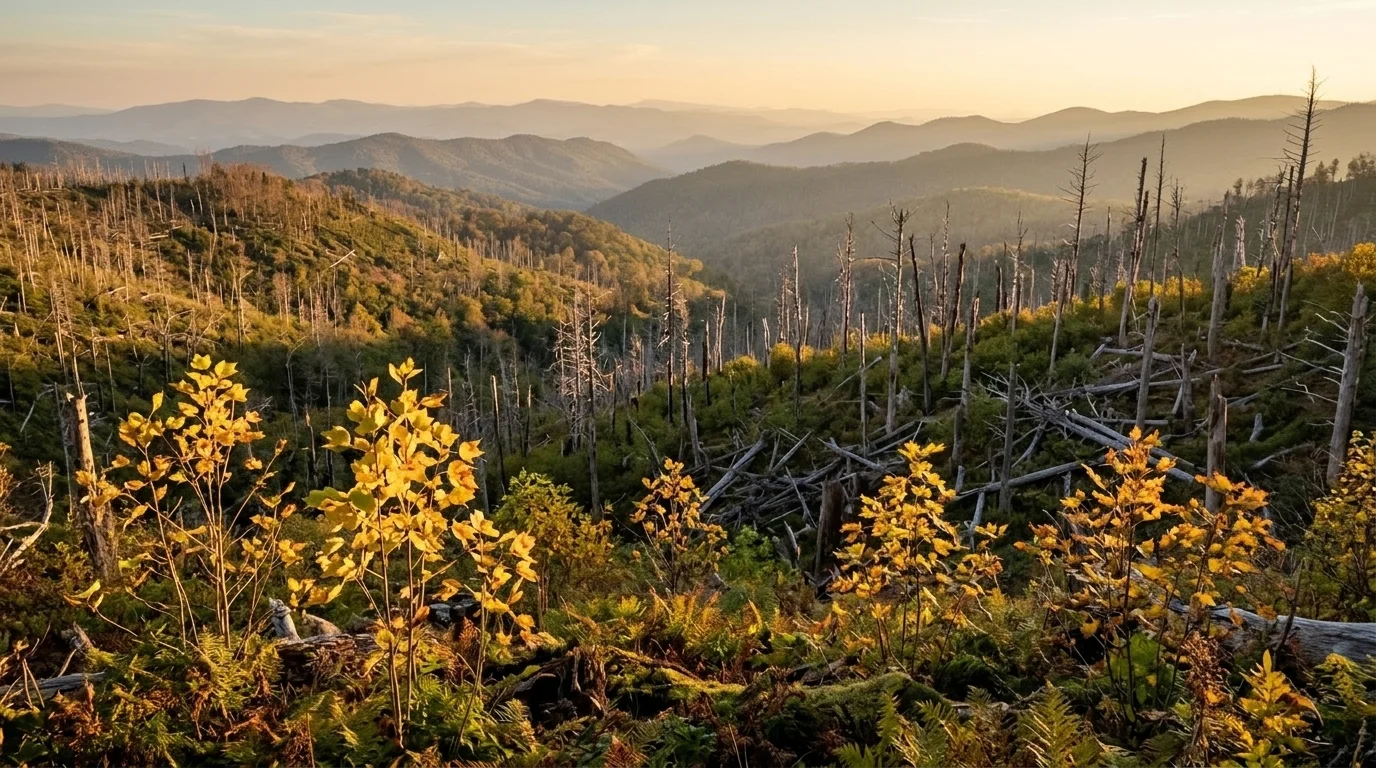
The shift marks something genuinely different from the Helene recovery story most Southwest Virginians have watched unfold since September 2024. The earlier stream of federal money repaired roads in Wythe County, restored waterlines in Tazewell, and patched bridges through FEMA's Public Assistance Program, project-by-project reconstruction of what the storm destroyed. The new money, a $38.56 million Good Neighbor Authority agreement signed with the Virginia Department of Forestry on September 8, 2026, is not about reconstruction. It is about regeneration: re-establishing native tree canopy, clearing wildfire fuel loads left by downed timber, and rebuilding the trails and watersheds that give the region's forests their ecological and economic value.
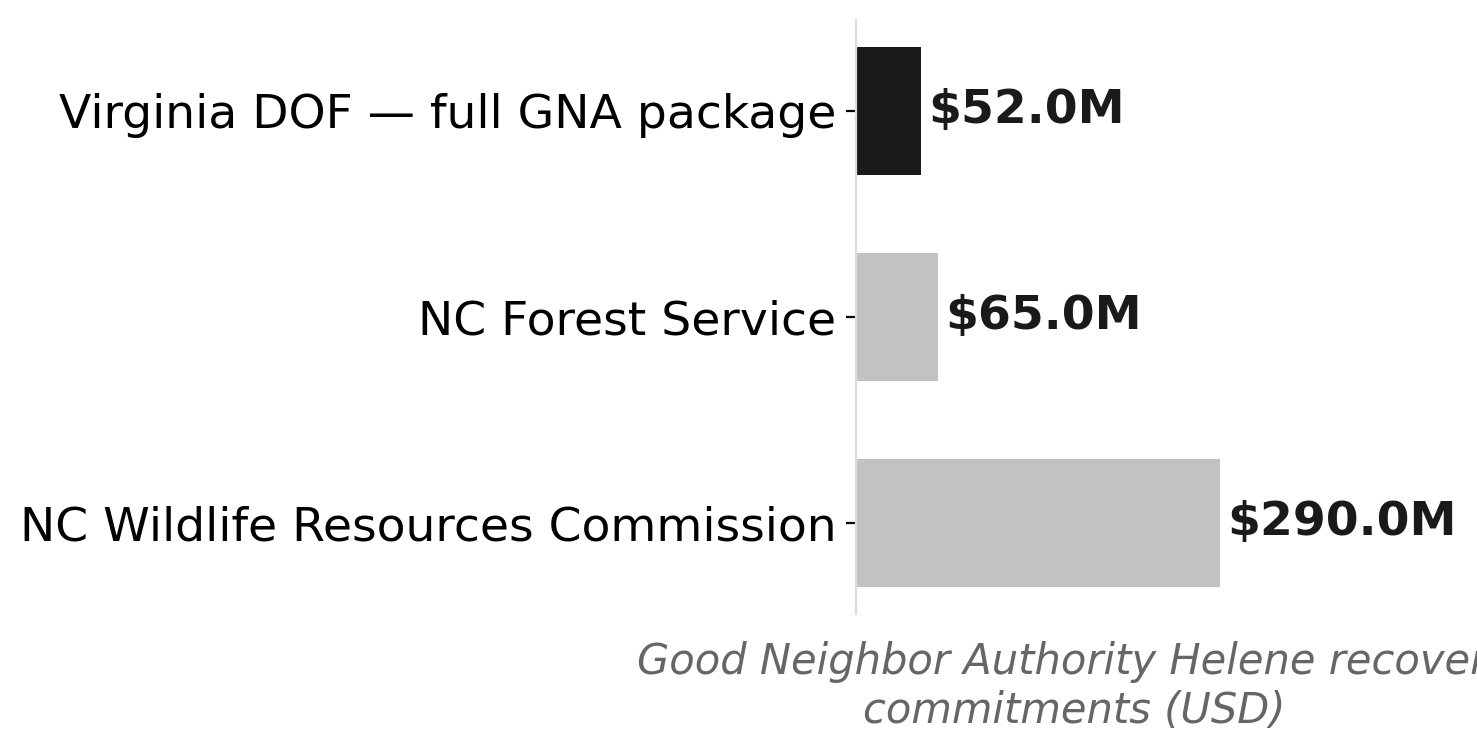
Governor Abigail Spanberger announced the full package, which totals more than $52 million in Good Neighbor agreements with the Virginia Department of Forestry, the Virginia Department of Conservation and Recreation, and the George Washington and Jefferson National Forest, on October 27, 2026, exactly two years after Helene struck. The timing was deliberate. As Sen. Mark Warner said at the announcement, "two years after Hurricane Helene devastated Southwest Virginia, communities across the region are still working to rebuild."
Source: NationGraph.
The money flows from the American Relief Act of 2025 (Public Law 118-158), which directed $6.35 billion to the USDA Forest Service for disaster recovery, with 80% of that sum explicitly earmarked for damage from Helene and Milton. The Good Neighbor Authority is the legal mechanism that lets the Forest Service contract with state agencies to do restoration work on federal, state, and private forestlands simultaneously, a flexibility that makes it particularly well-suited to Southwest Virginia, where storm damage crossed all three ownership categories.
The project breakdown explains why the timeframe is so long. According to Governor Spanberger's announcement, the DOF agreement allocates $15.5 million for native forest vegetation regeneration, $13.9 million for recreational infrastructure recovery, $9.5 million for wildfire hazard mitigation and prescribed burning, and $1.3 million for community forestry. Planting trees, re-establishing understory vegetation, and reducing the fire risk posed by thousands of acres of standing dead timber are not tasks that resolve in a single budget year. DOF State Forester Terry Lasher framed it plainly: the lasting ecosystem impacts have created "far-reaching consequences" that require a sustained, multi-year commitment.
The USDA Forest Service has characterized the American Relief Act agreements as a landmark in disaster recovery, but Virginia's share puts the state's damage in perspective. North Carolina, which absorbed a far larger footprint of Helene's destruction, received a $290 million Good Neighbor Agreement with the NC Wildlife Resources Commission and a separate $65 million agreement with the NC Forest Service. Virginia's $52 million total is proportionally smaller, reflecting a damage zone that is concentrated rather than sprawling, centered on Washington, Smyth, Grayson, Wythe, Tazewell, and Wise Counties, all of which sit within or adjacent to the George Washington and Jefferson National Forest.
For residents in that corridor, the two funding streams now operating in parallel matter differently. The FEMA Public Assistance grants have fixed what the storm broke: a $9.3 million waterline, an $8.6 million water line replacement, a $4.2 million wastewater project in Wytheville. Those grants addressed discrete, documented losses and are largely project-complete or close to it. The USDA Good Neighbor agreements address something harder to photograph: the slow failure of a forest ecosystem to recover on its own when the disturbance is severe enough. Downed canopy, disrupted seed banks, elevated fire risk from debris, and degraded watersheds do not appear on a damage assessment form, but they determine whether the region's outdoor recreation economy, built on assets like the Virginia Creeper National Scenic Trail, half of which was catastrophically damaged by Helene, returns to its pre-storm baseline or settles at something permanently diminished. The Creeper Trail had construction access restored in late 2025 and is expected to reopen by the end of 2026, but the forests surrounding it will be a work in progress for years.
The next signal to watch is whether the DOF agreement's prescribed burn and wildfire mitigation component moves into active implementation before the 2027 fire season. Southwest Virginia's combination of steep terrain, storm-killed timber, and reduced canopy cover has elevated its fire risk substantially since Helene. The $9.5 million allocated for that work is not simply ecological maintenance, it is a hedge against a secondary disaster that the region's thinned and stressed forests are now meaningfully more vulnerable to.