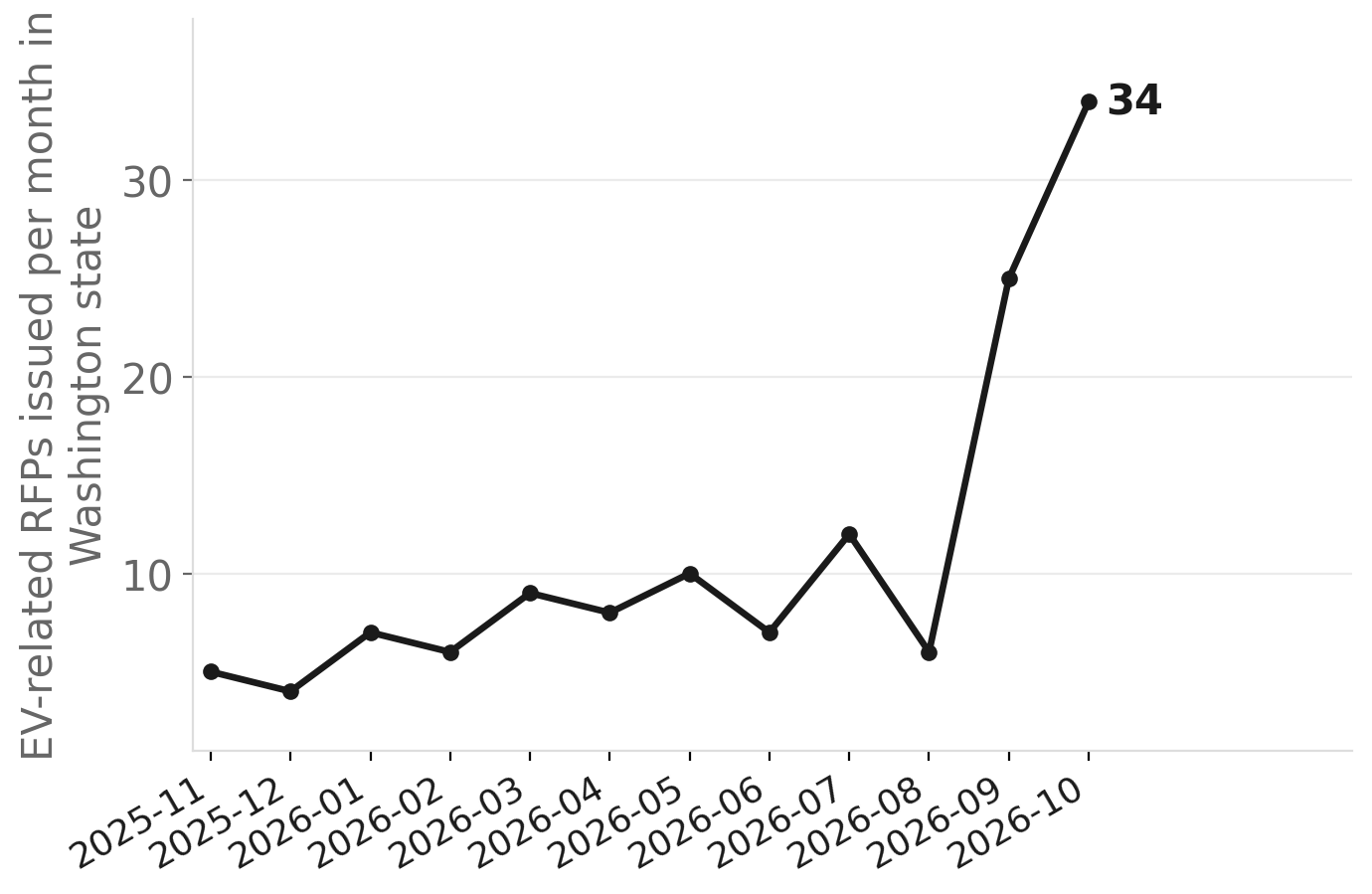
Washington state issued 34 electric vehicle RFPs in October 2026, against a trailing monthly average of roughly eight, a 4.3x surge that made last month the most concentrated single burst of public EV procurement in the state's history. The spike was not the product of any one program or policy shift. It was a collision: two structurally separate programs, one federal and one state, opened solicitations eleven days apart, pulling agencies across the full breadth of Washington government into simultaneous action.
The larger of the two is WSDOT's NEVI Round 2 solicitation, which opened October 20 and offers up to $69 million in federal funds for DC fast-charging infrastructure along Washington's remaining 1,493 unfunded Alternative Fuel Corridor miles. That figure includes rolled-over money from Round 1, funds that original awardees declined after reviewing program requirements, added on top of WSDOT's approximately $15 million FY2026 NEVI allocation. The solicitation carries real urgency: FY2026 is the final year of NEVI's five-year, $5 billion congressional authorization, and the House Transportation Committee advanced the BUILD America 250 Act in May 2026 without reauthorizing NEVI as a standalone program. What WSDOT awards in this cycle is, in practical terms, what Washington gets.
Eleven days earlier, on October 9, the Washington State Department of Commerce posted a separate EV Instant Rebate Round 2 RFP, seeking a third-party administrator to run a $5 million point-of-sale rebate program targeting income-eligible consumers. That $5 million comes from Washington's Electric Vehicle Account, funded by dealer and lessor fee revenue directed there by 2025-26 session legislation, not from federal pass-through dollars. The two programs are doing entirely different things: NEVI builds supply-side fast-charging infrastructure on specific highway corridors; the Commerce rebate supports demand-side consumer purchases. They share only the accident of timing.
Source: NationGraph.
That accident produced something worth noting in the procurement record: 20 distinct agencies issuing EV-related RFPs in a single month. The list spans state government (WSDOT, Commerce, Enterprise Services, State Patrol, the Office of Superintendent of Public Instruction), mid-size cities (Bellevue, Redmond, Cheney, Kenmore, Wenatchee), transit agencies, universities, ports, and tribal nations including the Quinault Indian Nation. Of the 34 October RFPs, 18 target charging infrastructure installation, six seek fleet EV procurement, and four relate to Commerce rebate program administration. The breadth of that list reflects how thoroughly EV infrastructure has worked its way into routine public-sector procurement, the State Patrol replacing cruisers, university parking structures adding chargers, ports building out drayage corridors.
Washington's existing federal EV and clean-transportation grant portfolio already exceeds $280 million. The Port of Anacortes holds a $63.8 million EPA Clean Ports award; King County Metro has a $33.6 million FTA low-emission bus grant; Whatcom County, Spokane Valley, and Seattle each carry major DOT and DOE commitments. The NEVI Round 2 procurement lands on top of that established base, targeting a different layer of the network: rural eastern Washington, where the remaining Alternative Fuel Corridor gaps are widest and charging density is lowest.
The state's position in this cycle is unusual in another respect. Washington was the lead plaintiff in the May 2025 multistate lawsuit challenging the Trump administration's executive-order freeze on NEVI funds. FHWA's August 2025 interim guidance ultimately unlocked $885 million nationally for FY2026 and loosened the 50-mile spacing rule that had complicated rural deployments. Washington submitted its updated Round 2 plan in September 2025 and moved into solicitation mode the following October. The state litigated its way back to the table and is now spending the money it fought to preserve, in what may be the program's last major disbursement cycle.
Compounding the federal pressure is a state-level compliance milestone. Washington's Clean Cars standard requires that 35 percent of new vehicle sales in model year 2026 be zero-emission, a threshold that is accelerating municipal fleet procurement independent of anything NEVI is doing. Fleet replacement cycles that agencies might have stretched another year or two are compressing against that mandate.
The November 20 deadline for Commerce rebate proposals is the next hard date on the calendar. WSDOT's NEVI solicitation runs as an open window through October 2027, but initial questions were due October 30, meaning the market signaling has already begun. What comes after is less certain: absent NEVI reauthorization, Washington's federal fast-charging pipeline after FY2026 depends on whatever successor program Congress eventually produces. The October surge is, in part, agencies making sure they are not still in the queue when the window closes.