Minnesota received just $5.6 million in new federal water infrastructure grant commitments over the last 90 days, an 86 percent drop from the $40 million awarded in the same window a year earlier. Three awards make up the entire recent haul: a $3.5 million EPA congressionally directed project for the City of Shakopee and two National Science Foundation geoscience grants totaling $2.1 million to the University of Minnesota. The collapse in new commitments looks alarming on its face. The reality is more complicated, and ultimately more worrying.
The year-over-year comparison is, in part, a story about a state that moved unusually fast. Minnesota's Public Facilities Authority (MPFA) accelerated its draws on Infrastructure Investment and Jobs Act supplemental funding throughout 2024 and into 2025, pulling down three large State Revolving Fund capitalization tranches totaling roughly $165 million to MPFA, plus a $200 million EPA Climate Pollution Reduction Grant to the Minnesota Pollution Control Agency, all within a concentrated stretch. That front-loading created an extraordinarily high comparison base. Peer Midwestern states that drew IIJA money more gradually show flat-to-stable year-over-year patterns, which confirms Minnesota's sharp drop is partly a timing artifact of its own efficiency.
But timing alone does not explain what comes next. The IIJA's five-year supplemental water funding authorization expired September 30, 2026, and no reauthorization bill has been introduced in Congress. As utility industry analysts have documented, the lapse is not a technical gap to be patched retroactively. The supplemental tranches that flowed to states under IIJA are simply gone unless Congress acts.
Source: NationGraph.
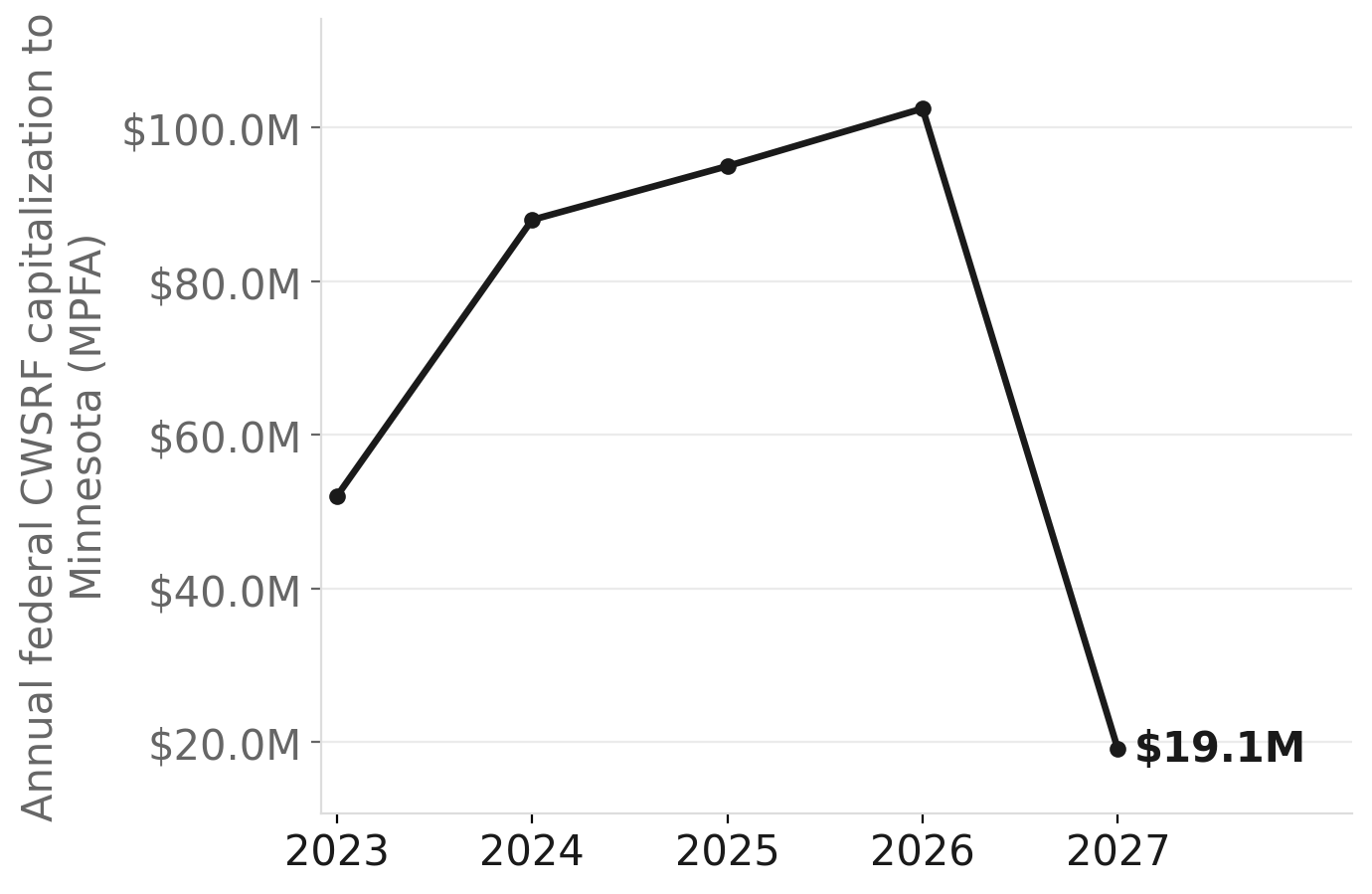
For Minnesota, the numbers are concrete. MPFA's SFY2027 Clean Water Intended Use Plan, filed October 1, confirms the authority is applying for only the base EPA capitalization grant of $13.1 million, with no expectation of the IIJA Year 6 supplemental that will not exist. The CWSRF supplemental alone had delivered $45.7 million to Minnesota in FFY2026. The DWSRF side was larger still: roughly $110.9 million in IIJA supplements covering general capitalization, lead service line replacement, and emerging contaminant remediation. All of that drops to zero under current law. The cifanet.org SRF analysis puts Minnesota's projected CWSRF funding drop at 84.3 percent, from $102.5 million to $19.1 million, under the FY2027 House proposal.
The mechanism matters here. The SRFs are not direct municipal grants. MPFA receives federal capitalization dollars and re-lends them to cities and rural water systems at below-market rates, with 49 percent of IIJA supplemental funds required to flow as principal forgiveness or outright grants to underserved communities. Separately, the Climate Pollution Reduction Grant is a direct implementation award to MPCA, authorized under the Inflation Reduction Act rather than the IIJA, and is also not being reauthorized. The Shakopee earmark is a different instrument again: a one-time congressional appropriation that bypasses the SRF system entirely. These are four distinct federal mechanisms, and the SRF expiration leaves the other two's already-obligated dollars untouched. What it does eliminate is the primary pipeline for new lending capacity.
Minnesota's exposure is above average. The state has more than 10,000 lakes, extensive rural water systems, and ongoing lead pipe replacement and PFAS remediation demands that were being financed specifically through the IIJA supplemental tranches. MPFA currently carries $1.9 billion in outstanding loans and has built an annual lending capacity of roughly $169 million for clean water and $62 million for drinking water, figures that were premised on continued federal capitalization. The Bluefield Research analysis notes that states with concentrated IIJA draw schedules face uneven exposure to the cliff, and Minnesota is among them.
At the national level, the Trump administration's FY2027 budget proposes cutting the combined Clean Water and Drinking Water SRFs from $2.7 billion to $305 million, a reduction of roughly 89 percent. The National League of Cities has called on Congress to maintain IIJA-equivalent SRF authorization levels, and cities have made the case directly on Capitol Hill, but no legislation has advanced. Analysts project total federal water infrastructure funding could fall roughly 60 percent nationally from FY2026 to FY2027 without congressional replacement.
For Minnesota residents, the immediate signal to watch is what MPFA can commit in its SFY2027 lending cycle, which is now being set against a dramatically reduced capitalization base. Communities counting on SRF loans for water main replacements, wastewater upgrades, or lead service line work will face longer queues and potentially higher borrowing costs as the revolving fund shrinks. The state's active EPA portfolio still exceeds $490 million in prior commitments, so money is still flowing on projects already underway. The gap is in what gets approved next.
The question Congress will answer, or decline to answer, in early 2027 is whether to restore something close to IIJA-level SRF capitalization as a permanent baseline. Minnesota moved fast to capture the money while it existed. Whether that money continues to exist is now entirely outside the state's control.