Pennsylvania school districts are entering the 2026-27 school year with access to more school safety funding than at any prior point in the state's history, but the two programs responsible for that surge were built by different governments, pay for different things, and carry very different levels of legal risk.
Federal school-safety-related grant awards in Pennsylvania hit roughly $22.9M in the trailing 90 days, more than double the $10.1M recorded in the same window a year ago. That 127% jump reflects two overlapping events that happened to land in the same fiscal season: the Shapiro-Davis administration's announcement of a record $138.8M state school safety appropriation and the U.S. Department of Education's December 2025 re-competition of $208M in federal mental health grants following a federal court order that ruled the Trump administration's April 2025 cancellation of roughly $1 billion in grants unlawful.
The two streams are not a coordinated strategy. They are, in practice, two separate bureaucracies sending separate checks for separate purposes.
Source: NationGraph.
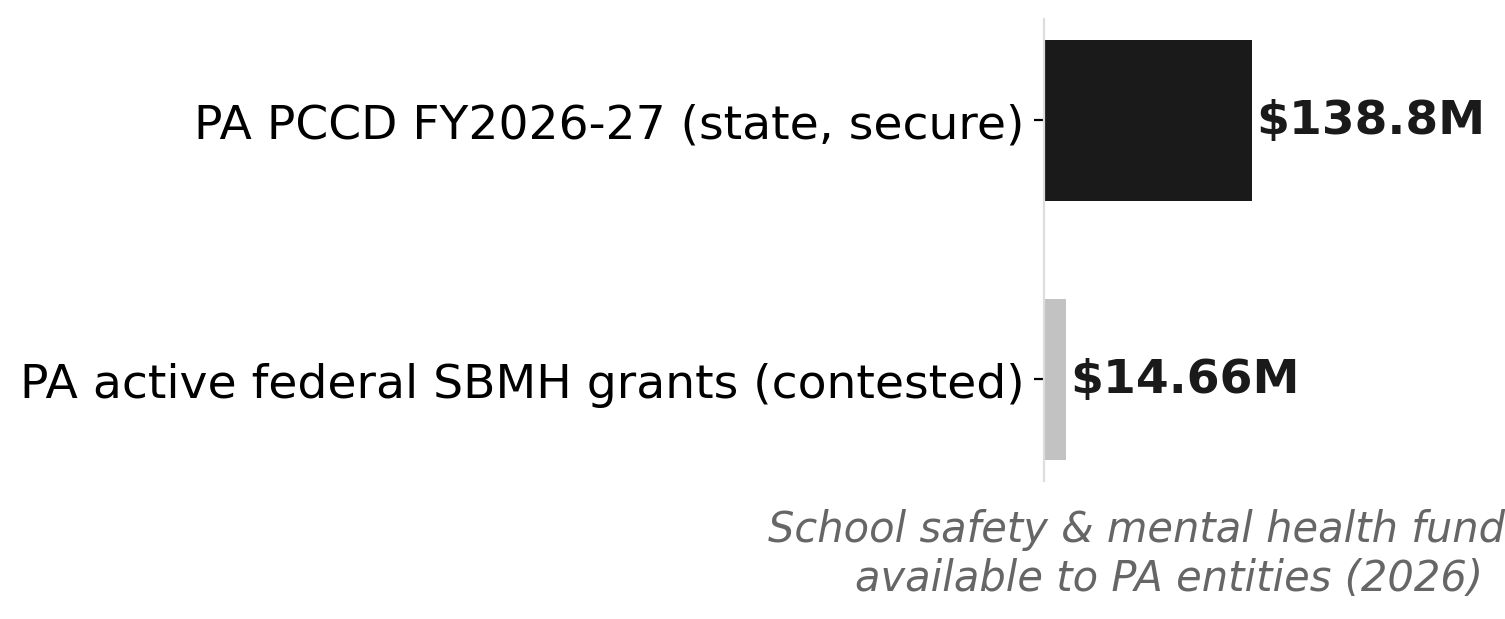
On the state side, the Pennsylvania Commission on Crime and Delinquency's School Safety and Mental Health Grant program is now at the largest single-year allocation in its history. The Shapiro-Davis administration announced $138.8M in FY2026-27 awards on August 18, $100M in new state appropriations combined with $38.8M in prior-year unspent funds. The PCCD program is a state appropriation, not a federal grant: it is noncompetitive, formula-based, and school entities can direct the money toward physical security improvements, behavioral health supports, or both. Applications for the current cycle closed October 16. The administration has framed the total as nearly $400M to over 1,100 schools since Governor Shapiro took office.
On the federal side, the picture is more complicated. The U.S. Department of Education's School-Based Mental Health Services program, authorized under the Bipartisan Safer Communities Act following the 2022 Uvalde shooting, awarded new competitive grants in December 2025 after a Western District of Washington judge ordered reinstatement of the canceled awards and the Department simultaneously re-competed the program. Pennsylvania's share of that federal cycle includes a $6.99M award to the Pennsylvania Department of Education for deploying credentialed school psychologists to high-need districts, and a $1.18M award to Central Dauphin School District for school psychologist expansion. Earlier active grants to Carlow University ($2.89M) and Eastern University ($3.6M) bring the federal program's active Pennsylvania footprint to at least five grantees.
The federal money is targeted narrowly: it requires hiring credentialed professionals, psychologists, counselors, social workers, in qualifying high-need schools. It cannot be redirected to security cameras or door locks. The state PCCD money can. A district receiving both has more flexibility than it has ever had, but the compliance requirements for each stream are independent. Receiving one does not affect eligibility for the other, and administrators will need to track them separately.
The more pressing issue is durability. As of September 2026, a new coalition of 15 states is litigating to block what they describe as a second DOE attempt to terminate the original class of Bipartisan Safer Communities Act grants through a procedural workaround, according to reporting on the renewed federal dispute. Pennsylvania was not among the 16 states in the original multistate lawsuit, meaning its federal grantees preserved their awards through the national court order rather than any state-level legal advocacy. If the second round of litigation fails or produces a different outcome, Pennsylvania's federal grantees could face another disruption with no state-AG backstop.
The state PCCD program carries no such uncertainty. It is governed by the Pennsylvania Public School Code and Act 17 of 2026, known as Greg Moyer's Law, which added new eligible activities to the program this cycle. A district that loses federal mental health funding mid-grant would not automatically gain additional PCCD dollars, but the state program's record scale means that many of the same districts have parallel resources to draw on.
Nationally, Pennsylvania ranks third in school-safety-related federal grant volume in the current window, behind California ($56.4M) and Florida ($26.4M). The Q3 2026 total of $22.6M in new grant starts is the highest since a Q4 2022 spike of $10.8M, which itself followed the Bipartisan Safer Communities Act's initial passage.
For district administrators, the immediate deadline has already passed: PCCD applications closed October 16. The next signal to watch is the federal courts. If the second wave of Bipartisan Safer Communities Act litigation produces another injunction, the DOE's re-competed December 2025 awards, including Pennsylvania's $6.99M and Central Dauphin's $1.18M, could face renewed legal questions about continuity. Districts that built hiring plans around those federal dollars will want a clear answer before those positions come up for renewal.