Federal mental health grants newly committed to Colorado have reached $19 million in the past 90 days, compared with $733,000 in the same window a year ago, a 2,497% increase that looks, on its face, like a breakthrough for a state with a persistent rural mental health access gap. The reality is more complicated.
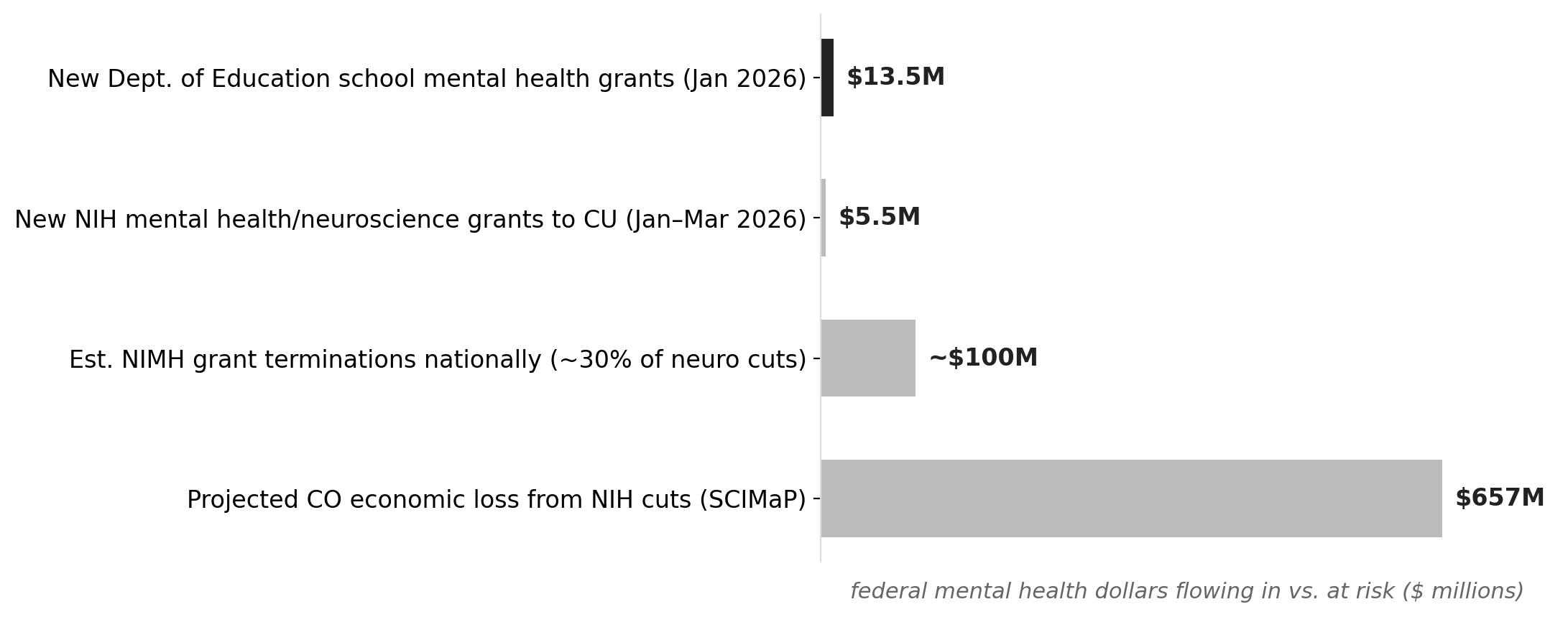
Nearly $13.5 million of that surge comes from a single program: four Department of Education "School Safety National Activities" awards that all began January 1, 2026. Poudre School District, partnered with Colorado State University, received the largest share at $6.2 million, aimed at building a school psychology workforce pipeline. The University of Northern Colorado took $2.8 million to train rural school psychologists, the University of Denver received $2.3 million for rural school placements, and the Colorado Department of Education's own board was awarded $2.25 million. The grants are targeted precisely at the gap Colorado's Behavioral Health Administration has documented for years: too few clinicians, in too many rural and linguistically diverse districts, too far from the institutions that train them.
The remaining roughly $5.5 million flows through the University of Colorado system via NIH research grants covering adolescent mental health, drug use, and neuroscience. That is where the split-screen gets uncomfortable.
Source: NationGraph.
While the Department of Education was writing those school-psychology checks, the Department of Government Efficiency was separately terminating more than 600 NIH grants nationally, worth between $6.9 billion and $8.2 billion. Two NIH officials testified under oath that DOGE directly ordered the terminations. The National Institute of Mental Health bore roughly 30% of neuroscience-related cancellations, nearly $100 million in cuts across the country. Colorado's projected exposure from NIH budget cuts is $657 million in economic output and approximately 2,800 jobs, according to analysis by SCIMaP. The University of Colorado Anschutz Medical Campus, the state's primary research hospital and the institution that trains many of the clinicians Colorado schools are now trying to hire, is identified as the highest-exposure institution in the state.
Congress did fund NIH at $47.22 billion for FY2026, rejecting a proposed White House cut of roughly 40%. A federal court also blocked a separate DOGE attempt to cap indirect research costs at 15%. But as reporting in the Washington Post has noted, grant-level terminations continued even after those institutional guardrails held. The pipeline from federal research dollar to trained clinician to rural Colorado classroom runs through CU Anschutz, and that pipeline is under pressure that no school-psychology workforce grant directly addresses.
Colorado is not starting from zero on behavioral health infrastructure. The state created a stand-alone Behavioral Health Administration in 2021 and holds $262 million in active HHS mental health commitments, plus $27 million in DOJ and $16 million in HUD behavioral health programs. It received a second SAMHSA Certified Community Behavioral Health Clinic planning grant in December 2024, extending a federally supported service model the state has built incrementally. The BHA has applied for the combined Mental Health Block Grant and Substance Use Block Grant through FY2026. The state is, by most measures, a sophisticated consumer of federal behavioral health dollars.
What the new Education grants do is add a workforce-development layer that Colorado's rural districts have explicitly lacked. Training more school psychologists through UNC and the University of Denver to place them in underserved districts is a durable investment, if the universities training them remain intact. That is the open question the $19 million figure does not answer.
For a parent in a rural Colorado school district, the near-term signal is genuinely positive: more school psychology resources are coming, and they are targeted at exactly the communities that have gone without. For a researcher at CU Anschutz working on adolescent mental health, the same federal government that is funding the school-based workforce is simultaneously threatening the research grants that generate the clinical knowledge and the training capacity behind it.
The next signal to watch is whether any of the NIH mental health grants held by CU Anschutz and Colorado's other research universities appear on future DOGE termination lists, and whether the Department of Education's new school-psychology pipeline can graduate enough clinicians to fill the gap before the institutions training them feel the full weight of those cuts.