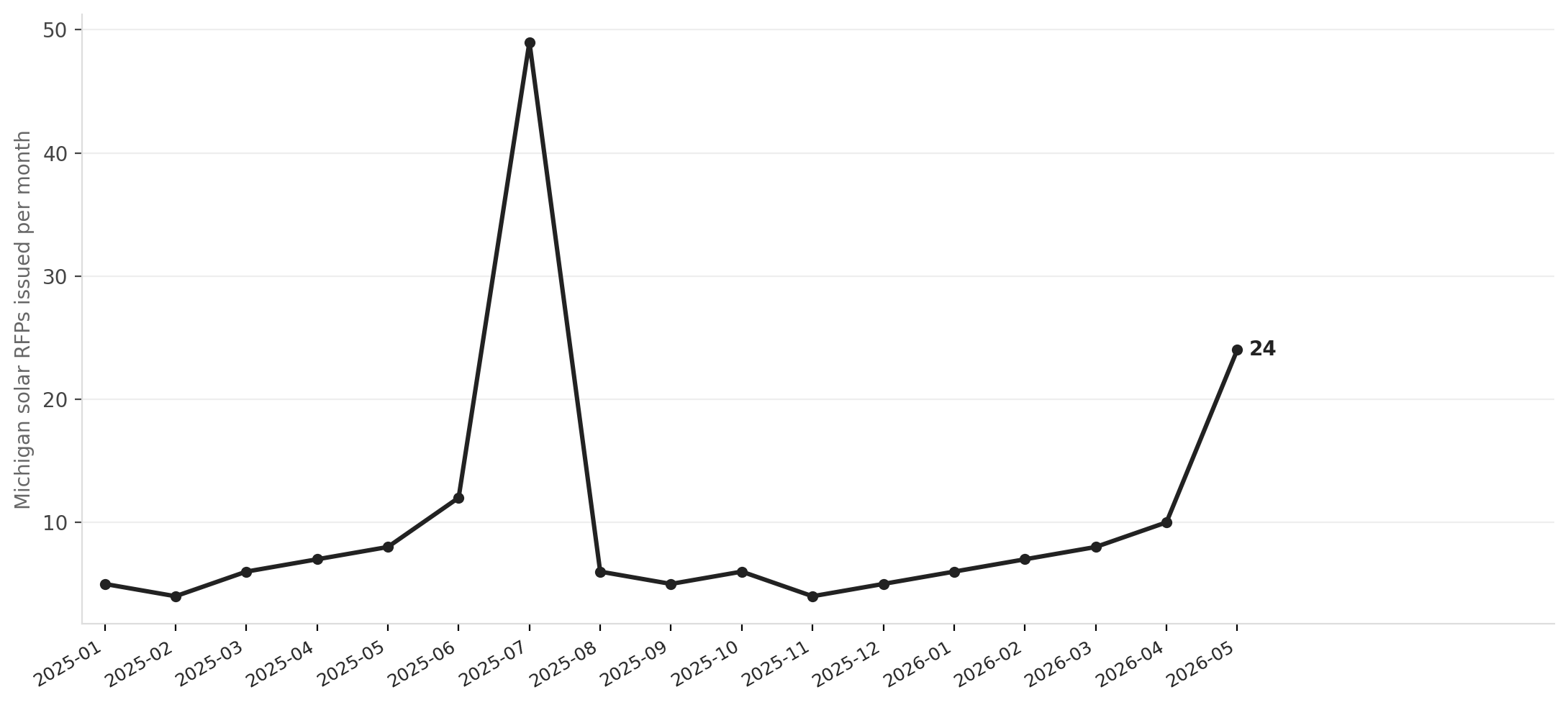
Michigan local governments issued 24 solar RFPs in the 30 days ending May 27, 2026, against a 12-month monthly average of roughly 7.2, a 3.3x surge and the highest single-month volume in the trailing 18 months. The buyers range from Lansing's wastewater treatment plant and East Lansing's DPW to Sterling Heights rooftop installations, the Bedford Public Library, and North Muskegon Public Schools. The common thread is not a shared budget cycle or a shared geography. It is a shared deadline that no one has officially announced.
The deadline is political. Public Act 233, which took effect November 29, 2024, transferred siting authority for solar projects of 50 megawatts or larger to the Michigan Public Service Commission, unless local governments adopt Compatible Renewable Energy Ordinances. For smaller municipal and institutional projects, the law created a clearer permitting runway than anything Michigan had offered before. But HB 4027 and HB 4028, backed by 50 House Republicans and passed out of the Energy Committee in April 2025, would repeal that state override authority entirely. Nearly 80 townships and several counties have filed a parallel challenge in the Michigan Court of Appeals. A ballot repeal campaign, Citizens for Local Choice, has suspended its 2026 push but has not disbanded. Local procurement officers don't need a legal brief to read the situation: the rules that make fast solar development possible may not survive the year.
The underlying framework that created this moment is Governor Whitmer's 2023 Clean Energy and Jobs Act, a package of legislation that mandates 50% renewable energy by 2030 and 100% clean electricity by 2040. The act also raised the distributed-generation cap from 1% to 10% of utility supply and increased the maximum rooftop solar project size from 150 kilowatts to 550 kilowatts, changes that put facility-scale rooftop projects within reach of schools, libraries, and municipal buildings that previously couldn't qualify. As the University of Michigan Graham Sustainability Institute has documented, PA 233's siting preemption was explicitly designed to prevent the township-by-township obstruction that had stalled wind and solar development across the state for years.
Source: NationGraph.
A separate financial incentive is compounding the urgency. EGLE's Renewables Ready Communities Award program pays host communities $5,000 per megawatt for accommodating renewable energy projects, drawing from $129.1 million in EPA Climate Pollution Reduction Grant funds awarded in October 2024 and running through September 2029. Seven award rounds have already paid out across 51 jurisdictions through February 2026. That cash flows to municipalities whether the project is a utility-scale array or a school rooftop, and it flows faster to communities that already have projects in procurement.
The current 30-day wave looks different from the spike that preceded it. In July 2025, Michigan logged 49 solar RFPs in a single month, driven almost entirely by school bond programs: Ann Arbor Public Schools issued 11, Lansing Public School District issued 8, and Saline Area Schools issued 6. That wave reflected a specific fiscal instrument, school bond referenda, working through a specific capital timeline. The May 2026 wave is broader. City utilities, DPW departments, and public libraries are now the primary buyers, suggesting that the urgency has migrated from bond-funded school construction into general municipal infrastructure budgets. The legal risk is being priced into a wider range of government procurement decisions.
Michigan's 30-day total ties Minnesota and more than doubles Ohio and Wisconsin, each of which issued 12 solar RFPs in the same window. Minnesota passed comparable siting legislation in 2023 and has faced less legislative resistance. Ohio and Wisconsin have not enacted equivalent state-level siting preemption. The Michigan-specific gap points to a Michigan-specific cause: not a regional energy market shift, but the particular combination of a strong enabling law, a credible threat to that law, and a federal grant program rewarding early movers.
What remains unresolved is significant. The $156 million MI Solar for All federal program received an EPA termination letter in August 2025; EGLE and the Michigan Attorney General are contesting that termination, leaving a major piece of the low-income solar pipeline in legal limbo. The Court of Appeals challenge from 80 townships has no ruling date. HB 4027/4028 has not yet reached the full House floor.
For residents in cities and school districts currently issuing RFPs, the practical effect is that solar installations that might have taken three to five years to move from concept to approval could be built within the next 18 months if procurement closes quickly. For communities that wait, the permitting environment they would be waiting for may look considerably different. The next signal to watch is whether HB 4027/4028 advances to a full House vote before the summer recess, a vote that would sharpen the deadline every Michigan municipal budget officer is already quietly calculating.